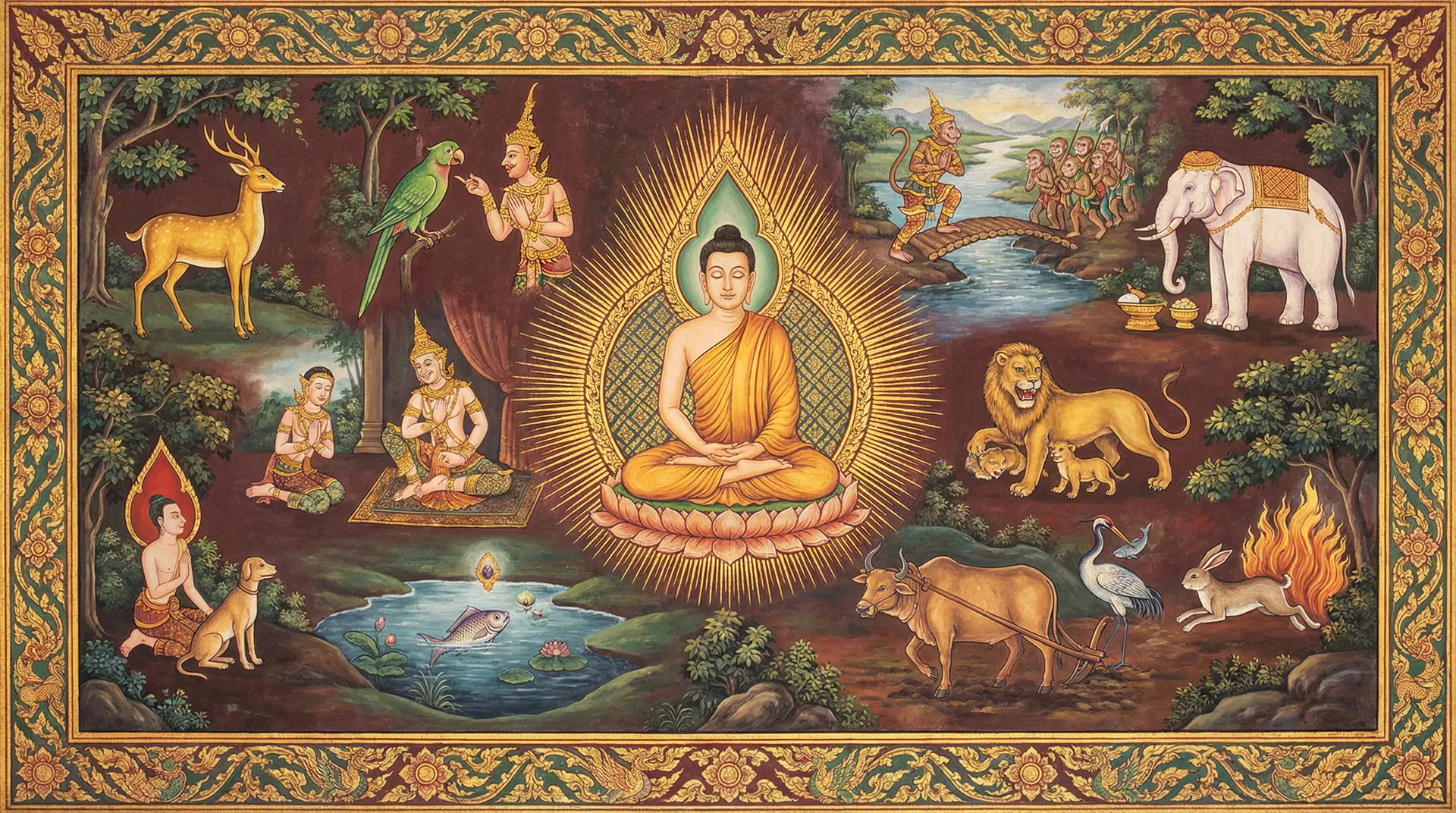
Mugapakkha Jataka
Mugapakkha Jataka
In the ancient land of Mithila, ruled a king named Janaka, a monarch known for his wisdom and his just reign. Yet, even the wisest of kings face trials that test the very core of their being. This tale begins with a curious phenomenon: a celestial lotus, shimmering with an otherworldly luminescence, bloomed in the king's royal garden. This was no ordinary flower; it was said to possess the power to reveal the truth of all things. King Janaka, fascinated, ordered his gardeners to tend to it with utmost care, and to report any changes.
One day, a young brahmin, with eyes as sharp as a hawk's and a mind as quick as lightning, arrived at the palace gates. He was a scholar of great repute, but his heart harbored a deep-seated ambition. He had heard whispers of the king's discerning mind and the wondrous lotus, and he saw in them an opportunity to gain favor and influence. He approached the king, bowing low. "O King," he began, his voice smooth as honey, "I have traveled far, seeking knowledge. I hear you possess a marvel, a lotus that unveils truth. I wish to test its power, and if it speaks true, I shall pledge my service to your throne."
King Janaka, ever open to genuine inquiry, granted his permission. The brahmin, with a confident smirk, approached the radiant lotus. He spoke a series of incantations, his hands weaving intricate gestures in the air. The lotus pulsed with light, and a soft, melodious voice emanated from its petals, a voice that seemed to echo from the very heavens. "Truth is the reflection of an honest mind, the echo of a noble heart." The brahmin, though pleased with the profound statement, felt a surge of frustration. He had expected a more personal revelation, a secret that would elevate him above others.
He tried again, this time with more forceful words, demanding a truth that would make him indispensable. The lotus responded, "The greatest strength lies not in knowledge alone, but in the wisdom to apply it with compassion." Still unsatisfied, the brahmin grew agitated. He muttered, "Tell me, O lotus, what is the greatest treasure a man can possess?" The lotus, its light dimming slightly, replied, "Contentment is a treasure beyond compare, for it frees the soul from endless want." The brahmin, his face contorted with impatience, finally blurted out, "You speak in riddles! Tell me, what is the most valuable thing in this kingdom?"
The lotus, now glowing with a steady, unwavering light, spoke with a voice that resonated with authority. "The most valuable thing in this kingdom, O brahmin, is the peace that arises from righteousness, the security that comes from justice, and the prosperity that is born of an honest ruler who governs with a compassionate heart." The brahmin, realizing the king was listening intently, felt a pang of shame. His ambition had blinded him to the true value of what the kingdom possessed. He had sought personal gain, while the lotus spoke of universal well-being.
King Janaka stepped forward, his gaze fixed on the brahmin. "You sought a truth that would serve your ambition," the king said, his voice gentle yet firm. "But the lotus has revealed a truth that serves all. The greatest treasure is not gold or power, but the well-being of the people, sustained by just and compassionate governance. Your desire for personal elevation has made you deaf to the true message." The brahmin, humbled by the king's words and the lotus's wisdom, bowed his head. "Your Majesty, I have been foolish. My pursuit of self-interest has blinded me. I thank the lotus, and I thank you for showing me the path of true value." From that day forward, the brahmin dedicated himself to serving the kingdom, not for personal gain, but for the greater good, remembering the wisdom of the celestial lotus.
— In-Article Ad —
💡Moral of the Story
True wealth lies not in personal gain, but in the collective well-being fostered by righteousness and compassion.
Perfection: Wisdom (Prajna)
— Ad Space (728x90) —
More Jataka Tales You May Enjoy
 459Ekādasanipāta
Pāṇḍava Jātaka
Pāṇḍava JātakaIn a forgotten era, when the world was young and the gods walked among mortals, there ...
💡 Steadfast integrity, truthfulness, and unwavering loyalty are the strongest defenses against deceit and malice. Inner strength can overcome external threats.
 317Catukkanipāta
Sutasoma Jataka
Sutasoma JatakaIn the ancient kingdom of Gandhara, nestled amidst rolling hills and verdant valleys,...
💡 True liberation from suffering comes through selfless sacrifice and detachment from worldly attachments, particularly the craving for existence.
 358Pañcakanipāta
Kaka Jataka
Kaka Jataka In the realm of Mithila, where kings were known for their wisdom and the land was blesse...
💡 Greed for material possessions leads to discord, weakness, and destruction. True value lies in community, shared resources, and practical sustenance, which ensure survival and harmony.
306CatukkanipātaMahā-Ummagga Jātaka
The Great Tunneling TaleLong ago, in the ancient city of Mithila, ruled a wise and just king named J...
💡 True wisdom lies not just in knowledge, but in the ability to apply it with perseverance and compassion to overcome adversity. Even the most daunting challenges can be surmounted with a clear vision, unwavering determination, and the unity of a community.
351PañcakanipātaNimi Jataka
Nimi Jataka In the heart of a thriving kingdom, ruled a just and wise monarch named King Nimi. His r...
💡 True happiness lies not in external pleasures or worldly possessions, but in the cultivation of inner virtues and selfless service.
 183Dukanipāta
Muḷapariyāya Jātaka
The Tale of the Root of All EvilIn the ancient and prosperous city of Varanasi, ruled a king named B...
💡 The root of all suffering and evil lies within the human mind, stemming from craving, attachment, and ignorance. True peace is found by understanding and overcoming these internal afflictions.
— Multiplex Ad —