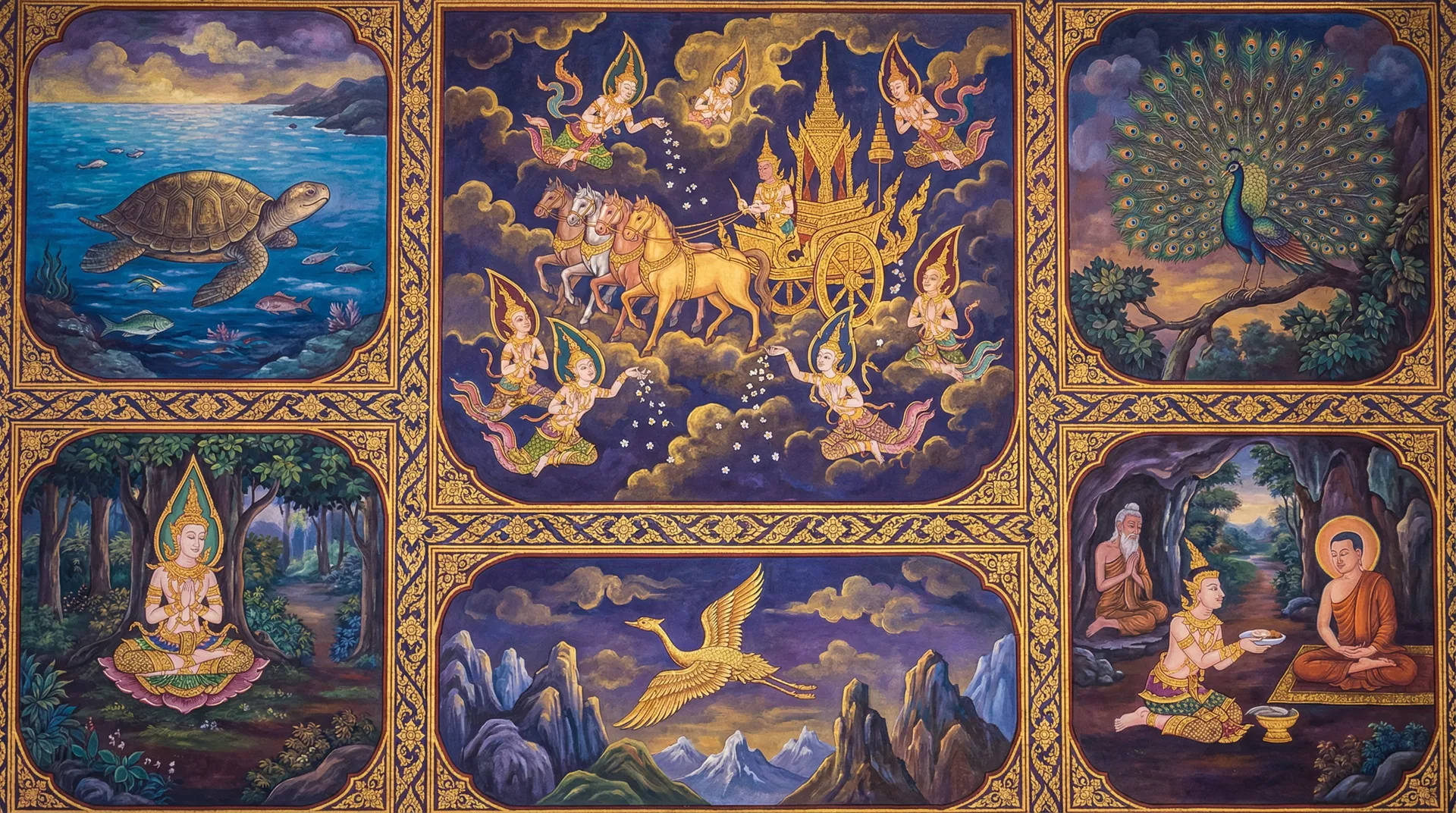
Maha-Ummaga Jataka
Maha-Ummaga Jataka
In the ancient kingdom of Videha, nestled beside the flowing river Candravati, lay the magnificent city of Indapatta. Here, King Maddhava reigned, a wise and benevolent ruler. Yet, it was not the king, but his son, Prince Mahosadha, who was known throughout the land for his extraordinary intelligence and foresight. From his very childhood, Mahosadha displayed a wisdom that far surpassed his years. He could solve intricate problems, understand complex situations, and offer solutions that astounded the learned scholars and seasoned advisors of the court.
One day, a grave dispute arose between the king's chief minister, Culani Brahmadatta, and the venerable sage Vessantara. Culani Brahmadatta, a man of ambition and subtle cunning, accused Vessantara of mismanaging the royal treasury, claiming that funds meant for public works had been squandered. The king, though trusting Vessantara, was troubled by the accusation and the potential for discord within his court.
He summoned Prince Mahosadha, who was still a young man but already respected for his sharp mind. "My son," the king said, "a serious charge has been laid against our wise sage Vessantara. I need your keen insight to uncover the truth. How shall we proceed?"
Mahosadha, with a calm demeanor, bowed to his father. "Your Majesty," he replied, "let us not rush to judgment. Let us investigate the matter with fairness and impartiality. I propose that we examine the treasury records meticulously, and if need be, we can even conduct a public audit."
Culani Brahmadatta, confident in his fabricated evidence, readily agreed to a public audit, believing it would expose Vessantara's supposed wrongdoing. The king, guided by Mahosadha's suggestion, appointed a panel of impartial judges and instructed them to work with Mahosadha to oversee the audit. The entire kingdom awaited the outcome with bated breath.
As the audit commenced, Mahosadha, with his unparalleled intellect, began to unravel the intricate financial records. He noticed subtle discrepancies, cleverly hidden entries, and missing documents that pointed not to Vessantara's incompetence, but to a deliberate act of sabotage. He painstakingly pieced together the evidence, employing logic and deduction that baffled even the most experienced accountants.
One evening, while poring over ancient ledgers, Mahosadha discovered a hidden compartment containing correspondence between Culani Brahmadatta and a group of unscrupulous moneylenders. The letters detailed a scheme by which Brahmadatta had been siphoning off funds from the treasury, using Vessantara as a scapegoat. He had been deliberately falsifying records and destroying evidence to frame the sage.
The next day, in the grand assembly hall, before the king and the entire court, Mahosadha presented his findings. He laid bare Culani Brahmadatta's treacherous plot, revealing the forged documents, the falsified accounts, and the incriminating letters. He explained, with irrefutable logic, how Brahmadatta had manipulated the system for his own personal gain, seeking to usurp Vessantara's position and sow chaos in the kingdom.
Culani Brahmadatta, cornered and exposed, attempted to deny the charges, but Mahosadha's evidence was overwhelming. The king, his heart heavy with disappointment, ordered Brahmadatta to be stripped of his titles and banished from the kingdom. Vessantara, his name cleared and his honor restored, was deeply grateful to Mahosadha.
The king, immensely proud of his son's wisdom and integrity, declared, "Mahosadha, you have proven yourself to be a prince of unparalleled intellect and unwavering justice. Your foresight has saved our kingdom from division and deceit."
News of Mahosadha's brilliant deduction spread far and wide. Kings from neighboring lands sought his counsel, and his reputation as the wisest prince in Jambudvipa grew with each passing day. He continued to serve his father and his kingdom with exceptional wisdom, resolving disputes, advising on matters of state, and ensuring peace and prosperity for all. His intelligence was not a tool for personal ambition, but a gift used for the welfare of others, a testament to the power of a discerning mind guided by righteousness.
— In-Article Ad —
💡Moral of the Story
True wisdom lies not only in intellect but also in using that intelligence with integrity and for the welfare of others, discerning truth from deception.
Perfection: Wisdom (Prajna) and Truthfulness (Sacca)
— Ad Space (728x90) —
More Jataka Tales You May Enjoy
 488Pakiṇṇakanipāta
Mahā-Ummagga Jātaka
Mahā-Ummagga JātakaIn the opulent city of Mithila, capital of the prosperous kingdom of Videha, reig...
💡 Intelligence, foresight, and strategic thinking, when applied with justice and compassion, are more powerful than brute force and can overcome even the most formidable challenges, leading to peace and prosperity.
 418Aṭṭhakanipāta
Assaka Jataka
The Tale of the Valiant HorseIn the prosperous kingdom of Mithila, ruled a king known for his opulen...
💡 Courage and loyalty are more powerful than brute strength. A brave heart can overcome any obstacle.
 354Pañcakanipāta
Phanasa Jataka
Phanasa Jataka In the ancient city of Ujjeni, lived a kind and virtuous Bodhisattva who was born as ...
💡 Integrity, unity, and perseverance are essential virtues, especially in times of hardship. Greed and selfishness lead to downfall.
373PañcakanipātaVirochana Jātaka
Virochana JātakaIn the magnificent city of Mithila, ruled a king named Vidhura, a monarch whose reig...
💡 True power resides not in external possessions or magical artifacts, but in inner wisdom, self-control, and freedom from attachment.
 383Chakkanipāta
Nemi Jātaka
Nemi Jātaka In the glorious city of Mithila, renowned for its magnificent architecture and the wisdo...
💡 Understanding the consequences of actions (karma) through a clear vision of heavens and hells strengthens one's resolve to live a virtuous life and seek liberation from the cycle of rebirth.
353PañcakanipātaSama Jataka
Sama Jataka In the verdant foothills of the Himalayas, nestled beside a crystal-clear river, lived a...
💡 Selfless devotion, compassion, and understanding the consequences of one's actions are paramount.
— Multiplex Ad —