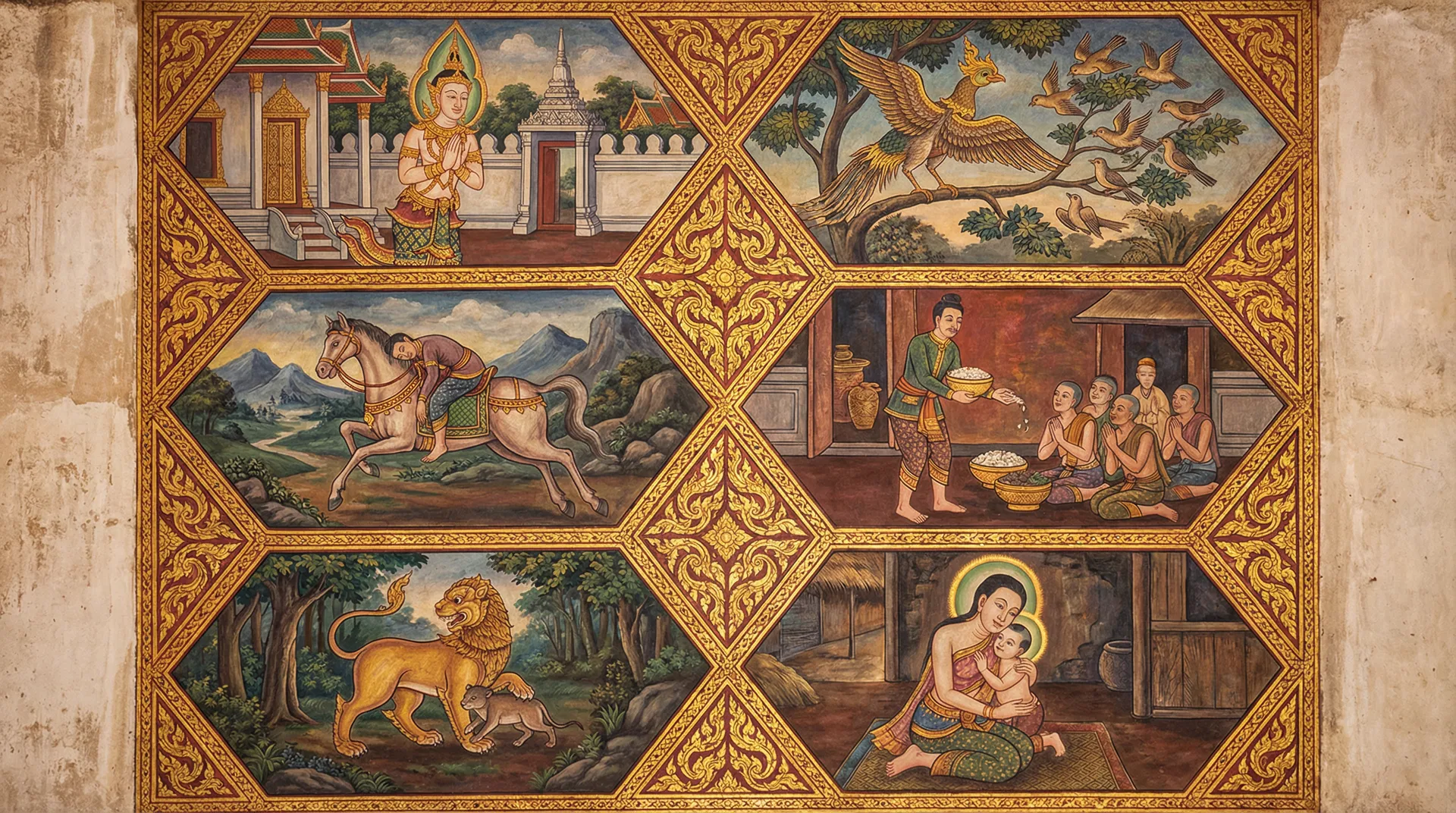
Nemi Jātaka
Nemi Jātaka
In the glorious city of Mithila, renowned for its magnificent architecture and the wisdom of its people, reigned King Maddhava, a monarch whose justice was as swift as his generosity was boundless. His kingdom, Videha, flourished under his benevolent rule, a land where righteousness and prosperity walked hand in hand. Yet, even in this paradise, the cycle of birth, death, and rebirth continued, each life a lesson, each existence a step on the path to enlightenment.
In one of his countless past lives, the Bodhisatta was born as Prince Nemi, the king of Mithila. He was a ruler of exceptional virtue, his reign a testament to the teachings of the Dhamma. He governed his kingdom with impartiality, his laws fair, his judgments wise. His people adored him, for he embodied the ideal of a righteous king, a protector of the weak and a champion of justice.
One celestial morning, as Prince Nemi was engaged in his royal duties, a magnificent celestial chariot, drawn by divine steeds, descended from the heavens and landed in the royal courtyard. Seated within was the King of the Gods, Sakka, his presence radiating a divine aura. Prince Nemi, showing the utmost respect, approached the divine visitor.
Sakka, with a benevolent smile, addressed the prince. "O King Nemi, your virtue and righteousness have reached the heavens. Your reign is a beacon of Dhamma in the mortal realm. As a reward for your unwavering commitment to justice and your profound understanding of the consequences of actions, I have come to offer you a unique privilege. I shall grant you a divine vision, a glimpse into the realms of existence, both the heavens and the hells. You will witness the fruits of good deeds and the bitter consequences of evil. This vision will serve to deepen your understanding and strengthen your resolve to uphold the Dhamma."
Prince Nemi, humbled by the divine offer, accepted with gratitude. Sakka then commanded his celestial charioteer, Matali, to take Prince Nemi on a journey through the cosmos. Matali, a wise and ancient being, expertly guided the divine chariot, its wheels humming with celestial energy.
Their first destination was the realm of the gods. Prince Nemi witnessed celestial beings enjoying boundless bliss, their lives filled with joy, music, and eternal youth. He saw exquisite palaces, gardens of unparalleled beauty, and beings radiant with happiness. Matali explained, "Your Majesty, this is the reward for a life lived with virtue, generosity, and compassion. These beings have accumulated immense merit through their good deeds in their mortal lives."
Next, Matali guided the chariot towards the lower realms, the domains of suffering. Prince Nemi's heart grew heavy as he witnessed beings enduring unimaginable torment. He saw fiery pits, icy landscapes, and grotesque creatures inflicting pain upon one another. He saw the agony of those who had committed evil deeds, their suffering a direct consequence of their negative karma. Matali explained, "These are the realms of the hells, where beings suffer the fruits of their unwholesome actions – hatred, greed, delusion, and cruelty."
The journey continued, taking Prince Nemi through various planes of existence, from the hungry ghosts to the realms of Brahma, each experience a profound lesson. He saw the impermanence of all things, the fleeting nature of both pleasure and pain. He understood that every action, no matter how small, had a consequence, rippling through the fabric of existence.
As they journeyed back towards Mithila, Prince Nemi's mind was filled with a deep sense of detachment and wisdom. He had seen the ultimate truth of existence: the cycle of samsara, the endless wheel of birth and death, driven by karma. He understood that true liberation lay not in the fleeting pleasures of the heavens, nor in the agonizing torments of the hells, but in transcending these realms altogether, by eradicating the defilements of the mind.
Upon his return, Prince Nemi was no longer merely a king; he was a being who had glimpsed the ultimate reality. His reign became even more dedicated to the propagation of the Dhamma. He preached the importance of righteous conduct, the dangers of attachment, and the path to liberation. He often recounted his celestial vision, using it as a powerful illustration of the consequences of karma.
He established a council of wise monks and lay practitioners, encouraging them to teach the Dhamma to all people. He personally ensured that justice was administered with utmost fairness, understanding that even the smallest act of injustice could lead to suffering in future lives. He lived his remaining years with profound equanimity, his mind serene, his heart filled with boundless compassion for all beings.
The Nemi Jātaka is a profound teaching on karma and rebirth. It illustrates the ultimate purpose of human existence – to understand the nature of suffering, to cultivate virtue, and to strive for liberation from the cycle of samsara. Prince Nemi's journey was not just a physical one; it was a spiritual awakening, a profound realization that led him to dedicate his life to guiding others towards the path of enlightenment.
— In-Article Ad —
💡Moral of the Story
Understanding the consequences of actions (karma) through a clear vision of heavens and hells strengthens one's resolve to live a virtuous life and seek liberation from the cycle of rebirth.
Perfection: Wisdom (Paññā)
— Ad Space (728x90) —
More Jataka Tales You May Enjoy
 259Tikanipāta
Mūgapakkha Jātaka
Mūgapakkha JātakaIn the bustling city of Ujjeni, a hub of commerce and culture, resided King Candapa...
💡 True greatness is found not in worldly fame or ambition, but in inner peace, profound wisdom, and a deep connection to life.
 32Ekanipāta
The Bodhisatta as a Compassionate King
The Bodhisatta as a Compassionate KingIn the prosperous kingdom of Avanti, renowned for its fertile ...
💡 True leadership is defined by profound compassion, and tending to suffering with kindness can overcome calamities.
 233Dukanipāta
Phra Ong Khon Duang Chan (The Bodhisatta as a Celestial Being Who Manifested as a Moonbeam)
Phra Ong Khon Duang Chan (The Bodhisatta as a Celestial Being Who Manifested as a Moonbeam) High abo...
💡 Compassion, even in its most subtle forms, has the power to bring forth life and renewal, transforming despair into hope and offering solace to those in need.
234DukanipātaPhra Ong Thammachak (The Bodhisatta as a Sage Who Established Justice)
Phra Ong Thammachak (The Bodhisatta as a Sage Who Established Justice) In the ancient land of Gandha...
💡 True justice is the foundation of a prosperous and harmonious society. Leadership must be guided by wisdom, compassion, and truth, ensuring fairness and equity for all.
114EkanipātaCūḷaka-Seṭṭhi Jātaka
Cūḷaka-Seṭṭhi Jātaka In the ancient city of Mithila, a bustling hub of trade and commerce, lived a w...
💡 True wealth is not measured by possessions, but by the generosity of spirit and the goodwill cultivated through acts of kindness. Giving with a pure heart brings greater abundance.
14EkanipātaThe Bodhisatta as a Hunter
The Bodhisatta as a HunterIn the dense, untamed wilderness of the Himalayas, where snow-capped peaks...
💡 True compassion transcends self-preservation, and great sacrifices bring immeasurable blessings.
— Multiplex Ad —