Kusa Jataka
Kusa Jataka
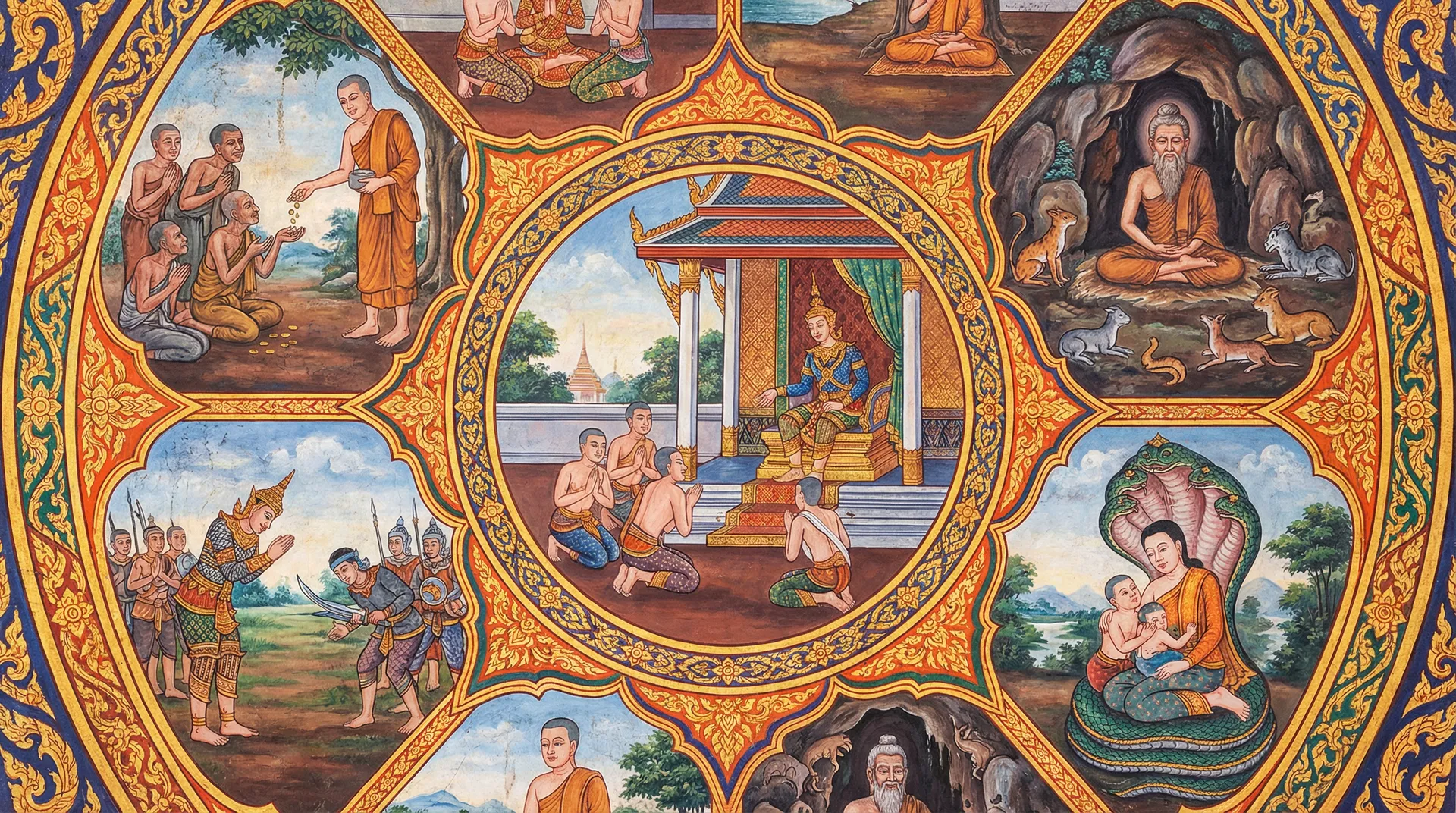
Long, long ago, in the ancient kingdom of Mithila, there lived a prince named Kusa. He was as handsome as the moon and as brave as a lion, destined to inherit the throne. However, fate had a peculiar twist in store for him. His mother, the Queen, was deeply superstitious and, upon consulting an astrologer, was told that her son would bring great misfortune to the kingdom if he ever married a princess. Fearing the worst, she decided to protect her son and her people by keeping him away from any royal alliances.
When Prince Kusa came of age, he was betrothed to a princess from a neighboring kingdom. But on the eve of the wedding, his mother, driven by her fear, orchestrated a plan to separate them. She convinced Kusa that the princess was not worthy of him and that he should flee the kingdom. Heartbroken and confused, Kusa fled, leaving behind his homeland and his intended bride.
Meanwhile, the princess, named Pabhavati, was left at the altar, her heart shattered. Despite the deception, she harbored no ill will towards Kusa. Instead, she was consumed by a deep longing to understand why he had abandoned her. She decided to embark on a journey to find him, disguised as a simple traveler.
Her search led her through dense forests, treacherous mountains, and bustling cities. Along the way, she encountered many hardships, but her determination never wavered. She learned to fend for herself, to be resourceful, and to endure suffering with grace. Her journey was not just a physical one but a profound internal transformation.
One day, her path led her to a remote hermitage where she heard tales of a humble ascetic who lived a life of extreme austerity and detachment. The villagers spoke of his wisdom and his ability to calm even the fiercest storms with his presence. Intrigued, Pabhavati sought him out. To her astonishment, the ascetic was none other than Prince Kusa, living a life of renunciation, his once regal demeanor replaced by a serene, almost otherworldly calm.
Kusa, having renounced his kingdom and his princely life, had dedicated himself to spiritual practices. He had realized the impermanence of worldly power and the suffering that often accompanied it. He had sought solace in detachment and austerity.
Pabhavati, recognizing him despite his changed appearance, approached him with a heavy heart. She did not reveal her identity immediately but engaged him in conversation, sharing her own travails. Kusa, though detached from worldly matters, was moved by her story and her quiet strength. He found himself drawn to her wisdom and her resilience.
Over time, their conversations deepened. Kusa began to recall fragments of his past, of a love lost and a promise unfulfilled. Pabhavati, seeing his inner turmoil, gently began to remind him of their shared past, of their betrothal, and of the circumstances that had led to their separation. She spoke of her unwavering love and her long search for him.
The realization dawned upon Kusa with immense force. The ascetic's life, which he had thought was his path to peace, was actually a form of self-imposed suffering born from his mother's misguided fear. He saw how his own fear and confusion had led him to abandon his duty and his love.
With renewed purpose, Kusa decided to return to his kingdom. Pabhavati, her quest fulfilled, stood by his side. Together, they traveled back to Mithila, where Kusa, now a wiser and more compassionate man, reclaimed his throne. He ruled with justice and empathy, forever changed by his experiences.
His mother, witnessing the transformation in her son and the unwavering devotion of Pabhavati, finally understood the folly of her fear. She sought forgiveness and lived to see her son and daughter-in-law bring an era of unprecedented peace and prosperity to the kingdom.
The tale of Prince Kusa and Princess Pabhavati became a legend, a testament to enduring love, resilience in the face of adversity, and the wisdom gained through hardship. It taught that true strength lies not in avoiding difficulties but in confronting them with courage and compassion, and that love, when pure and true, can overcome even the greatest of obstacles.
— In-Article Ad —
💡Moral of the Story
True love and unwavering resolve can overcome great obstacles, and wisdom is often gained through hardship and self-reflection.
Perfection: Perseverance (Virya)
— Ad Space (728x90) —
More Jataka Tales You May Enjoy
 493Pakiṇṇakanipāta
The Wisdom of the Humble Bee
The Wisdom of the Humble Bee In a sun-drenched meadow, where wildflowers danced in the breeze and th...
💡 True strength lies not only in power and aggression, but in wisdom, observation, careful planning, and collective unity. Even the smallest among us can possess great insight.
 212Dukanipāta
Mulasutta Jataka
The Root of All EvilIn the prosperous city of Varanasi, ruled a king known for his immense wealth an...
💡 Greed and envy are the root of all evil, leading to deception, loss, and suffering. True contentment comes from appreciating what one possesses and cultivating inner virtue.
232DukanipātaPhra Ong Khong Khon (The Bodhisatta as a King Who Values Honesty)
Phra Ong Khong Khon (The Bodhisatta as a King Who Values Honesty) In the bustling city of Varanasi, ...
💡 Honesty is the most valuable treasure, far surpassing any material wealth. True worth lies in integrity and truthfulness, which form the bedrock of a just and prosperous society.
222DukanipātaMulapariyaya Jataka
Mulapariyaya JatakaIn the vibrant city of Savatthi, where merchants plied their trade and scholars d...
💡 True wisdom lies not in the accumulation of knowledge, but in understanding the fundamental nature, essence, and interconnectedness of all things. Humility is the gateway to genuine understanding.
235DukanipātaPhra Ong Khong Rak Khon (The Bodhisatta as a King Who Loved His People)
Phra Ong Khong Rak Khon (The Bodhisatta as a King Who Loved His People) In the verdant kingdom of Ko...
💡 True leadership is defined by selfless love and service to one's people, especially during times of hardship. Unity and compassion can transform adversity into a source of strength and resilience.
223DukanipātaCullapada Jataka
Cullapada JatakaIn the bustling city of Mithila, a jewel of the eastern lands, ruled King Janaka, a ...
💡 Honesty and integrity, even regarding minor flaws or imperfections, build trust and are more valuable than a superficial claim of perfection. True worth is found in acknowledging reality.
— Multiplex Ad —