
The Tale of the Twin Elephants
The Tale of the Twin Elephants
In the heart of the ancient kingdom of Mithila, where emerald forests whispered secrets to the wind and rivers flowed like veins of pure silver, there lived a magnificent royal elephant named Samphahu. He was a creature of immense power and unparalleled grace, his ivory tusks gleaming like polished moonlight, his hide a tapestry of deep, earthy brown. Samphahu was not just any elephant; he was the King’s most prized possession, a symbol of his might and his benevolent rule. But Samphahu was destined for a life of solitude, for fate had decreed that he be born an only child, a solitary giant in the royal stables.
Yet, in a distant, verdant grove, a remarkable event was unfolding. The Bodhisatta, in a previous existence, had been born as a young, spirited elephant, identical in every way to Samphahu. He was also a solitary creature, but his heart yearned for companionship. One day, as he roamed through the dense foliage, he stumbled upon a marvel that defied all natural laws. Nestled amongst the ferns, as if sprung from the very earth, was another elephant, a perfect replica of himself. They were twins, born of the same mother, yet separated at birth by some unseen cosmic hand. The Bodhisatta, filled with an inexplicable joy, greeted his newfound sibling. They spent their days exploring the jungle, their movements synchronized, their trumpets echoing in perfect harmony. They were inseparable, their bond as strong as the ancient banyan trees that shaded their playground.
One fateful afternoon, while the twin elephants were playfully sparring, a fearsome lion, its eyes burning with predatory hunger, emerged from the undergrowth. The lion, a creature of immense strength and cunning, lunged at the Bodhisatta’s twin. Without a moment’s hesitation, the Bodhisatta threw himself between his brother and the snarling beast. His trumpeting was a thunderclap, his charge a force of nature. He met the lion head-on, his powerful tusks a glinting barrier. The ensuing struggle was a maelstrom of dust and fury. The Bodhisatta, though smaller than the lion, fought with a ferocity born of selfless love. He sustained grievous wounds, his hide torn, his strength waning. Yet, he refused to yield, his sole focus on protecting his beloved twin. The lion, sensing the unwavering resolve of the Bodhisatta and the growing threat of the Bodhisatta’s twin, who was also beginning to defend himself, eventually retreated, wounded and humbled.
The Bodhisatta, his body battered and bleeding, collapsed, his last breath a gentle sigh of contentment. He had saved his brother. His twin, heartbroken and overwhelmed with grief, stayed by his side, his mournful trumpets echoing through the silent forest. The other animals, witnessing this act of ultimate sacrifice, were deeply moved. They gathered around, paying their respects to the fallen hero. The Bodhisatta, in his final moments, felt a profound sense of peace, knowing that his brother was safe.
Back in Mithila, the story of Samphahu’s solitary existence reached the ears of the King. The King, a man of wisdom and compassion, was saddened to hear of his prized elephant’s loneliness. He consulted his ministers and his wise men, seeking a solution to Samphahu’s isolation. After much deliberation, they suggested a daring plan: to search for another elephant, a perfect match for Samphahu, and bring it to the royal stables. The King, eager to bring joy to his beloved elephant, dispatched a contingent of skilled hunters and mahouts to scour the vast forests, their mission to find a companion for Samphahu.
The search was long and arduous. They traveled for months, crossing treacherous mountains and dense jungles, their hope dwindling with each passing day. Just as they were about to give up, they stumbled upon a sight that took their breath away. In a secluded clearing, a magnificent elephant stood, its form mirroring Samphahu’s in every detail. It was the Bodhisatta’s twin, still living in the grove, his heart still heavy with the memory of his lost brother, but his spirit unbroken. The mahouts, awestruck by the uncanny resemblance, knew they had found a miracle. They approached the elephant with great care, offering it food and speaking in gentle tones. The elephant, sensing no threat, allowed them to approach. They gently led him away from his solitary grove, towards the distant kingdom of Mithila.
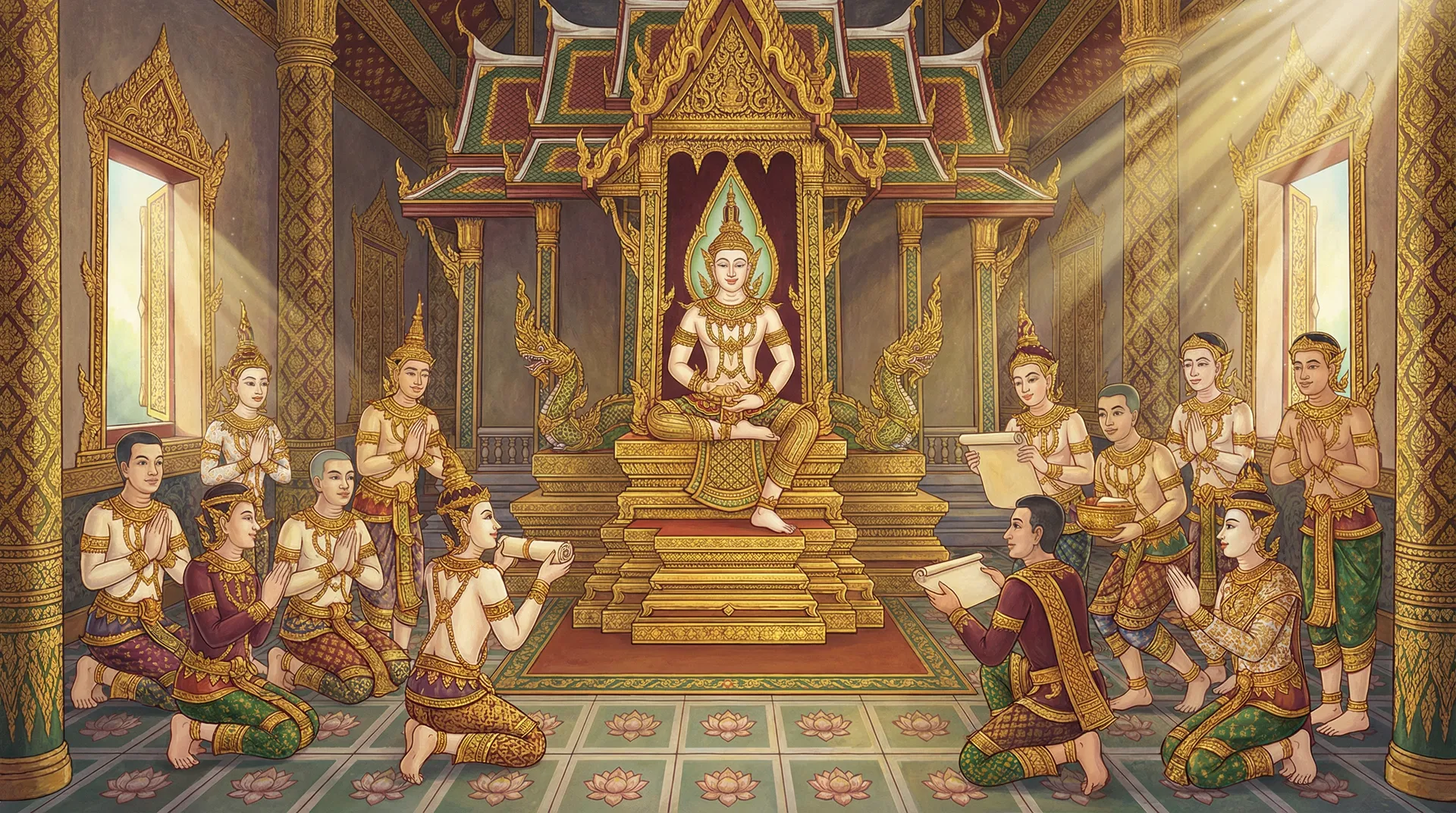
When the twin elephant arrived at the royal stables, the King himself came to witness the reunion. As Samphahu saw the newcomer, his eyes, usually stoic and reserved, widened with a flicker of recognition, a spark of something deep and ancient. The two elephants, though they had never met before, instinctively understood. They trumpeted in unison, a sound that resonated with the echoes of a shared past. They touched trunks, their bodies pressing together in a silent affirmation of their bond. It was as if they had been reunited after an eternity of separation. Samphahu, the solitary giant, was no longer alone. The King, witnessing this extraordinary connection, was filled with a profound sense of awe and gratitude. He ordered a grand celebration, recognizing the miraculous nature of the event.
From that day forward, Samphahu and his twin lived side by side, their lives interwoven like the roots of an ancient tree. They played together, bathed together, and their trumpets, once solitary calls, now filled the royal grounds with a joyous symphony. The kingdom of Mithila flourished under the benevolent gaze of their King, who was inspired by the unwavering bond of his two magnificent elephants. The tale of the twin elephants, their uncanny resemblance and their profound connection, became a legend, whispered from generation to generation, a testament to the enduring power of love and kinship, even across the vast expanse of time and rebirth.
The moral of this story is that true kinship and love can transcend the boundaries of life and death. Even when separated by circumstances, the bonds of affection forged in past lives can resurface, bringing solace and joy to those who have experienced loss. It also teaches us the importance of companionship and the profound happiness that comes from shared experiences and unwavering loyalty.
— In-Article Ad —
💡Moral of the Story
Laziness leads to downfall, while diligence, learning, and good deeds can lead to success and happiness.
Perfection: Perfection of Effort, Perfection of Generosity
— Ad Space (728x90) —
More Jataka Tales You May Enjoy
 195Dukanipāta
Mahanaradajataka
Mahanaradajataka In the magnificent city of Indrapura, ruled a wise and benevolent king named Brahma...
💡 True enlightenment and ultimate happiness are found not in external pursuits or mythical treasures, but within the awakened mind. Wisdom is the key that unlocks the door to liberation, enabling us to overcome internal obstacles and realize our true nature.
 519Vīsatinipāta
Temiya Jataka
The Prince Who Found Joy in StillnessIn the ancient city of Ujjeni, amidst the grandeur of a royal p...
💡 True happiness and liberation are found in detachment from worldly possessions and transient pleasures. Understanding the impermanence of all things leads to inner peace and freedom from suffering.
169DukanipātaDhammapāla Jātaka
Dhammapāla JātakaIn a land of rolling hills and verdant valleys, where the air was often perfumed wi...
💡 Integrity and truth, when faced with malice and deception, should be met with patience and steadfastness rather than retaliation. True virtue will eventually be recognized.
212DukanipātaMulasutta Jataka
The Root of All EvilIn the prosperous city of Varanasi, ruled a king known for his immense wealth an...
💡 Greed and envy are the root of all evil, leading to deception, loss, and suffering. True contentment comes from appreciating what one possesses and cultivating inner virtue.
81EkanipātaMāhāsukha Jātaka
Māhāsukha Jātaka Long ago, in the bustling city of Mithila, lived a king named Brahmadatta. He was a...
💡 True happiness is found not in external possessions or status, but in inner peace, detachment, and boundless compassion.
135EkanipātaVessantara Jataka
The Tale of the Generous Prince Vessantara In the kingdom of Siwi, ruled a wise and benevolent king....
💡 True generosity extends beyond material possessions; it involves the willingness to sacrifice even the most cherished aspects of one's life for the sake of others and one's principles.
— Multiplex Ad —