
Vessantara Jataka
The Tale of the Generous Prince Vessantara
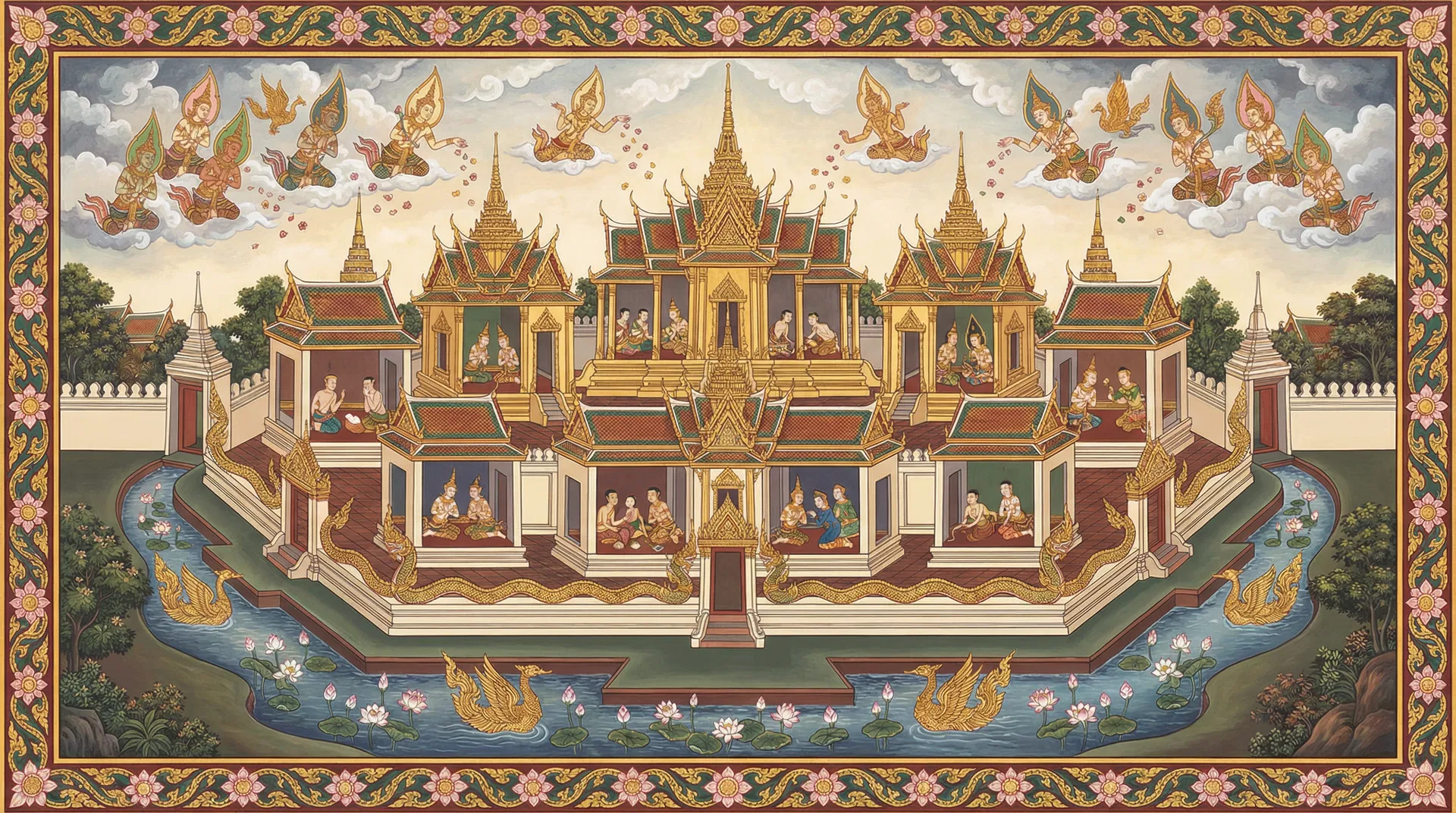
In the kingdom of Siwi, ruled a wise and benevolent king. His reign was one of peace and prosperity, and his people were content. The king had a son, Prince Vessantara, who was renowned throughout the land not only for his handsome appearance and noble bearing but, most importantly, for his boundless generosity. Vessantara’s generosity was legendary; he believed that true wealth lay in giving, and he practiced this belief with an unparalleled spirit of selflessness.
Prince Vessantara was married to the beautiful and virtuous Princess Maddi, and they had two children, a son named Jaliya and a daughter named Kanhā. The prince loved his family dearly, but his compassion extended to all beings. He would often give away his possessions – his fine clothes, his jewelry, even the royal elephants and horses – to those in need, much to the concern of his father and the kingdom's ministers. They worried that his extreme generosity would one day lead to disaster.
One day, a group of Brahmins, led by a stern and imposing man named Jujaka, arrived at the palace. They had heard tales of Prince Vessantara’s legendary generosity and had come seeking a boon. Jujaka, with a voice like dry thunder, approached the prince. 'O noble prince,' he proclaimed, 'we have traveled far. We are poor and have nothing. We have heard that you possess a magical white elephant that brings rain and prosperity to the kingdom. We desire this elephant for our village, which is suffering from drought.'
Prince Vessantara, seeing the Brahmins’ apparent plight and driven by his innate compassion, felt he could not refuse. He believed that the elephant’s blessings, meant for all the people, could be shared even if it meant parting with such a valuable treasure. He readily agreed. He led the Brahmins to the royal stables and, with a heavy heart but a resolute spirit, presented them with the magnificent white elephant.
When news of this reached the king and the ministers, they were aghast. Giving away the royal white elephant, the symbol of the kingdom’s prosperity and the guarantor of its rains, was seen as a catastrophic act. The king, though understanding his son’s intentions, was forced to act to appease the worried populace and his council. He decreed that Prince Vessantara, for his reckless act, must leave the kingdom with his wife and children. They were to live in exile in the forest, far from the capital.
And so, Prince Vessantara, Princess Maddi, and their two young children, Jaliya and Kanhā, bid farewell to their beloved kingdom and set out for the deep, dark forest. They traveled for many days, facing hardships and privations. Princess Maddi, though devoted, found the journey arduous, carrying the young children while Vessantara, ever the compassionate one, would stop to help every creature they encountered.
They eventually settled in a humble hermitage within the forest, living a life of austerity. Vessantara continued to practice his vows of generosity, sharing whatever little they had with any ascetic or traveler who happened upon their dwelling. Princess Maddi, though longing for her former life, remained steadfast by her husband’s side, tending to their needs and caring for their children.
One day, while Prince Vessantara was out gathering fruits and roots, the same Jujaka, the Brahmin who had taken the white elephant, reappeared. This time, his eyes fell upon the prince’s two children, Jaliya and Kanhā, who were playing near the hermitage. Jujaka, still driven by a greedy and cruel heart, thought, 'The prince gave me an elephant, but I gained little from it. These children, however, are strong and healthy. Perhaps I can sell them into servitude and gain real wealth.'
Jujaka approached the children and, with cunning words, lured them away from the hermitage, promising them sweet treats. When Princess Maddi realized her children were missing, her heart filled with terror. She searched frantically, calling their names, her voice echoing through the trees.
Prince Vessantara returned to find his wife distraught. Learning of the children's disappearance, he was overcome with grief. However, he quickly regained his composure, remembering his vows. He knew that even in this dire situation, he must respond with compassion and adhere to his principles.
Just then, Jujaka appeared, dragging the crying children, and demanded of Vessantara, 'Prince, I have taken your children. Give me more riches, or I shall sell them to the lowest bidder!'
Prince Vessantara, seeing his children in such distress and facing the cruel Brahmin, felt a pang of unimaginable sorrow. Yet, his commitment to Dana Paramita, the perfection of generosity, was absolute. He looked at Jujaka and said, with a voice heavy with emotion but firm in resolve, 'Brahmin, I have nothing left to give that is more precious than my children. If giving them away, as I gave away the elephant, will bring you satisfaction and end their suffering, then I shall give them to you. Take them.'
He then called for Princess Maddi. In one of the most heartbreaking moments of his life, he asked her to fetch water for Jujaka to perform the ritual of gifting the children. Maddi, though her heart was breaking into a million pieces, understood her husband’s vow. She fetched the water, and as Vessantara poured it over Jujaka’s hand, symbolizing the completion of the gift, he formally gave his children away.
Jujaka, having achieved his wicked goal, began to lead the children away. The forest creatures wept, the trees seemed to bend in sorrow, and the very earth trembled. The gods, witnessing this ultimate act of selfless generosity in the face of profound personal loss, were moved to intervene.
Sakkaradevendra, the King of Gods, disguised himself as a wealthy merchant and intercepted Jujaka. He bought the children from the cruel Brahmin for a substantial sum, ensuring their safety and returning them to their distraught parents. The gods also miraculously restored Princess Maddi's strength and well-being, as she had suffered greatly from the ordeal.
The story of Prince Vessantara’s ultimate sacrifice and unparalleled generosity spread far and wide. Eventually, the King of Siwi, hearing of his son’s suffering and the extraordinary circumstances, invited them back to the kingdom. Prince Vessantara, having demonstrated the perfection of generosity to its absolute extreme, returned to his people, his wisdom deepened by his trials. He continued to rule with great compassion, forever remembered as the prince who gave away everything, even his beloved children, for the sake of his vows and his boundless love for all beings.
— In-Article Ad —
💡Moral of the Story
True generosity extends beyond material possessions; it involves the willingness to sacrifice even the most cherished aspects of one's life for the sake of others and one's principles.
Perfection: Generosity (Dana)
— Ad Space (728x90) —
More Jataka Tales You May Enjoy
 464Dvādasanipāta
Mugapakkha Jātaka
Mugapakkha JātakaIn the ancient land of Mithila, a realm renowned for its scholars and philosophers,...
💡 True strength and leadership are demonstrated through courageous actions and unwavering commitment, not necessarily through eloquent speech. Overcoming personal limitations and past karmic consequences requires inner strength and resolute will.
65EkanipātaThe Great Monkey King
The Great Monkey King In a time long past, when the world was young and the forests teemed with lif...
💡 Upholding one's promise is of utmost importance. Breaking one's word inevitably leads to negative karma.
33EkanipātaThe Bodhisatta as a Brave Lion
The Bodhisatta as a Brave LionIn the heart of a vast and ancient forest, where towering trees formed...
💡 True courage is demonstrated by the willingness to make the ultimate sacrifice for the well-being of others.
1EkanipātaThe Tale of the Great Lotus
The Tale of the Great Lotus In a time long past, when the world was a canvas of verdant forests and...
💡 Impatience is like a fire that burns everything, but wisdom and concentration are the tools that allow us to control situations and achieve goals with stability.
 253Tikanipāta
Kusa-Jātaka
Kusa-JātakaIn the kingdom of Kampilla, nestled beside the sacred River Ganges, lived a king named Ud...
💡 Jealousy and hasty judgments can lead to terrible suffering and separation. True love is tested by adversity, and forgiveness is essential for healing and reconciliation. Patience, inner strength, and understanding are virtues that can overcome even the most profound injustices.
23EkanipātaThe Bodhisatta as a King of Birds
The Bodhisatta as a King of BirdsIn the celestial realm of the heavens, where clouds of spun gold dr...
💡 True wisdom lies in selfless compassion, and the greatest sacrifices bring about miraculous salvation.
— Multiplex Ad —