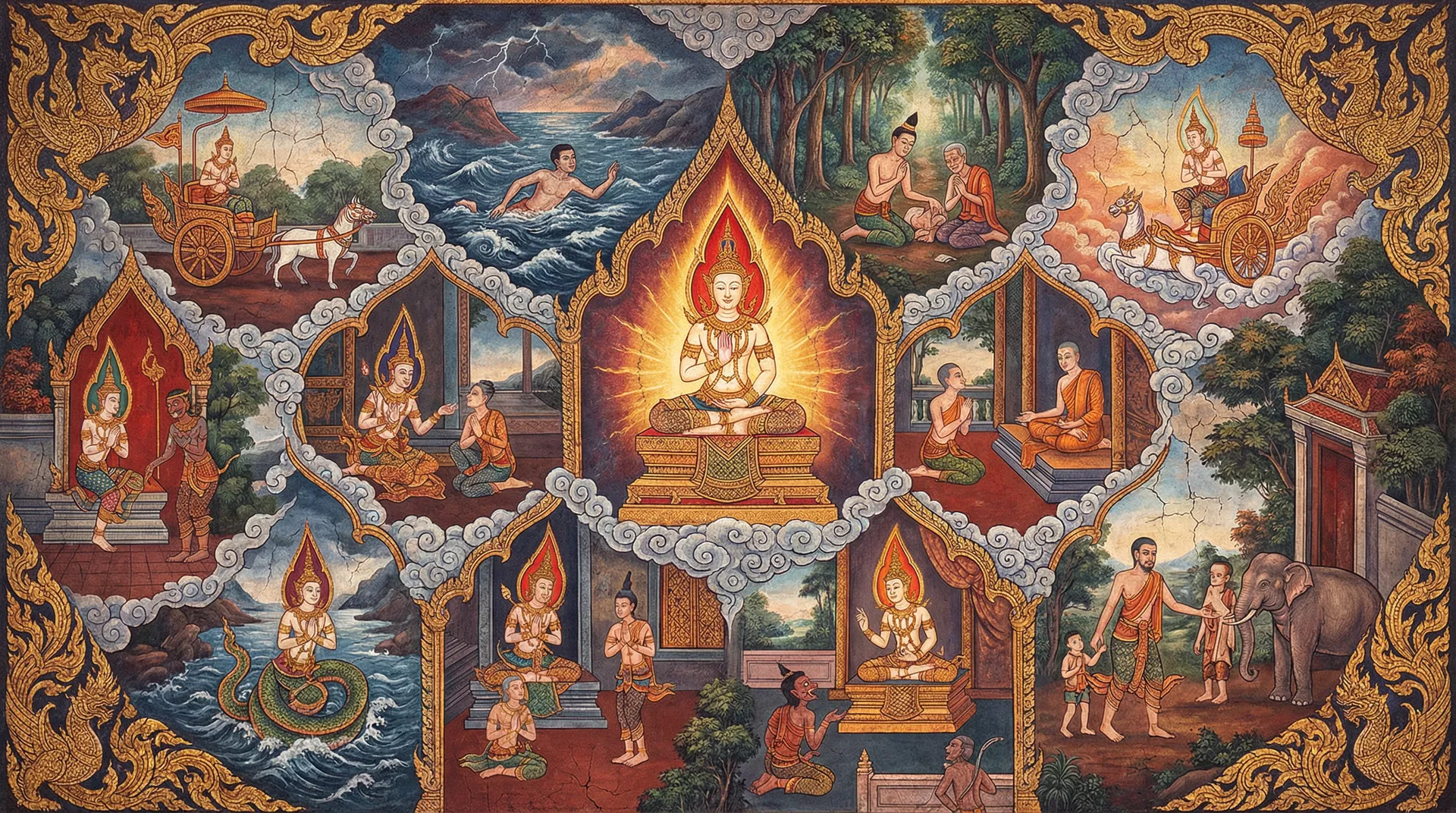
Sattubhatta Jātaka
The King's Feast and the Virtuous Monk
In the grand kingdom of Kosala, ruled a king named Pasenadi, a monarch known for his piety and his love for the Dharma. He was a man who genuinely sought to live a life of virtue, and his court was often graced by the presence of wise monks and learned scholars who guided him on the path of righteousness.
One day, King Pasenadi decided to hold a magnificent feast, an event meant to honor the Sangha and to share the fruits of his kingdom with those who dedicated their lives to spiritual practice. Invitations were sent to all the esteemed monks, promising an abundance of the finest food and the most comfortable accommodations.
Among those invited was a venerable monk, a man of profound wisdom and immense self-control. He was known for his ascetic lifestyle, his detachment from worldly comforts, and his unwavering devotion to the teachings. He accepted the king's invitation, not for the sake of luxury, but out of respect for the king's intentions.
On the day of the feast, the royal dining hall was adorned with flowers and banners, and tables were laden with a dazzling array of delicacies. The monks arrived, each receiving a warm welcome and a place of honor. The king himself served the monks, his heart filled with joy as he offered them the choicest dishes.
As the feast progressed, the king noticed that the venerable monk, though present, ate very little. He observed that the monk seemed to be partaking of a simple meal of rice gruel, prepared from the remnants of grains, which he had brought himself. The king, puzzled by this, approached the monk with great humility.
"Venerable sir," the king asked, "you are my honored guest, and this feast has been prepared with the utmost care. Yet, I see you eating only your own simple gruel. Is there something lacking in our offerings? Have I failed in my duty as a host?"
The monk, with a gentle smile, replied, "Your Majesty, your hospitality is boundless, and your offerings are indeed magnificent. However, my practice requires me to abstain from rich foods and to consume only what is essential for sustaining life. This simple gruel is all that my discipline requires."
The king, deeply impressed by the monk's austerity and self-discipline, felt a surge of respect. He understood that true contentment was not found in abundance, but in moderation and self-control. He saw that while he, a king, ruled over vast riches, this humble monk possessed a wealth far greater – the wealth of inner peace and freedom from desire.
The king then asked, "Venerable sir, if you were offered the finest delicacies, the most exquisite dishes, would you still choose this simple gruel?"
The monk responded, "Your Majesty, the purpose of food is to nourish the body, not to gratify the senses. If these rich foods were to disturb my peace of mind or hinder my spiritual progress, I would certainly choose this simple gruel. True nourishment comes from a content mind, not from the richness of the meal."
King Pasenadi was profoundly moved by the monk's words. He realized that the monk's detachment from worldly pleasures was the source of his profound peace and wisdom. He understood that the monk's virtue was not dependent on external circumstances but stemmed from an inner conviction.
The king bowed deeply to the monk, expressing his gratitude for the lesson. He left the feast with a renewed understanding of the Dharma, realizing that true happiness lies in simplicity, self-control, and the cultivation of inner virtues, rather than in the accumulation of material possessions or the indulgence of desires. The monk's quiet example served as a powerful reminder of the path to spiritual liberation.
— In-Article Ad —
💡Moral of the Story
True contentment and spiritual progress are achieved through simplicity, self-control, and detachment from worldly desires, not through material wealth or indulgence.
Perfection: Renunciation (Nekkhamma) and Patience (Khanti)
— Ad Space (728x90) —
More Jataka Tales You May Enjoy
 390Chakkanipāta
Saddhanta Jataka
Saddhanta JatakaIn a thriving city known for its bustling marketplace and its scholarly pursuits, th...
💡 Honesty and integrity are paramount, even in the face of severe consequences. True value lies not in outward perfection, but in truthfulness and the courage to admit one's flaws.
541MahānipātaMahā-janaka Jātaka
The Great JanakaIn the ancient kingdom of Mithila, nestled amidst lush gardens and bustling marketpl...
💡 True happiness and peace are found not in external circumstances, but in the inner state of one's mind, through acceptance and inner strength.
 316Catukkanipāta
Mugapakkha Jataka
Mugapakkha JatakaIn the heart of a lush forest, teeming with life and vibrant hues, there once lived...
💡 True leadership is demonstrated through selfless sacrifice for the well-being of others, even at great personal cost. Compassion and courage can overcome immense hardship.
311CatukkanipātaNimi Jataka
Nimi JatakaLong ago, in the heart of the magnificent city of Mithila, ruled a just and benevolent ki...
💡 The path to true happiness and spiritual elevation is paved by one's own virtuous actions, guided by wisdom and compassion.
 255Tikanipāta
Sattigumba-Jātaka
Sattigumba-JātakaIn the sprawling kingdom of Kasi, renowned for its skilled artisans and vibrant mar...
💡 True magnificence and strength lie in compassion, respect for nature, and harmonious coexistence, not in dominance or possession. Righteous rule is demonstrated through justice, empathy, and the protection of all living beings.
 352Pañcakanipāta
Kusa Jataka
Kusa Jataka Long, long ago, in the ancient kingdom of Mithila, there lived a prince named Kusa. He w...
💡 True love and unwavering resolve can overcome great obstacles, and wisdom is often gained through hardship and self-reflection.
— Multiplex Ad —