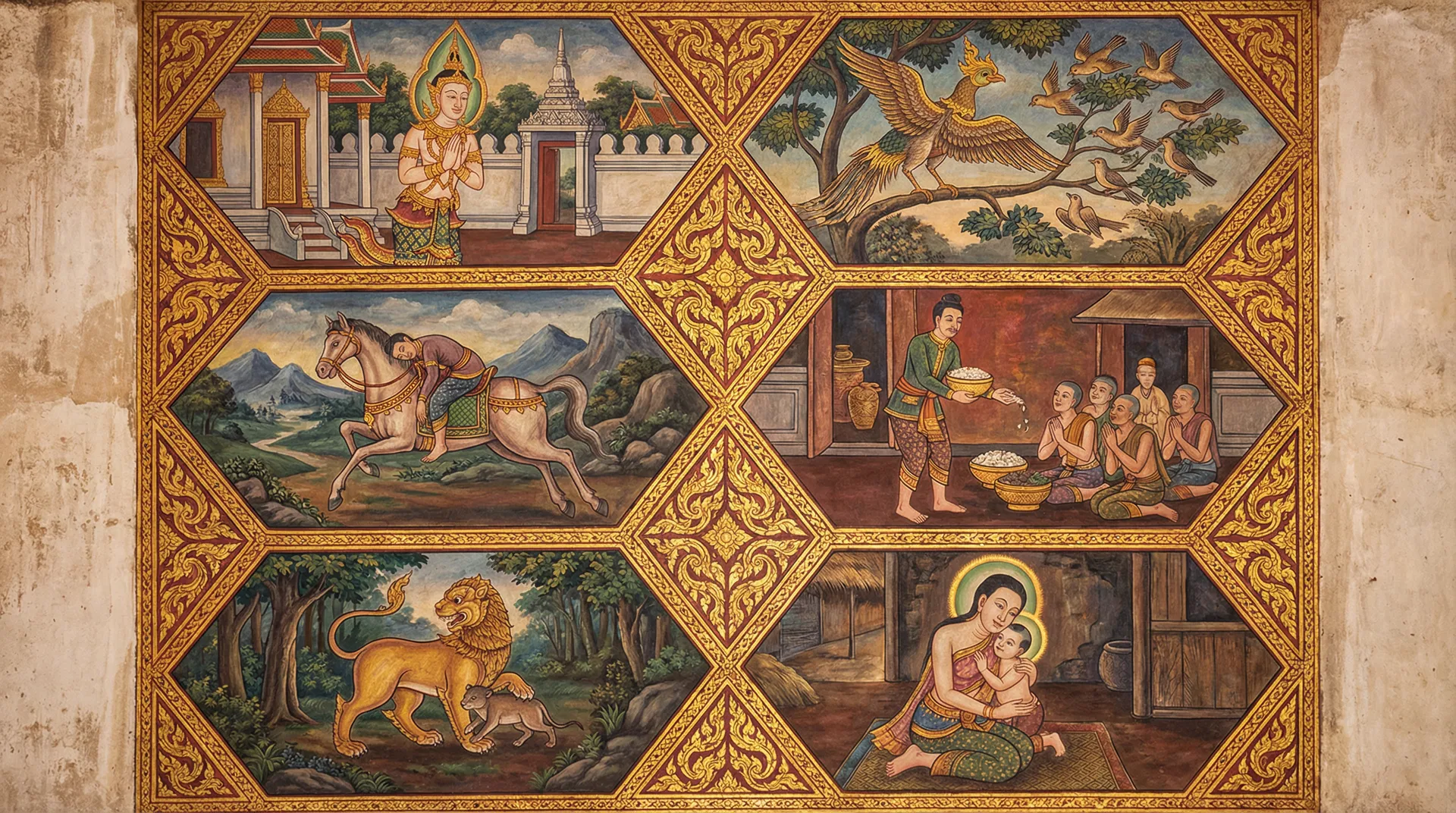
Saddhanta Jataka
Saddhanta Jataka
In a thriving city known for its bustling marketplace and its scholarly pursuits, there lived a wise and virtuous Bodhisatta, who in this lifetime was born as a skilled artisan named Saddhanta. He was renowned throughout the land for his exceptional craftsmanship, particularly his ability to carve intricate statues that seemed to breathe with life. His work was sought after by kings and wealthy patrons alike. Saddhanta, however, was not driven by fame or fortune. He believed that true artistry lay in honesty, in pouring one's heart and soul into every creation, and in fulfilling promises with unwavering commitment.
One day, a wealthy and powerful merchant approached Saddhanta. The merchant, who had a reputation for being somewhat capricious and demanding, commissioned a magnificent statue of a celestial being. 'Saddhanta,' he declared, his voice booming with self-importance, 'I require a statue of unparalleled beauty and divine grace. It must be completed within one year, and it must be flawless. If you succeed, I shall reward you handsomely. But if you fail, or if there is even the slightest imperfection, you will face my wrath and severe punishment.'
Saddhanta, accustomed to the demands of his patrons, calmly accepted the commission. He meticulously studied the specifications, the desired posture, the expression of divine serenity, and the intricate details. He promised to deliver a masterpiece within the stipulated time.
He began his work with immense dedication. Days turned into nights as Saddhanta toiled away in his workshop. He selected the finest marble, his hands moving with precision and grace. He breathed life into the stone, sculpting every curve, every line, with utmost care. He was driven by his commitment to his craft and his promise to the merchant.
As the year drew to a close, Saddhanta was nearing completion. The statue was indeed a marvel, radiating an ethereal beauty that captivated all who saw it. However, on the very last day of the year, as Saddhanta was applying the final touches, a tiny, almost imperceptible flaw appeared. A minuscule crack, no larger than a hair's breadth, formed on the statue's forehead due to an unforeseen internal stress in the marble. Saddhanta, a perfectionist to his core, was devastated. He knew that this tiny flaw, though barely visible, violated his promise of flawlessness.
He wrestled with his conscience. He could try to hide the flaw, or perhaps even claim it was part of the design. But his integrity wouldn't allow it. He knew that true honesty meant admitting any shortcomings, no matter how small.
On the day of delivery, the merchant arrived, his face alight with anticipation. He gazed upon the statue, and his eyes widened in admiration. 'Magnificent!' he exclaimed. 'You have surpassed all expectations, Saddhanta! Truly, a divine creation!'
Saddhanta, his heart heavy, stepped forward. 'Honorable merchant,' he began, his voice filled with a mixture of pride and sorrow, 'I am grateful for your appreciation. The statue is indeed a culmination of my efforts. However, I must confess that there is a flaw. On the final day, an unforeseen crack appeared on its forehead. Though small, it is a blemish, and I have failed to deliver a perfectly flawless piece as promised.'
The merchant's face contorted with rage. 'A flaw? You dare bring me a flawed statue after promising perfection? You have deceived me! You shall pay dearly for this!' He was furious, his ego wounded by the notion of imperfection in something he commissioned.
The artisans and onlookers, who had gathered to witness the unveiling, were stunned. Some whispered that the flaw was too small to even notice, while others sided with the merchant, arguing that a promise was a promise.
Saddhanta, despite the merchant's fury, stood firm. 'Sir,' he said respectfully, 'I have not deceived you. I have brought you the statue and truthfully disclosed its imperfection. My promise was for a flawless statue, and this is not it. I understand your anger, but I could not lie to you. I am prepared to accept the consequences.'
The merchant, blinded by his anger and pride, refused to listen. He ordered his men to seize Saddhanta and punish him. As they dragged Saddhanta away, the Bodhisatta, even in his distress, maintained his composure. He understood that his commitment to truth was more important than his own safety or comfort.
However, the onlookers, particularly the other artisans and scholars present, were deeply moved by Saddhanta's honesty. They saw his integrity and his unwavering commitment to truth, even when it meant facing severe punishment. They argued with the merchant, pleading for Saddhanta's release.
'Mercy, good merchant!' cried one elder artisan. 'The flaw is almost invisible. His honesty in admitting it speaks volumes of his character and his dedication to truth. Is this not more valuable than a perfect, yet deceitfully presented, statue?'
The merchant, though initially stubborn, began to waver under the collective plea of the crowd. He looked at the statue again, then at Saddhanta, who stood stoically awaiting his fate. He saw not a deceiver, but a man of profound integrity. He realized that Saddhanta's honesty, his courage to admit a flaw, was indeed a rare and valuable quality, far more precious than any perfect statue.
Finally, the merchant relented. He approached Saddhanta, his anger subsiding, replaced by a grudging respect. 'Saddhanta,' he said, his voice softer, 'you have shown me a lesson in truth that no statue could teach. Your integrity is admirable. I have been foolish and blind. Forgive my outburst. I shall not punish you. In fact, I shall reward you, for you have taught me the true meaning of value.'
The merchant not only forgave Saddhanta but commissioned him to create another statue, this time with the understanding that perfection is an ideal, and honesty in acknowledging imperfections is a greater virtue. Saddhanta, relieved and grateful, continued his work, forever embodying the principle that true artistry, and indeed true life, is about striving for excellence while embracing honesty and integrity above all else.
— In-Article Ad —
💡Moral of the Story
Honesty and integrity are paramount, even in the face of severe consequences. True value lies not in outward perfection, but in truthfulness and the courage to admit one's flaws.
Perfection: Honesty (Sacca) and Integrity (Sil)
— Ad Space (728x90) —
More Jataka Tales You May Enjoy
 10Ekanipāta
The Bodhisatta as a Tortoise
The Bodhisatta as a TortoiseIn the tranquil embrace of a sacred forest, where ancient trees formed a...
💡 The ultimate act of compassion, even at the cost of one's own life, can bring forth miraculous salvation.
 214Dukanipāta
Samukkita Jataka
The Value of Truthful SpeechIn the ancient city of Ujjain, there lived a renowned scholar named Vidh...
💡 Truthful and honest communication is the most effective means of resolving conflict and building lasting peace and prosperity, far more valuable than deception or force.
86EkanipātaThe Great Vanga Jataka
Once upon a time, in the glorious city of Savatthi, while the Supreme Buddha resided at Jetavana Mon...
💡 True compassion lies in the willingness to sacrifice one's own well-being for the benefit of others, and such selfless acts can bring about miraculous positive change.
 299Tikanipāta
Mahosadha Jataka
The Mahosadha Jataka: The Wise Minister Mahosadha In the ancient kingdom of Videha, ruled by the jus...
💡 Wisdom, clarity of thought, and foresight are the most powerful tools for solving problems, dispensing justice, and ensuring the prosperity and peace of a kingdom. True leadership lies in intelligent and ethical decision-making.
 310Catukkanipāta
Samkicca Jātaka
The Humble Merchant's ResolveIn the bustling city of Varanasi, there lived a merchant named Samkicca...
💡 True strength lies not in physical might or aggression, but in unwavering resolve, unity, and the courage to face adversity with a determined spirit. Collective action and inner fortitude can overcome even the most daunting threats.
309CatukkanipātaMūga-Pakṣa Jātaka
The Silent SageIn the kingdom of Mithila, there lived a king named Vidhuratha. He was a just ruler, ...
💡 True wisdom is not always expressed through eloquent speech; profound understanding and inner peace can be conveyed through silence and action. Do not be swayed by superficial appearances or clever words; seek the deeper truths that lie beneath.
— Multiplex Ad —