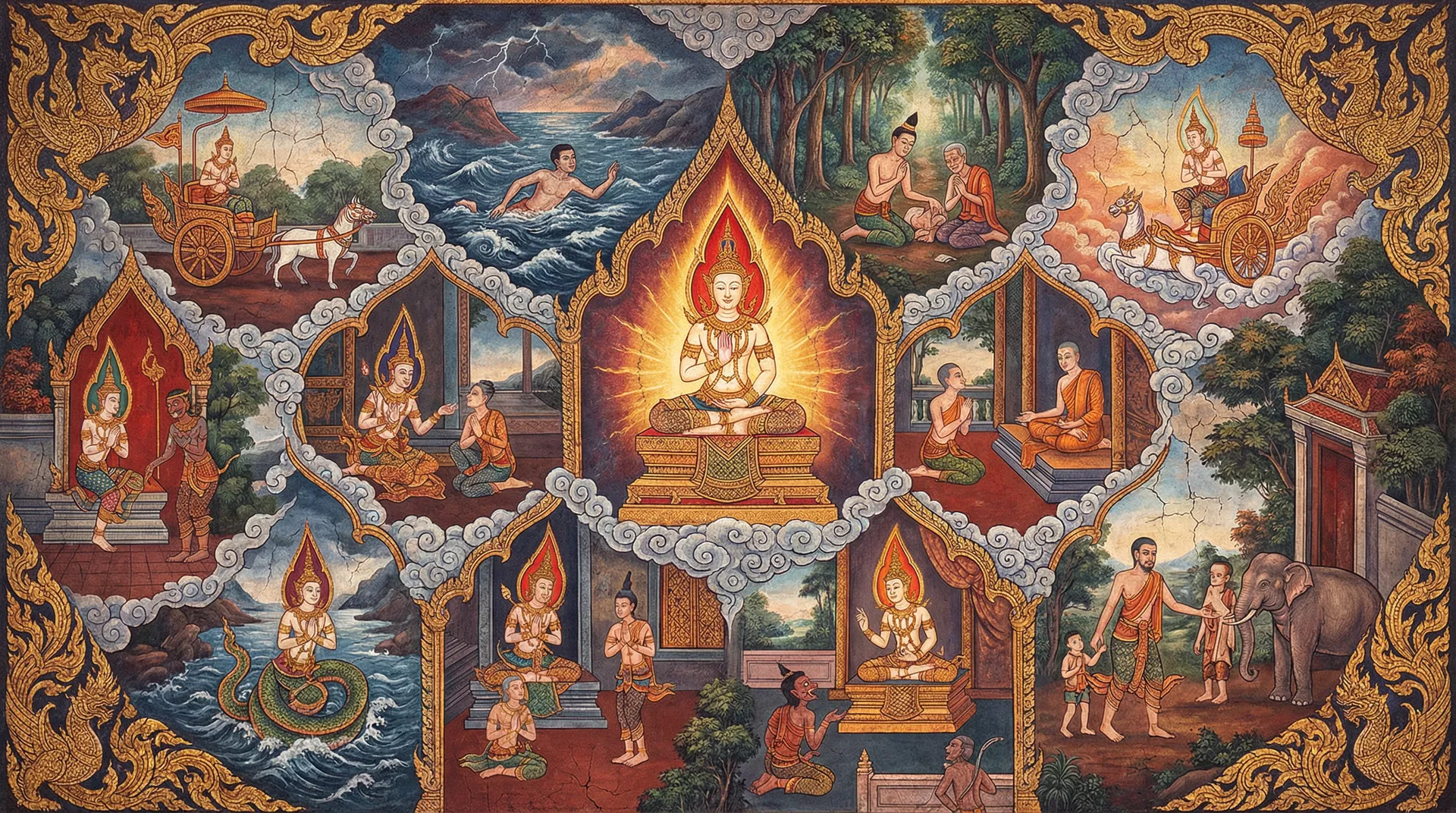
Sama Jataka
The Tale of Prince Sama and the Mother's Love
In the ancient kingdom of Kuruksetra, there lived a pious king and queen who, after many years, were blessed with a son named Sama. However, their joy was short-lived. During a royal hunt, the king was mortally wounded by a hunter's arrow, and the queen, grief-stricken, followed him in death shortly thereafter. Young Prince Sama was orphaned, left in the care of his devoted nurse.
As Sama grew, he became increasingly devoted to his blind parents. He understood their plight and dedicated his life to their service. He would venture into the deep forest daily, gathering fruits and roots, fetching water, and tending to their every need. His love for them was absolute, a pure and selfless devotion that filled his young heart.
One day, as Prince Sama was fetching water from the river, he heard the sound of arrows being shot in the forest. It was the king, King Dighavapi, practicing archery. Unbeknownst to Sama, the king had heard tales of the prince's filial piety and had been curious to see him. However, mistaking the prince for a deer or some other creature due to the dense foliage and the prince's humble attire, and perhaps driven by a moment of pride in his own skill, the king loosed an arrow.
The arrow struck Prince Sama, and he fell mortally wounded. As he lay dying, his only thought was of his blind parents. "Who will care for them now?" he lamented, his voice weak.
The king, realizing his terrible mistake, rushed to the scene. He was horrified to see the young prince, whom he had accidentally slain. He saw the devotion in Sama's eyes, the selfless concern for his parents, and was overcome with remorse.
"Young prince," the king stammered, his voice choked with tears, "I am the cause of your suffering. I have committed an unforgivable act. What can I do to atone?"
Sama, with his dying breath, pleaded, "My lord, my parents are blind and helpless. Please, go to them and tell them of my fate. And for their sake, I beg you, bring them water from this river."
The king, humbled and deeply moved by Sama's selfless concern even in his final moments, promised to fulfill his dying wish. He carried the prince's body back to his parents and, with a heavy heart, explained what had happened.
The blind parents, upon hearing of their son's death, were devastated. They wept uncontrollably, their grief inconsolable. The mother cried out, "Oh, my son! If only I had the power to bring you back to life, I would give my own!" The father echoed her sorrow, lamenting the loss of his beloved son.
At that moment, the gods, witnessing the profound love and sacrifice of Prince Sama and the immense grief of his parents, were moved by their devotion. They descended from heaven and, using their divine power, restored Prince Sama to life. They then granted the blind parents the ability to see again, so they could behold their son once more.
The king, witnessing this miracle, was filled with awe and gratitude. He saw the power of true filial piety and the divine intervention that rewarded such selfless love. From that day forward, King Dighavapi dedicated his life to the practice of righteousness and compassion, never forgetting the lesson he learned from Prince Sama.
Prince Sama, restored to life, continued to serve his parents with even greater devotion. The kingdom of Kuruksetra flourished under the king's just rule, inspired by the tale of Sama's unwavering love and the divine grace that followed his selfless act.
— In-Article Ad —
💡Moral of the Story
Unwavering filial piety and selfless devotion are virtues of the highest order, capable of inspiring compassion and even divine intervention. True love transcends personal sacrifice.
Perfection: Truthfulness (Sacca) and Devotion (Anuraga)
— Ad Space (728x90) —
More Jataka Tales You May Enjoy
 356Pañcakanipāta
Kosiya Jataka
Kosiya Jataka In the ancient city of Varanasi, nestled beside the sacred river Ganges, lived a wealt...
💡 True wisdom lies not just in intellectual knowledge, but in a contented mind, compassionate actions, and the generosity of spirit. Pride blinds us to deeper truths, while humility opens the door to genuine understanding.
 529Mahānipāta
Mahā-pattakajātaka
The Tale of the Generous King In the ancient land of Kalinga, renowned for its fertile fields and pr...
💡 The greatest act of generosity is the selfless offering of oneself for the well-being of others. True giving comes from the heart and involves sacrifice.
 315Catukkanipāta
Temiya Jataka
Temiya JatakaIn the grand city of Varanasi, nestled beside the sacred Ganges, ruled a wise and just ...
💡 True liberation comes from understanding the impermanence of worldly life and the suffering it entails, leading to detachment and the pursuit of spiritual freedom.
 289Tikanipāta
The Serpent King's Generosity (Phala Jātaka)
The Serpent King's Generosity (Phala Jātaka) In a realm where the boundary between the mortal world ...
💡 True wealth lies in selfless generosity and the willingness to share one's blessings, for compassion nourishes not only others but also the giver and the world around them.
 42Ekanipāta
The Bodhisatta as the Golden Deer
The Bodhisatta as the Golden DeerIn the ancient kingdom of Mithila, nestled beside a shimmering, eme...
💡 Unwavering truthfulness and selfless compassion can overcome even the direst of circumstances, leading to prosperity for all.
298TikanipātaSamkicca Jataka
The Samkicca Jataka: The Virtuous Gardener In the bustling city of Varanasi, known for its vibrant m...
💡 True happiness is found not in accumulating possessions, but in the act of selfless giving. Generosity purifies the heart, liberates us from attachment, and creates a profound and lasting sense of contentment.
— Multiplex Ad —