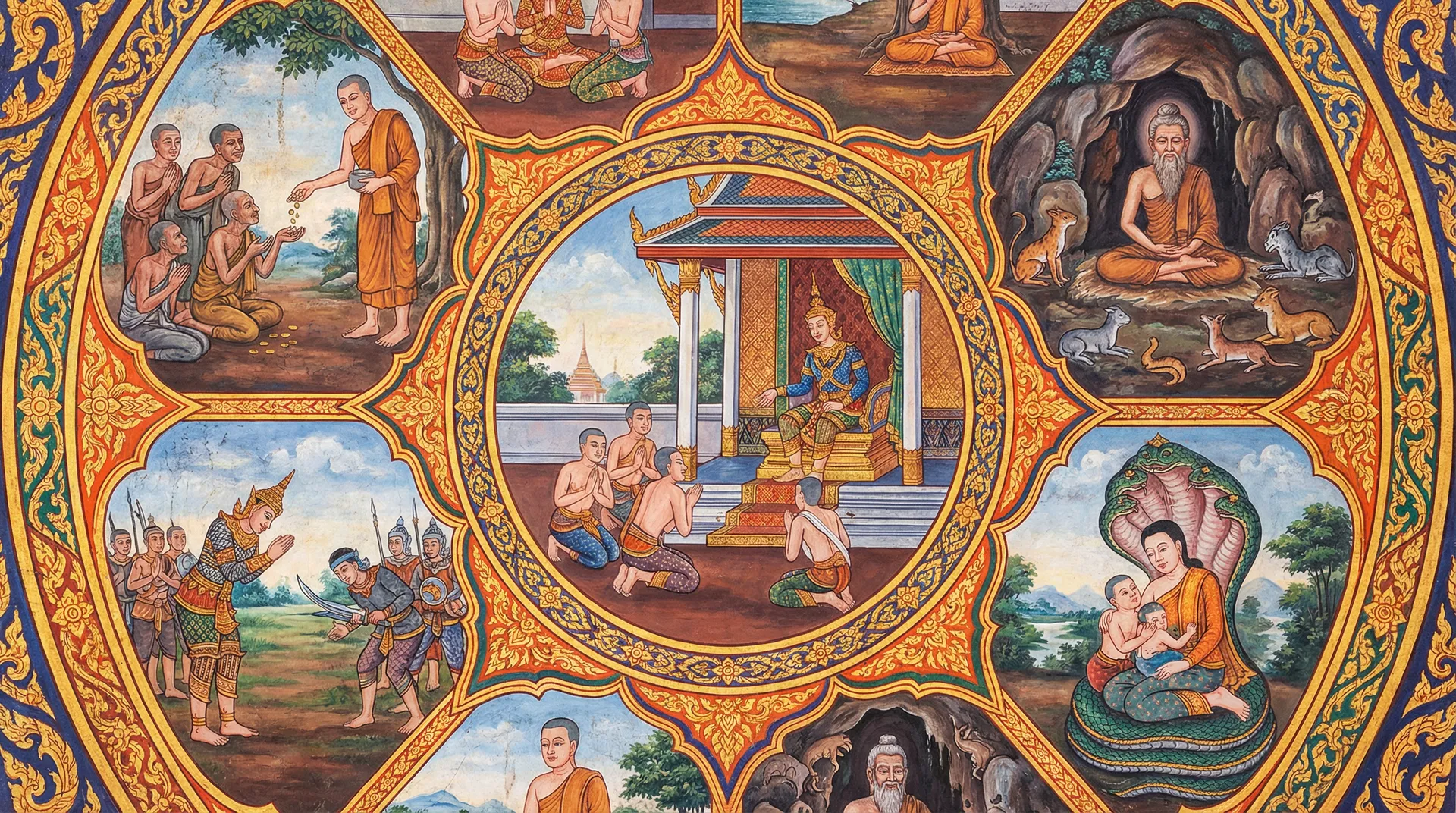
Kosiya Jataka
Kosiya Jataka
In the ancient city of Varanasi, nestled beside the sacred river Ganges, lived a wealthy and respected merchant named Kosiya. He was known throughout the land for his vast fortune, his fairness in trade, and his generous heart. Kosiya was not merely rich; he was wise, and he understood that true wealth lay not just in accumulating possessions, but in using them to bring happiness to others. His home was a beacon of hospitality, always open to travelers, the poor, and those in need. Food was always plentiful, and comfort was readily offered.
One day, a curious brahmin, a scholar of ancient texts and a seeker of spiritual truths, arrived in Varanasi. This brahmin, named Bavari, was renowned for his asceticism and his deep knowledge of the Vedas. However, Bavari was also known for his insatiable pride. He believed himself to be the most learned man in all of Jambudipa, and he relished opportunities to showcase his intellect and to subtly belittle those he deemed less knowledgeable.
Hearing of Kosiya’s renown, Bavari decided to visit him, not out of genuine need, but to test the merchant’s wisdom and, if possible, to find fault with him. He arrived at Kosiya’s magnificent mansion, adorned in simple saffron robes, but carrying an aura of intellectual arrogance. Kosiya, ever the gracious host, welcomed Bavari with utmost respect, offering him a comfortable seat, cool water, and delicious fruits.
“Welcome, learned sir,” Kosiya said with a warm smile. “It is an honor to have such a distinguished guest grace my humble abode. Please, make yourself at home. Is there anything I can offer you?”
Bavari, his eyes surveying the opulent surroundings with a mixture of disdain and admiration, replied, “Merchant Kosiya, I have traveled far, seeking discourse with those who are said to possess great understanding. I have heard tales of your wisdom, and I wished to see for myself if it is indeed as profound as the common folk proclaim.”
Kosiya chuckled softly. “Wisdom, esteemed Bavari, is like a vast ocean. I am but a humble fisherman casting his net, hoping to catch a few pearls. Perhaps you, with your vast knowledge, can teach me much.”
Bavari, pleased by Kosiya’s apparent humility, decided to begin his intellectual onslaught. “Tell me, merchant,” he began, his voice laced with condescension, “what is the greatest treasure one can possess?”
Kosiya paused, his gaze serene. “The greatest treasure, learned Bavari, is a contented mind. For with contentment, one finds peace in abundance and resilience in scarcity.”
Bavari scoffed inwardly. “A contented mind? How naive! True treasure lies in knowledge, in the mastery of the Vedas, in the understanding of the universe. Without knowledge, what is a man but a brute animal?”
“And what use is knowledge,” Kosiya countered gently, “if it does not bring peace to the mind that holds it? A mind filled with pride and anger, even if brimming with scriptures, is a prison, not a treasure.”
Bavari was taken aback by the merchant’s calm response. He had expected a debate, a chance to demonstrate his intellectual superiority. Instead, he found himself being subtly challenged.
“Let us speak of wealth, then,” Bavari pressed on, shifting his tactic. “What is the true nature of wealth?”
“True wealth,” Kosiya replied, “is not the gold in one’s coffers, but the love in one’s heart and the good deeds one performs. For wealth that is hoarded brings no joy, but wealth that is shared multiplies happiness.”
Bavari’s brow furrowed. “You speak of charity, a noble pursuit, perhaps, but ultimately a fleeting one. Wealth is power. It allows one to command respect, to influence the world.”
“Respect earned through fear or obligation is a hollow thing,” Kosiya said. “But respect earned through kindness and generosity is a bond that strengthens both giver and receiver. Power without compassion is a dangerous weapon.”
The brahmin grew agitated. He launched into a lengthy discourse on the cyclical nature of existence, the importance of ritual, and the ultimate futility of material pursuits, all delivered with an air of unassailable authority. Kosiya listened patiently, interjecting only with gentle questions that probed the underlying assumptions of Bavari’s arguments.
As the day wore on, Bavari found himself increasingly frustrated. Kosiya’s wisdom was not the dry, academic kind he was accustomed to. It was a living wisdom, rooted in experience and expressed with profound simplicity. He could not find a single flaw in Kosiya’s reasoning, nor could he dismiss his insights as mere common sense.
Finally, as the sun began to set, casting long shadows across the courtyard, Bavari stood up, his face a mask of barely concealed irritation. “Merchant Kosiya,” he said stiffly, “you have given me much to ponder. However, I still maintain that true enlightenment comes from rigorous intellectual pursuit and the mastery of ancient lore.”
Kosiya bowed his head respectfully. “And I, learned Bavari, believe that the greatest wisdom is found in understanding the heart, in living with compassion, and in serving others. For in the end, it is not what we know, but how we live, that truly matters.”
Bavari left Kosiya’s home that evening, not with the satisfaction of having proven the merchant wrong, but with a gnawing sense of unease. His intellectual pride had been challenged not by superior knowledge, but by a different kind of wisdom – one that was practical, humane, and deeply rooted in ethical living.
He continued his travels, but the encounter with Kosiya haunted him. He found himself questioning his own relentless pursuit of knowledge for its own sake, his condescending attitude towards those he considered less intelligent. He saw how his pride had isolated him, how his intellectual prowess had failed to bring him the inner peace he secretly craved.
Months later, Bavari, a changed man, returned to Varanasi. He sought out Kosiya, not as a challenger, but as a humble student. He confessed his earlier arrogance and expressed his newfound respect for Kosiya’s practical wisdom. Kosiya, ever forgiving and generous, welcomed him back with open arms. He shared his meals, his knowledge of the world, and the simple truths that guided his life.
From that day on, Bavari dedicated himself not just to studying the scriptures, but to applying their teachings in service to others. He learned that true wealth was indeed found in a contented mind, generous actions, and compassionate relationships. The pride that had once consumed him slowly dissolved, replaced by a quiet humility and a deep appreciation for the interconnectedness of all beings. Kosiya, the wise merchant, had not only shared his fortune but had also gifted Bavari the greatest treasure of all: the understanding of true wisdom.
— In-Article Ad —
💡Moral of the Story
True wisdom lies not just in intellectual knowledge, but in a contented mind, compassionate actions, and the generosity of spirit. Pride blinds us to deeper truths, while humility opens the door to genuine understanding.
Perfection: Generosity (Dana Paramita), Wisdom (Panna Paramita)
— Ad Space (728x90) —
More Jataka Tales You May Enjoy
 140Ekanipāta
Saranadbhu Jataka
The Tale of the Generous King and the WeaverIn the ancient and prosperous city of Varanasi, there re...
💡 True generosity lies not just in giving material possessions, but in empowering others to utilize their skills and potential, thereby ensuring their long-term well-being and prosperity.
 531Mahānipāta
Mahājanaka Jātaka
Mahājanaka JātakaIn the ancient kingdom of Mithila, nestled beside the great ocean, lived a wise and...
💡 True leadership is not about claiming power, but about serving others with courage, compassion, and unwavering integrity. Even in the face of overwhelming adversity, one's determination and virtuous actions can lead to victory and justice.
 152Dukanipāta
Sālaka Jātaka
Sālaka JātakaLong ago, in the bustling city of Benares, lived a wise and benevolent king. His kingdo...
💡 True wealth lies not in hoarding, but in sharing. Contentment and moderation lead to a harmonious and prosperous life.
23EkanipātaThe Bodhisatta as a King of Birds
The Bodhisatta as a King of BirdsIn the celestial realm of the heavens, where clouds of spun gold dr...
💡 True wisdom lies in selfless compassion, and the greatest sacrifices bring about miraculous salvation.
13EkanipātaThe Steadfast Brahmin
The Steadfast BrahminIn the ancient city of Varanasi, a beacon of spiritual learning, lived a devout...
💡 Unwavering steadfastness and a pure heart can inspire others and lead to rebuilding.
1EkanipātaThe Tale of the Great Lotus
The Tale of the Great Lotus In a time long past, when the world was a canvas of verdant forests and...
💡 Impatience is like a fire that burns everything, but wisdom and concentration are the tools that allow us to control situations and achieve goals with stability.
— Multiplex Ad —