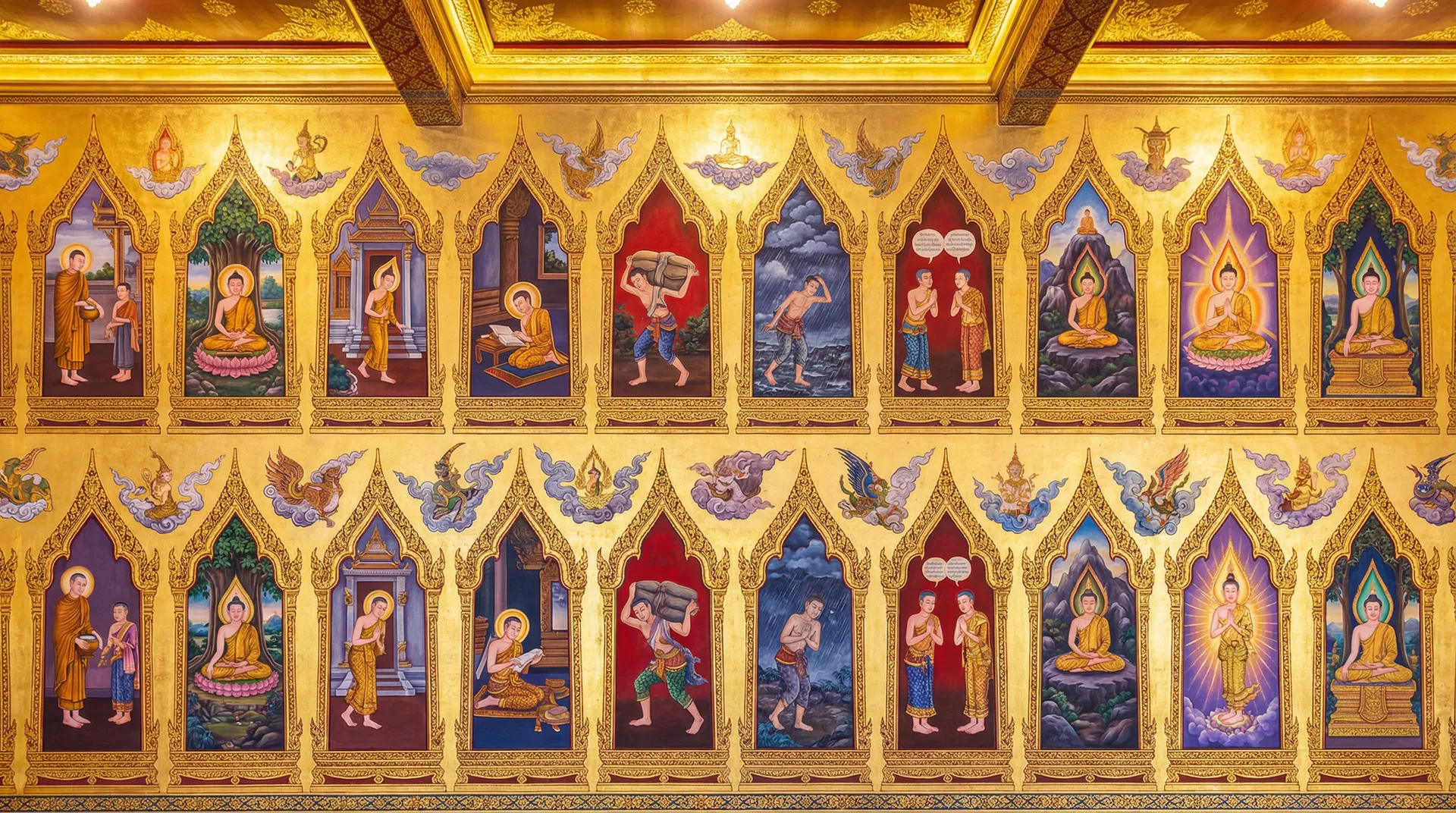
Maha-Ummagga Jātaka
Maha-Ummagga Jātaka
In the ancient kingdom of Mithila, there lived a king named Vedeha, a ruler known for his just and equitable governance. However, King Vedeha, though wise, was often prone to making hasty decisions, easily swayed by the cunning words of his ministers, particularly the wily chief minister, Pukkusa. This left the kingdom vulnerable to misrule and injustice, much to the dismay of the virtuous queen, Subhadra.
In this very kingdom, a Bodhisattva was born, destined to become Prince Mahosadha, the wisest of all beings. From his very birth, Mahosadha displayed an extraordinary intellect. While other children played with toys, young Mahosadha would engage in philosophical debates, solve complex riddles, and offer profound insights into matters of governance. His wisdom was so profound that even the learned scholars of the kingdom marveled at his brilliance.
As Mahosadha grew, his reputation for wisdom spread far and wide. King Vedeha, though initially dismissive, began to hear tales of the young prodigy's uncanny ability to resolve disputes and foresee consequences. One day, a critical dispute arose between two wealthy merchants, each claiming ownership of a valuable elephant. The king, unable to discern the truth, summoned Mahosadha.
Mahosadha, now a young man, arrived at the royal court. He listened patiently to both merchants' claims, his gaze calm and perceptive. Then, he devised a simple yet ingenious test. He ordered the elephant to be brought before them and asked both merchants to pull on its tail. The first merchant, upon pulling, struggled and could not budge the elephant. The second merchant, however, with great effort, managed to move the tail slightly.
'The second merchant is the true owner,' declared Mahosadha. The king was astonished. 'How can you be so certain?' he asked.
'My Lord,' Mahosadha explained, 'a true owner would be concerned about the welfare of his animal. He would not try to force it unnaturally. Instead, if one were to gently coax the elephant from its head, it would follow. This is the way of a kind and caring master.'
The second merchant, overjoyed, confessed that he had indeed tried to lead the elephant from its head, which is why it had responded. The first merchant, who had tried to force the elephant by its tail, was revealed to be a fraud who had stolen the elephant. King Vedeha, witnessing this display of unparalleled wisdom, was deeply impressed. He appointed Mahosadha as his chief advisor, recognizing that his kingdom desperately needed such discernment.
From that day forward, Mahosadha became the guiding force of Mithila. He navigated the king through complex political challenges, exposed the deceit of corrupt ministers like Pukkusa, and implemented reforms that brought prosperity and justice to the land. He established a system of canals to irrigate the fields, ensuring bountiful harvests. He created wise laws that protected the weak and punished the wicked. He even devised ingenious methods to outsmart neighboring kingdoms that sought to exploit Mithila.
One of Mahosadha's most famous feats involved a plot by the neighboring king of Kalinga to invade Mithila. The king of Kalinga, a formidable warrior, sent a messenger to King Vedeha, demanding that Mithila surrender or face annihilation. The ministers, including Pukkusa, panicked, urging the king to capitulate.
But Mahosadha, ever calm, devised a counter-strategy. He ordered the construction of a massive wall around the city, not with bricks and mortar, but with a dense forest of thorny bushes and sharp stakes, creating an impenetrable barrier. He then had the city's inhabitants gather heaps of fragrant flowers and sweet-smelling incense. When the army of Kalinga arrived, expecting a swift victory, they were met with an unexpected sight: a city seemingly abandoned, yet surrounded by an impassable thicket, emitting the most delightful aromas.
'This is no ordinary city,' whispered the Kalingan soldiers, their morale faltering. 'The king of Mithila has conjured a magical defense. The sweet scents are a lure, and the thorny barrier is a trap!' Fear and superstition spread through their ranks. The king of Kalinga, seeing his army waver and fearing an unseen magical force, ordered a retreat, his invasion thwarted without a single drop of blood being shed.
Mahosadha's wisdom was not confined to matters of war and governance. He also possessed great insight into human nature. He mediated personal disputes with fairness and compassion, always seeking the root cause of conflict and guiding individuals towards reconciliation. He understood that true wisdom lay not just in intellect, but in the ability to apply that intellect with kindness and understanding.
Throughout his life, Mahosadha served King Vedeha and the kingdom of Mithila with unwavering dedication. He faced numerous challenges, from internal corruption to external threats, but his profound wisdom, his foresight, and his unwavering commitment to justice always guided them to safety and prosperity. He showed that true leadership is not about wielding power, but about using intelligence and compassion to serve and protect others.
— In-Article Ad —
💡Moral of the Story
Profound wisdom, coupled with compassion and foresight, is the greatest asset a leader can possess. It allows one to overcome challenges, expose deceit, and bring prosperity and justice to all.
Perfection: Wisdom (Prajna), Truthfulness (Sacca), Determination (Adhitthana)
— Ad Space (728x90) —
More Jataka Tales You May Enjoy
 38Ekanipāta
The Jataka of the Great King of the Utmost Wisdom
In the city of Savatthi, during the time of the Buddha, the Bodhisatta was born as the wise prince n...
💡 Unwavering adherence to truth and virtue possesses a divine power that can overcome deceit and injustice.
 152Dukanipāta
Sālaka Jātaka
Sālaka JātakaLong ago, in the bustling city of Benares, lived a wise and benevolent king. His kingdo...
💡 True wealth lies not in hoarding, but in sharing. Contentment and moderation lead to a harmonious and prosperous life.
111EkanipātaBhūridatta Jātaka
Bhūridatta Jātaka Long ago, in the mystical kingdom of Indapatta, there lived a wise and benevolent ...
💡 True strength lies not in subjugating others, but in compassion and self-sacrifice. Wisdom and kindness can transform even the most hardened hearts.
 451Dasakanipāta
Mahā-Ummagga Jātaka
The Great Tunnel Jātaka (Mahā-Ummagga Jātaka) In the ancient city of Mithila, ruled a wise and benev...
💡 True wisdom lies not only in skill but in understanding intentions and acting with righteousness. Deceit and envy ultimately lead to ruin, while integrity and foresight ensure security.
98EkanipātaThe Bodhisattva as Prince Kumara
In the magnificent city of Varanasi, under the benevolent reign of King Brahmattata, who upheld the ...
💡 True wisdom lies in understanding the consequences of actions and choosing the path of righteousness, rather than succumbing to anger, hatred, or fear.
85EkanipātaVessantara Jātaka
Vessantara Jātaka In the magnificent kingdom of SiBī, ruled the noble King Sanjaya and his virtuous ...
💡 True generosity comes from the heart and requires immense courage and sacrifice. The practice of giving, even when it leads to personal suffering, leads to profound spiritual merit and liberation.
— Multiplex Ad —