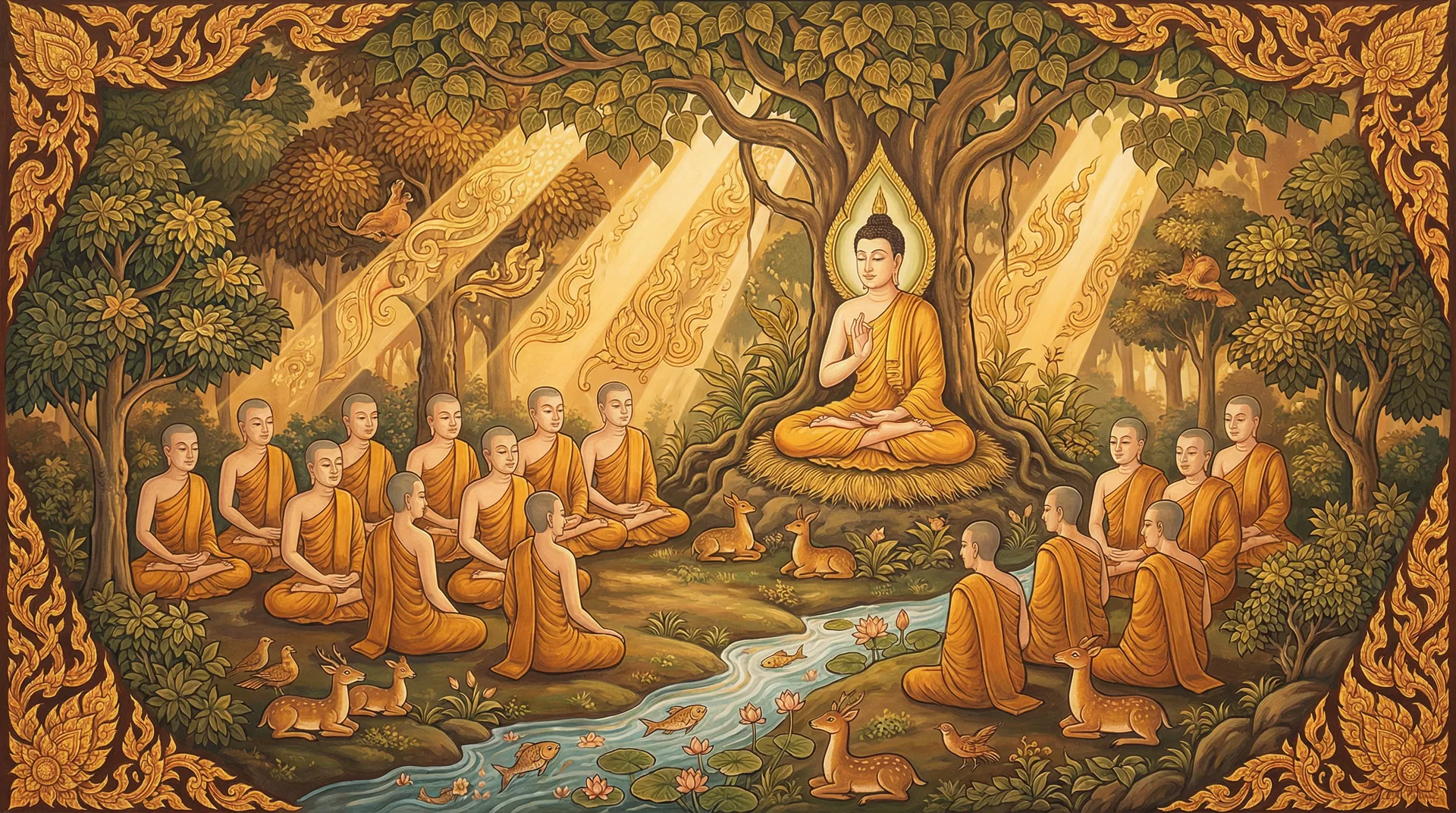
Mahā-susukajātaka
The Tale of the Contented Monkey
In a lush, verdant forest teeming with life, where ancient trees scraped the sky and a crystal-clear river meandered through moss-covered rocks, lived a community of monkeys. They were a boisterous and energetic bunch, their days filled with leaping from branch to branch, chattering incessantly, and squabbling over the ripest fruits. Among them was a young monkey named Susukā, who was known for his unusually cheerful disposition. While his kin often fretted over the scarcity of food or the approach of predators, Susukā seemed to find joy in the simplest of things.
One particularly hot afternoon, as the other monkeys grumbled about the wilting leaves and the lack of sweet berries, Susukā sat on a high branch, his eyes sparkling. He was meticulously grooming his fur, a look of utter contentment on his face. An elder monkey, grizzled and wise, named Bhāradvāja, observed him with a knowing smile.
“Susukā,” Bhāradvāja called out, his voice a low rumble, “you seem unfazed by the heat and the meager pickings today. What is it that brings you such joy?”
Susukā paused his grooming and looked at the elder. “Venerable Bhāradvāja,” he replied, his voice bright, “I find joy in this very moment. The sun warms my fur, the breeze rustles the leaves, and I have this fine fur to preen. What more could a monkey ask for?”
Bhāradvāja chuckled. “You have a rare gift, young one. Most of us are always looking for more – more fruit, a cooler shade, a safer nest. We are rarely satisfied with what we have.”
As days turned into weeks, a severe drought descended upon the forest. The river dwindled to a trickle, the plants drooped, and the fruits became scarce and bitter. The monkeys grew desperate. They chattered anxiously, their usual exuberance replaced by a palpable fear. They spent their days searching fruitlessly for food and water, their bodies growing thin and their spirits low.
Susukā, however, remained remarkably calm. He still found moments of joy. He would find a patch of cool earth to lie in, or enjoy the feel of a smooth stone. He would share his meager findings with others, and his cheerful demeanor seemed to offer a sliver of hope to his distressed community.
One day, driven by hunger and thirst, a group of monkeys, led by a particularly anxious monkey named Lohita, decided to venture beyond the familiar boundaries of their forest. Lohita was always dissatisfied, always believing that happiness lay just over the next hill. “There must be a place with plenty of food and water,” he insisted. “This forest has failed us!”
Susukā watched them go, a gentle sadness in his eyes. “May you find what you seek,” he called out, “but remember, happiness is often found within, not without.”
Lohita and his group traveled for days. They faced treacherous terrain, dodged dangerous predators, and endured scorching sun. They found some food, but it was never enough, and the water sources were unreliable. Exhausted and disheartened, they eventually stumbled upon a vast, barren wasteland. There was nothing but sand and a few withered bushes. Their hope turned to despair.
Meanwhile, back in the forest, Susukā, with his keen observation and careful rationing, managed to survive. He discovered a hidden spring that had not completely dried up, and he learned to identify certain roots that, though not sweet, provided sustenance. He shared his knowledge with the few monkeys who had chosen to stay, including the wise Bhāradvāja. They learned to appreciate the small blessings, finding comfort in each other’s company and the resilience of nature, even in hardship.
One evening, a dejected Lohita and his weary companions, having found nothing but desolation, finally returned to their home forest. They were gaunt, their fur matted, and their spirits broken. To their astonishment, they found their community not in utter ruin, but surviving. They saw Susukā sharing a handful of roots with Bhāradvāja, his face still bearing that characteristic cheerful glow. They saw other monkeys diligently tending to the small, precious spring.
Lohita, humbled and ashamed, approached Susukā. “You were right, Susukā,” he murmured, his voice hoarse. “We searched far and wide for what we thought was happiness, only to find despair. And here, in what we thought was a failing home, you found a way to endure, and even find joy.”
Susukā smiled, a warm, genuine smile. “The forest provided what it could,” he said. “But true contentment, my friend, comes not from abundant riches, but from appreciating the gifts we already possess, no matter how small they may seem. It is a choice we make, to find the good even in difficult times.”
From that day on, the monkeys of the forest learned a valuable lesson. They understood that constant yearning for more often leads to dissatisfaction, while gratitude for what one has fosters true happiness and resilience. Susukā, the contented monkey, became a symbol of inner peace, a reminder that even in the harshest of droughts, the spirit can find nourishment if one chooses to be content.
— In-Article Ad —
💡Moral of the Story
True happiness and contentment are found not in the abundance of external possessions, but in appreciating what one already has and choosing to find joy in the present moment.
Perfection: Contentment and Equanimity
— Ad Space (728x90) —
More Jataka Tales You May Enjoy
 49Ekanipāta
The Bodhisatta as the Bodhi Tree
The Bodhisatta as the Bodhi TreeIn a tranquil corner of the great forest, where the air was thick wi...
💡 True patience and generosity are unwavering, offering sanctuary and life, and inspire others to choose compassion over destruction.
 421Aṭṭhakanipāta
Mūgapakkha Jātaka
Mūgapakkha JātakaIn the heart of the Kosala kingdom, where golden fields stretched to the horizon an...
💡 True strength lies not in the ability to speak or exert force, but in the power of selfless compassion and unwavering sacrifice. Actions, especially those born of immense kindness, speak louder than words.
526MahānipātaMūga-pakkhajātaka
The Tale of the Silent Swan In the ancient kingdom of Mithila, nestled amidst rolling hills and verd...
💡 True wisdom can be cultivated in silence, and the ability to observe and understand is a powerful weapon. Sometimes, the most profound insights come from those who listen more than they speak.
 480Terasanipāta
Vessantara Jataka
Vessantara Jataka In the magnificent kingdom of Siwi, ruled a king named Sañjaya, a monarch of great...
💡 True generosity means sacrificing even the most precious possessions, including one's own children, for the sake of alleviating the suffering of others. This ultimate act of selflessness is the highest form of compassion.
 445Dasakanipāta
Temiyavada Jataka
Temiyavada JatakaIn the kingdom of Supparaka, there was a prince named Temiya. From the moment of hi...
💡 True freedom and peace are found not in worldly possessions or status, but in detachment from suffering and the dedicated pursuit of spiritual liberation.
 487Pakiṇṇakanipāta
Sutasoma Jātaka
Sutasoma JātakaIn the heart of the ancient kingdom of Kampilya, a kingdom famed for its magnificent ...
💡 True strength lies not in violence or the taking of life, but in unwavering compassion, understanding, and the courage to break cycles of suffering through acts of profound kindness and non-violence.
— Multiplex Ad —