Sutasoma Jātaka
Sutasoma Jātaka
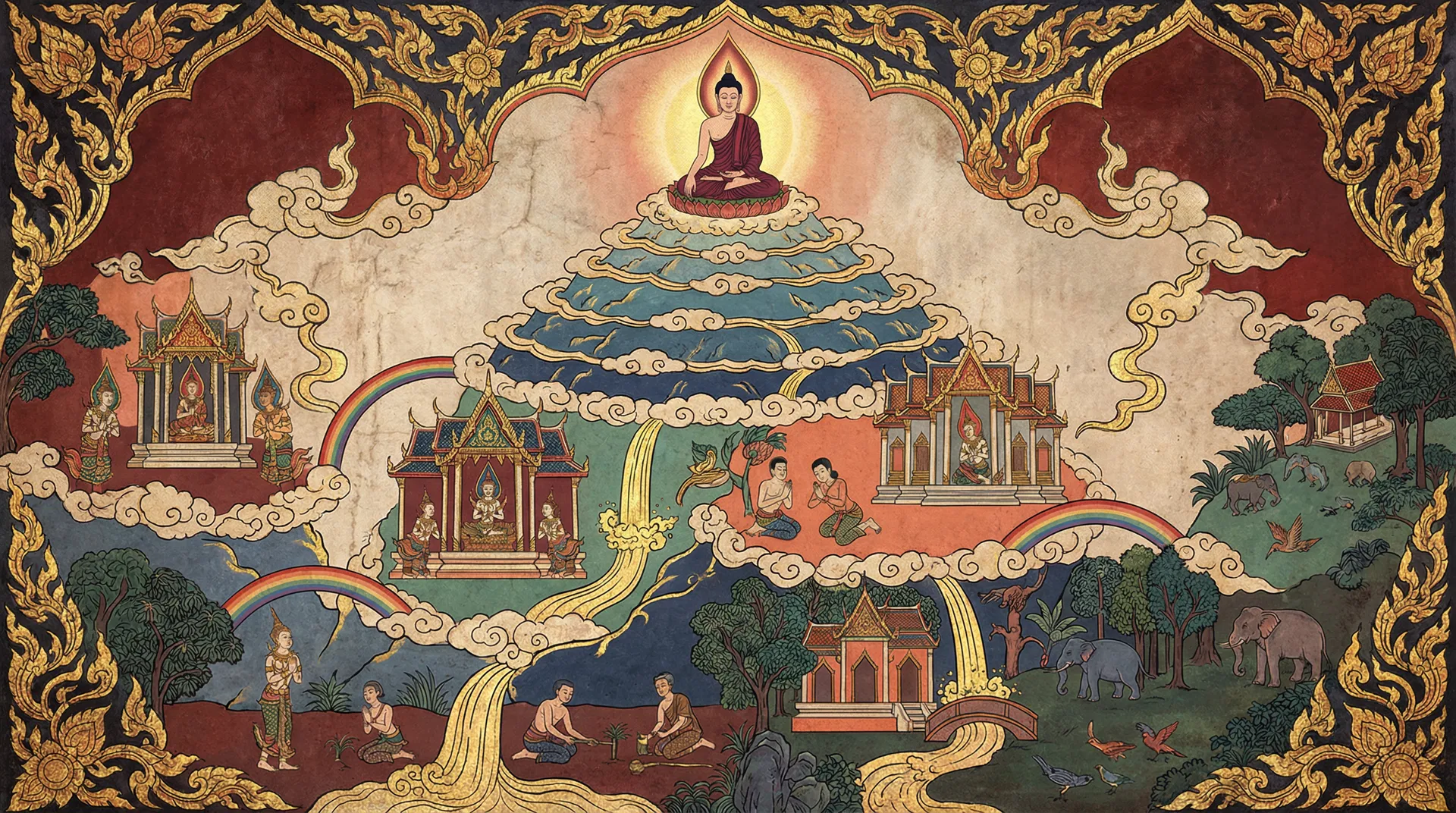
In the heart of the ancient kingdom of Kampilya, a kingdom famed for its magnificent architecture and the vibrant spirit of its people, ruled King Kampilya. He was a just and benevolent ruler, but his reign was shadowed by a deep personal sorrow: he was childless. He yearned for an heir, a continuation of his noble lineage, and his prayers and rituals for a son were incessant.
One fateful night, the Queen dreamt of a magnificent white elephant, adorned with golden tusks, descending from the heavens and entering her womb. When she awoke, she knew in her heart that this was a sign. Soon, she found herself with child. The entire kingdom rejoiced, for the birth of a prince was prophesied to bring an era of unprecedented peace and prosperity.
Nine months later, a prince was born, fair of face and strong of limb. He was named Sutasoma, for his birth was heralded by the gentle trumpeting of elephants, a sound that resonated with auspiciousness. Prince Sutasoma grew to be a young man of extraordinary character. He was not only skilled in warfare and the arts of governance but also possessed a deep compassion for all living beings and an insatiable thirst for knowledge. He spent his days in the royal library, poring over ancient texts, and his evenings in quiet contemplation, seeking to understand the deeper truths of existence.
As Sutasoma matured, his father, King Kampilya, began to prepare him for the throne. He instructed him in the intricacies of statecraft, the delicate art of diplomacy, and the stern necessity of justice. However, Sutasoma, while diligent in his studies, often found himself questioning the traditional approaches to kingship, particularly those that involved the use of force or the subjugation of others. He believed that true strength lay not in power over others, but in the power to uplift and to heal.
One day, a delegation of Brahmins arrived at the royal court. They were learned scholars, but their hearts were filled with a cruel superstition. They told the King that to ensure the continued prosperity and longevity of the kingdom, a grand sacrifice was required. This sacrifice, they declared, involved the ritualistic offering of a thousand innocent lives to appease the gods.
King Kampilya, though a just ruler, was deeply traditional and the fear of losing his kingdom’s favor weighed heavily upon him. He was on the verge of agreeing to the Brahmins’ horrific request when Prince Sutasoma intervened.
“Father,” Sutasoma said, his voice resonating with quiet authority, “this is a barbaric and senseless act. How can the gods, who are benevolent, be appeased by the shedding of innocent blood? True devotion lies not in violence, but in compassion and understanding.”
The Brahmins, angered by the Prince’s defiance, turned on him. “You are but a young fool!” one of them spat. “You know nothing of the ancient ways. This sacrifice is essential for the kingdom’s well-being. If you oppose it, you bring ruin upon us all!”
Sutasoma, unfazed, met their angry gazes with a calm smile. “I will not stand by while innocent lives are extinguished for the sake of blind faith. If a sacrifice is truly needed, then I myself shall offer it.”
The Brahmins, seeing an opportunity, seized upon his words. They declared that the Prince himself was the only worthy offering. King Kampilya was aghast. He pleaded with his son to reconsider, but Sutasoma’s resolve was unshakable. He saw this as his ultimate test, an opportunity to demonstrate the profound truth that non-violence and compassion were the highest forms of sacrifice.
“Let it be so,” Sutasoma declared to the stunned court. “I shall offer myself as the sacrifice. But I ask for one condition: that this be the last such sacrifice ever performed in this kingdom. Let my life be the one that breaks the cycle of violence.”
The Brahmins, triumphant, agreed. The day of the ritual arrived, and the kingdom was plunged into a somber mood. The sacrificial altar was prepared, and Prince Sutasoma, clad in white robes, was led to the center. The Brahmins chanted their ancient incantations, their faces alight with a cruel anticipation.
As the moment of the “sacrifice” approached, Sutasoma closed his eyes. He did not fear death. Instead, he focused his mind on cultivating boundless compassion for all beings, for the Brahmins who sought his life, for his father who grieved, and for the kingdom he was sworn to protect. He envisioned a world free from violence and suffering.
Suddenly, as the sacred knife was about to descend, a blinding light filled the hall. The ground trembled, and the Brahmins cried out in fear. From the heavens, a majestic voice boomed, “Enough! Your compassion has reached the highest heavens. The cycle of violence is broken.”
The light subsided, and the Brahmins found themselves unharmed. Prince Sutasoma stood before them, his eyes shining with an inner radiance. The cruel knife lay shattered on the ground. The Brahmins, humbled and awestruck, fell to their knees. They realized that Sutasoma’s true sacrifice was not his life, but his unwavering commitment to non-violence and his ability to radiate such profound compassion that it transformed the hearts of his would-be executioners.
King Kampilya rushed to embrace his son, tears of joy streaming down his face. The kingdom rejoiced, not in a victory of arms, but in the triumph of peace and compassion. Prince Sutasoma had not only saved his own life but had also shown them a higher path, a path where true strength lay in empathy and understanding, not in bloodshed.
From that day forward, the kingdom of Kampilya became known as a land of peace. The practice of animal sacrifice was abolished, and compassion became the guiding principle of its governance. Prince Sutasoma, upon ascending the throne, ruled with wisdom and kindness, always remembering the profound lesson learned on the sacrificial altar. He taught his people that the greatest sacrifice is not the giving of one’s life, but the giving of one’s heart, filled with love and understanding for all sentient beings.
— In-Article Ad —
💡Moral of the Story
True strength lies not in violence or the taking of life, but in unwavering compassion, understanding, and the courage to break cycles of suffering through acts of profound kindness and non-violence.
Perfection: Compassion (Karunā) and Non-violence (Ahiṃsā)
— Ad Space (728x90) —
More Jataka Tales You May Enjoy
 546Mahānipāta
Mūkapacca Jātaka
The Tale of the Mute Pacce In the ancient city of Mithila, nestled beside the shimmering river Ganda...
💡 True strength lies not in the ability to speak or shout, but in the power of silent compassion and understanding, which can overcome even the most profound despair.
 66Ekanipāta
The Great Crane Jataka
Long ago, in an age when the Buddha had not yet appeared, in a time immeasurably distant, the Bodhis...
💡 True wealth is measured not by the abundance of possessions, but by the happiness and prosperity of one's people. Greed leads to suffering, while generosity and compassion bring true prosperity.
 181Dukanipāta
Pañcabrāhmaṇa Jātaka
The Tale of the Five BrahminsIn the ancient city of Mithila, nestled beside the gently flowing Gange...
💡 True wisdom lies not in the accumulation of knowledge, but in self-understanding, humility, cooperation, and the courage to overcome inner fears. Superficial learning is useless without inner strength and practical application.
143EkanipātaSasa Jataka
The Tale of the Hare Who Gave Himself to the Gods In a time long past, when the Bodhisattva was born...
💡 Selfless sacrifice and compassion for all beings are the highest virtues.
27EkanipātaThe Bodhisatta as a Deer King
The Bodhisatta as a Deer KingIn the heart of a verdant forest, where ancient trees stood sentinel an...
💡 True courage and leadership are demonstrated through selfless sacrifice for the well-being of others.
176DukanipātaMahāsuka Jātaka
Mahāsuka JātakaIn the ancient city of Mithila, nestled amidst lush gardens and bustling marketplaces...
💡 True happiness is not found in external possessions or fleeting pleasures, but in the cultivation of inner peace, wisdom, and virtue. The greatest treasure is the joy of a contented mind, free from the bondage of insatiable desires.
— Multiplex Ad —