Avasaka Jataka
The Bodhisattva's Unwavering Resolve
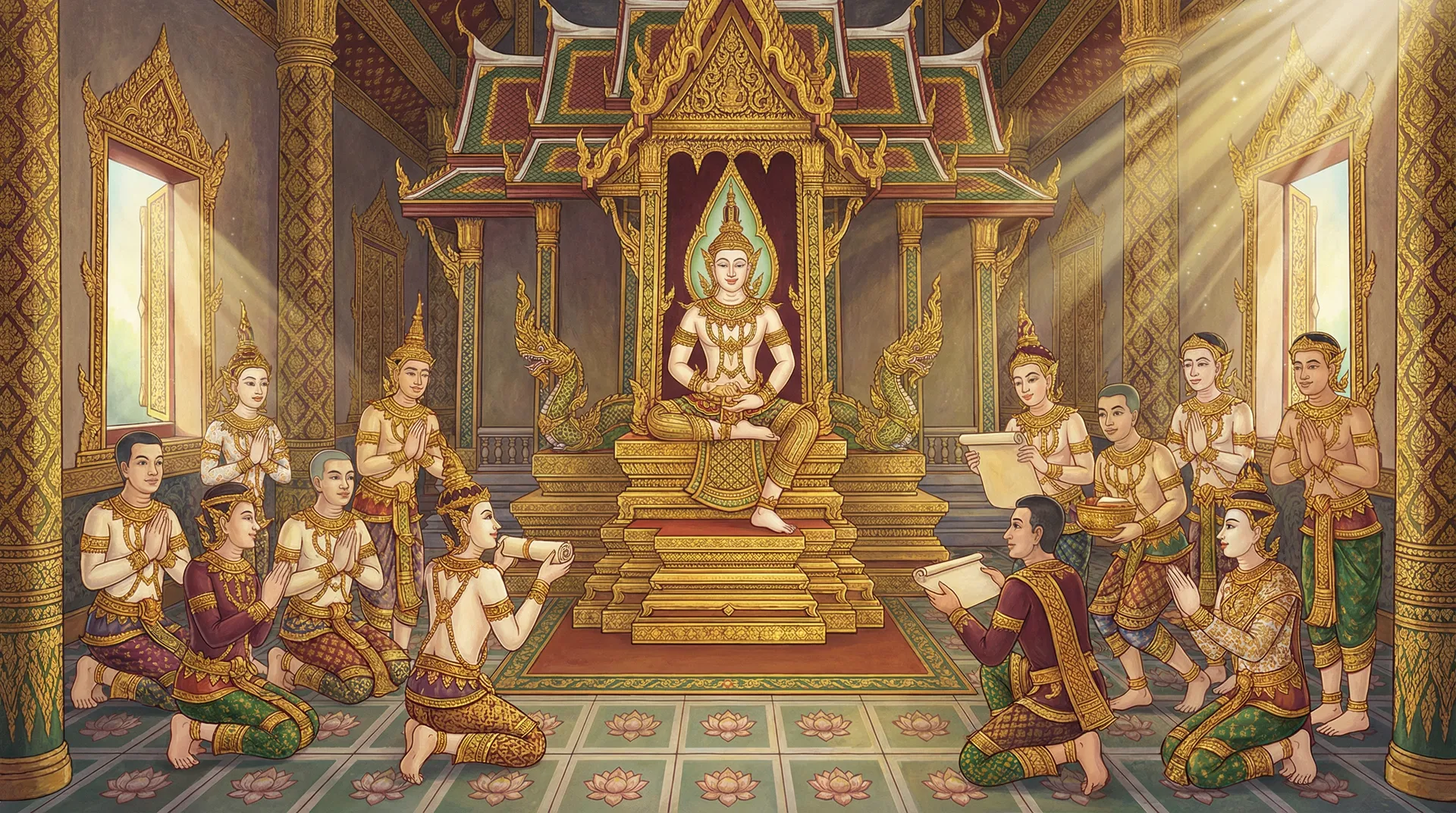
In a kingdom renowned for its prosperity and the wisdom of its ruler, the Bodhisattva was born as the king's own son, Prince Sattadhana. From his earliest years, Prince Sattadhana exhibited an extraordinary sense of duty and a deep commitment to righteousness. He possessed a keen mind, a compassionate heart, and an unwavering resolve to uphold justice and alleviate suffering.
As he matured, the King, impressed by his son's virtues, began to delegate more responsibilities to him. Prince Sattadhana handled every task with diligence and integrity, earning the respect and admiration of the entire kingdom. He oversaw the welfare of the people, ensured fair trade, and resolved disputes with impartiality. Yet, despite his impeccable conduct, a whisper of doubt began to spread among some of the courtiers. They spoke of his unwavering adherence to duty, his refusal to compromise even on minor matters, and his seemingly relentless pursuit of perfection.
One particularly ambitious and unscrupulous minister, known for his cunning and his desire for power, saw an opportunity in these whispers. He approached the King, his face a mask of grave concern. "Your Majesty," he began, his voice dripping with feigned sincerity, "your son, Prince Sattadhana, is a man of great virtue. However, his rigidity is a cause for concern. He adheres so strictly to his duties that he allows no room for flexibility. In governance, one must sometimes bend the rules, make exceptions, for the good of the kingdom, or for personal gain. His absolute adherence to what he perceives as right may one day lead to conflict or hardship."
The King, though wise, was also human and susceptible to subtle manipulation. He loved his son dearly but began to feel a prickle of unease. He summoned Prince Sattadhana to his chambers. "My son," the King said, his brow furrowed, "I have heard that your adherence to duty is so absolute that it leaves no room for compassion or practical consideration. Is it true that you refuse to bend even slightly from your path, no matter the circumstances?"
Prince Sattadhana, with his usual calm demeanor, bowed respectfully. "Father," he replied, his voice steady and clear, "my adherence to duty is not born of inflexibility, but of a deep understanding of the principles of righteousness. To bend the rules for personal gain or convenience is to erode the very foundation of justice. If I were to make exceptions today, where would I draw the line tomorrow? The path of righteousness may seem arduous, but it is the only path that leads to true peace and prosperity for all."
The King, still influenced by the minister's words, was not entirely convinced. He decided to test his son. He summoned the Prince and said, "Sattadhana, there is a matter of great importance. A delegation from a neighboring kingdom is arriving, and they have requested a lavish banquet in their honor. The royal treasury is currently depleted due to recent famines and public works. I need you to ensure this banquet is held, but you must do so without exceeding the allocated budget, which is meager. If you fail, our kingdom's reputation will suffer."
The minister, smugly confident, believed this was an impossible task. He envisioned the Prince struggling, making compromises, perhaps even resorting to questionable means to fulfill the King's command. He had secretly ensured that the allocated budget was indeed insufficient for a truly grand banquet.
Prince Sattadhana accepted the challenge without hesitation. He understood the King's unspoken doubt and the minister's hidden agenda. He knew that he could not compromise the principles of honesty and integrity. He spent days deliberating, not on how to cheat or deceive, but on how to fulfill the request with absolute integrity.
He devised a brilliant plan. Instead of focusing on extravagant food and decorations, he organized a banquet of knowledge and cultural exchange. He invited the finest scholars, artists, and musicians from within his own kingdom to present their talents and share their wisdom with the visiting delegation. The feast itself was simple but wholesome, prepared with fresh, locally sourced ingredients. The entertainment was not one of boisterous revelry, but of intellectual discourse and artistic appreciation.
When the delegation arrived, they were initially surprised by the understated nature of the feast. However, as the evening unfolded, they were captivated by the intellectual stimulation and the genuine warmth of the hospitality. They engaged in lively debates with the scholars, admired the exquisite artistry, and were moved by the melodic performances. They left not with tales of excessive indulgence, but with profound respect for the intellectual and cultural richness of the kingdom.
The King, witnessing the success of the banquet, was deeply moved. He saw that his son had not compromised his principles, yet had achieved a result far more valuable than mere opulence. He realized that true excellence lay not in bending rules, but in finding ingenious ways to uphold them with unwavering integrity. The minister, witnessing the Prince's triumph, slunk away in shame, his machinations exposed.
From that day forward, Prince Sattadhana's reputation as a just and righteous leader was solidified. He continued to rule with unwavering resolve, demonstrating that true strength lies not in compromise, but in steadfast adherence to virtue, even when faced with challenges and skepticism.
— In-Article Ad —
💡Moral of the Story
Upholding principles of righteousness and integrity, even in the face of challenges and skepticism, leads to true and lasting success. Ingenuity within ethical boundaries can achieve greater results than compromise.
Perfection: Resolve (Adhithana)
— Ad Space (728x90) —
More Jataka Tales You May Enjoy
 331Catukkanipāta
Mūgapakkha Jātaka
Mūgapakkha JātakaIn the sun-drenched land of Mithila, ruled a king named Brahmadatta, a monarch whos...
💡 True wisdom is revealed not through eloquent speech, but through careful observation, strategic patience, and decisive action.
 452Dasakanipāta
Sattigumba Jātaka
The Spear-Bearer's Grove Jātaka (Sattigumba Jātaka) In the flourishing kingdom of Kosala, lived a pr...
💡 True solutions often lie in understanding and working with nature's principles, rather than resorting to superficial rituals or force. Resourcefulness, respect for natural balance, and equitable sharing are key to overcoming hardship.
 136Ekanipāta
Panchavudha Jataka
The Tale of the Five WeaponsIn the ancient city of Varanasi, nestled beside the sacred Ganges River,...
💡 True fulfillment and invincibility are not found in external possessions or power, but in the cultivation of inner virtues like truth, compassion, generosity, patience, and wisdom.
 383Chakkanipāta
Nemi Jātaka
Nemi Jātaka In the glorious city of Mithila, renowned for its magnificent architecture and the wisdo...
💡 Understanding the consequences of actions (karma) through a clear vision of heavens and hells strengthens one's resolve to live a virtuous life and seek liberation from the cycle of rebirth.
 195Dukanipāta
Mahanaradajataka
Mahanaradajataka In the magnificent city of Indrapura, ruled a wise and benevolent king named Brahma...
💡 True enlightenment and ultimate happiness are found not in external pursuits or mythical treasures, but within the awakened mind. Wisdom is the key that unlocks the door to liberation, enabling us to overcome internal obstacles and realize our true nature.
22EkanipātaThe Bodhisatta as a Skilled Physician
The Bodhisatta as a Skilled PhysicianIn the ancient city of Varanasi, renowned for its spiritual lea...
💡 True skill and compassion, combined with determination, can overcome formidable obstacles and bring about healing.
— Multiplex Ad —