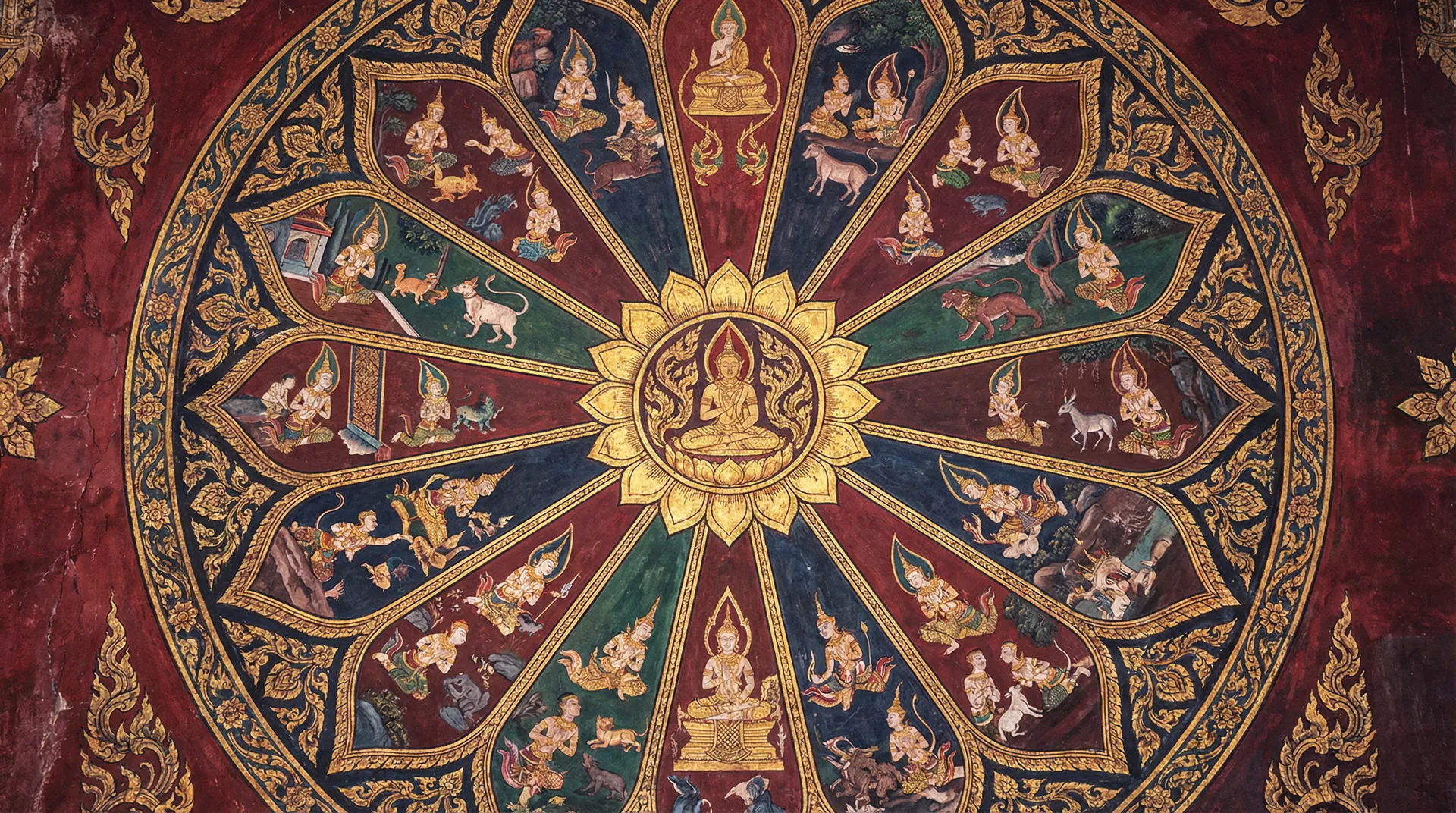
Kusa Jataka
The Prince Who Endured Hardship for Love
Long ago, in the opulent kingdom of Kosala, lived a prince named Bodhisattva, renowned for his virtue and his deep love for his wife, Princess Padmavati. Their union was one of pure bliss, a beacon of happiness for all who witnessed it. However, destiny, as it often does, had a cruel twist in store. The king, Padmavati’s father, a man consumed by pride and a twisted sense of honor, found himself in a bitter feud with the king of Kosala.
The conflict escalated, and in a moment of rash anger, the king of Padmavati’s kingdom declared war. The king of Kosala, a formidable warrior, emerged victorious. In the aftermath, driven by a desire for retribution and a misguided belief that humiliation would teach the vanquished king a lesson, he demanded a steep price for peace. He decreed that the princess, Padmavati, his own daughter-in-law, must be exiled and wander in the wilderness for seven years, her beauty and virtue to be tested by the harsh elements and the solitude of the forest.
Prince Bodhisattva was heartbroken. He pleaded with his father, the king of Kosala, to reconsider, but his pleas fell on deaf ears. The king, bound by his word and his pride, refused to yield. Padmavati, though deeply distressed, accepted her fate with grace and fortitude. With a heavy heart, Prince Bodhisattva watched as his beloved wife, clad in simple garments, was led away into the unforgiving wilderness.
The prince, unable to bear the thought of his beloved suffering alone, secretly vowed to find her and support her from afar. He disguised himself as a humble ascetic, taking on the appearance of a wanderer. He shed his princely robes, cut his hair, and smeared his body with ash, leaving behind the comforts of his palace to embark on a solitary quest.
For seven long years, Prince Bodhisattva wandered through dense forests, climbed treacherous mountains, and navigated desolate plains. He endured hunger, thirst, and the biting cold. His only companion was the burning desire to protect his wife and ensure her well-being. He would often find traces of her presence – a discarded flower, a footprint, a faint scent – and his heart would swell with a mixture of sorrow and renewed determination. He would leave behind small offerings of food or shelter, subtle signs of his care that she might never know were from him.
Meanwhile, Princess Padmavati, though alone, did not despair. Guided by her inner strength and the teachings of the Dhamma, she found solace in nature. She learned to forage for edible roots and berries, to find shelter in caves, and to live in harmony with the wild creatures. Her spirit remained unbroken, her virtue untainted. She often thought of her beloved husband, praying for his well-being and for the day their ordeal would end.
The seven years passed agonizingly slowly. Prince Bodhisattva, now gaunt and weathered, his princely bearing hidden beneath layers of ascetic garb, finally heard whispers of a woman matching Padmavati’s description living in a secluded part of the forest. His heart pounded with anticipation. He followed the trail, his steps quickening with every passing moment.
He found her near a crystal-clear stream, her beauty undimmed by her hardships, her spirit radiant. She was weaving a garland of flowers, her fingers moving with practiced ease. He approached her cautiously, his ascetic disguise still in place. He addressed her with a respectful greeting, and though he looked like a stranger, there was an undeniable familiarity in his eyes. Padmavati, though surprised, felt a strange sense of comfort in his presence.
They spoke for a while, and Bodhisattva, unable to contain his emotions any longer, revealed his true identity. Padmavati’s eyes widened in disbelief, then filled with tears of joy. The reunion was one of profound emotion, a testament to their enduring love. They embraced, their hearts overflowing with gratitude for their reunion and for the strength they had found within themselves.
Upon their return to Kosala, the king of Kosala was deeply ashamed of his past cruelty. He welcomed them back with open arms, offering his deepest apologies. Prince Bodhisattva and Princess Padmavati, their love tested and strengthened by their seven-year ordeal, ruled the kingdom with wisdom, compassion, and a profound understanding of suffering, becoming an inspiration to their people and a living testament to the power of unwavering devotion.
— In-Article Ad —
💡Moral of the Story
True love endures all trials and tribulations. Compassion and understanding are paramount in overcoming conflict and bitterness.
Perfection: Compassion, Patience, Determination
— Ad Space (728x90) —
More Jataka Tales You May Enjoy
 533Mahānipāta
Kusa Jātaka
Kusa JātakaIn the ancient kingdom of Kampilla, ruled a just and virtuous king named Okkāka. His reig...
💡 Integrity and truth will always prevail over deceit and envy. True nobility lies not in birthright, but in character, compassion, and the unwavering commitment to justice, even when faced with personal adversity.
 427Navakanipāta
Sakuna Jataka
The Tale of the Virtuous Bird In the heart of a dense forest, where ancient trees reached for the sk...
💡 Compassion, selflessness, and the accumulation of spiritual merit have the power to overcome great adversity and benefit all beings. In times of crisis, unity and shared good deeds are far more powerful than anger and division.
435NavakanipātaSaddanta Jataka
Saddanta JatakaIn the magnificent city of Pupphavati, renowned for its vibrant marketplaces and perf...
💡 True generosity lies in selfless giving, even at great personal cost. Compassion and forgiveness can transform even the most greedy and envious hearts, leading to spiritual awakening.
 426Aṭṭhakanipāta
Mugapakkha Jataka
The Tale of the Muzzled Ox In the ancient city of Mithila, nestled amidst lush gardens and bustling ...
💡 True salvation comes not from superstitious rituals or sacrifices, but from cultivating wisdom, compassion, and living in harmony with the natural world. Our actions, our understanding, and our respect for life are what truly bring about prosperity and balance.
424AṭṭhakanipātaSarabhaṅga Jātaka
Sarabhaṅga JātakaIn the ancient land of Gandhāra, nestled amidst snow-capped mountains and whisperin...
💡 True peace is cultivated from within and achieved through understanding, compassion, and wisdom, not through violence or the imposition of power. Inner resilience is the greatest defense against external aggression.
433NavakanipātaNimi Jataka
Nimi JatakaIn the vibrant city of Mithila, nestled beside a flowing river and surrounded by fragrant...
💡 Virtuous actions and the cultivation of merit lead to happiness and favorable rebirths. True leadership involves not only ruling justly but also guiding one's people towards spiritual understanding and well-being.
— Multiplex Ad —