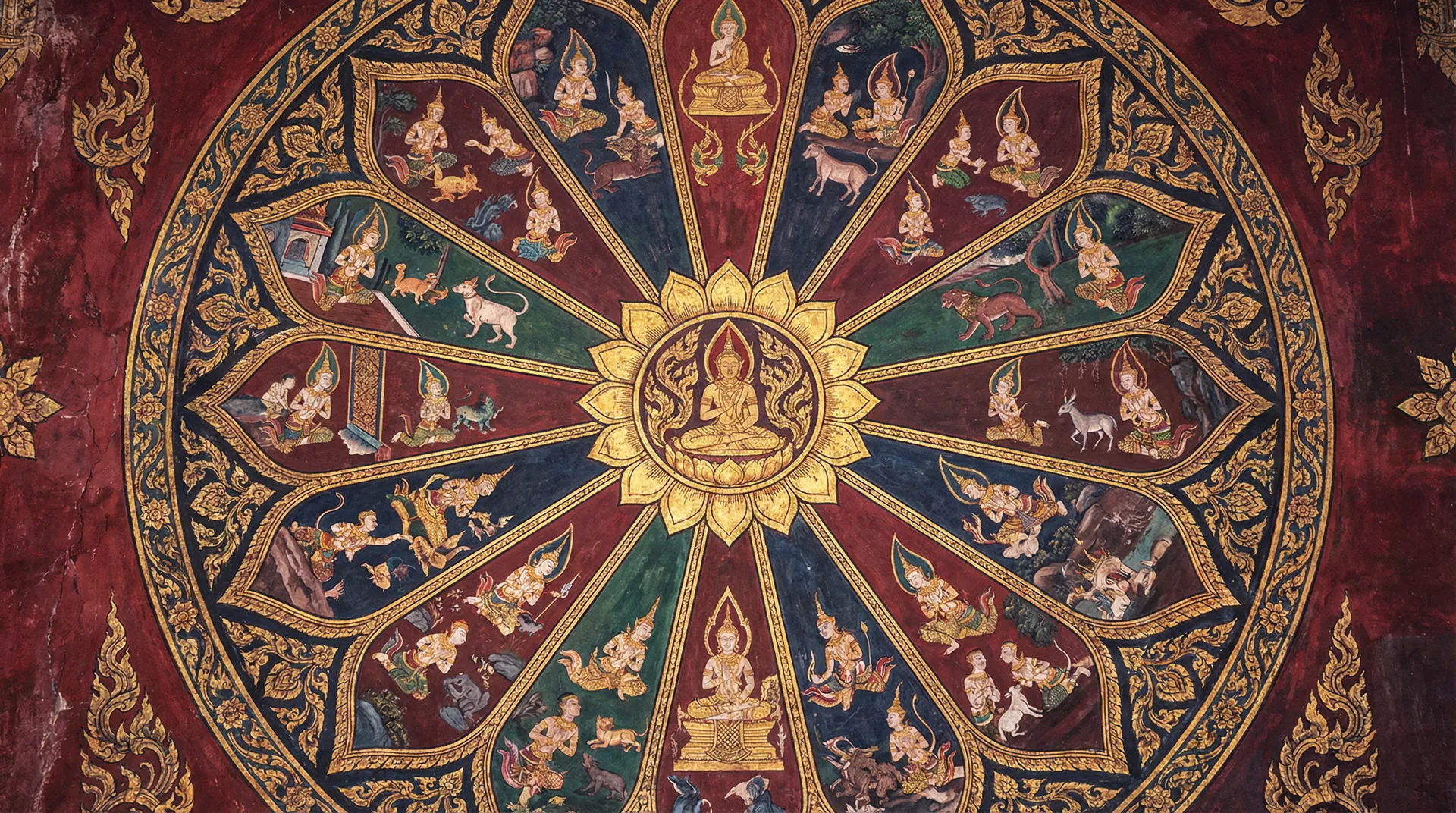
Mahasutasoma Jataka
The Virtuous Prince and the Cannibal King
In a land far away, nestled between towering mountains and a shimmering sea, lay the kingdom of Maddra. Its king was a just and wise ruler, but his heart was heavy with a growing concern for his son, Prince Bodhisattva. The prince, though noble and compassionate, had a singular fascination: he was deeply intrigued by the concept of sacrifice and the lengths to which some beings would go for their beliefs, however misguided.
This fascination, while born of a desire to understand, inadvertently drew the attention of a dark force. In a neighboring, more savage land, ruled a fearsome king known only as King Kalabhu. This king was not like other rulers; he was a flesh-eater, his reign marked by terror and a voracious appetite for human flesh. His kingdom was a place of dread, and his reputation for cruelty spread like wildfire.
One day, a delegation from Maddra, led by Prince Bodhisattva himself, traveled to the neighboring kingdom on a diplomatic mission. The prince, driven by his insatiable curiosity and a misguided sense of intellectual pursuit, had agreed to meet King Kalabhu, hoping to understand the depths of his depravity. The king of Maddra, though apprehensive, could not dissuade his determined son.
Upon their arrival, King Kalabhu, his eyes gleaming with a predatory hunger, greeted the delegation. However, he saw in Prince Bodhisattva not a diplomat, but a potential feast. As the talks progressed, Kalabhu, with cunning words, lured the prince away from the rest of his retinue. He led the prince to a secluded part of his palace, where the air was thick with the scent of blood and despair.
'Prince,' Kalabhu hissed, his voice like the scraping of stones, 'your kingdom is prosperous, your people live in comfort. Yet, you seek to understand me? Let me show you true understanding. You shall be my final meal, and in that sacrifice, you will truly comprehend the nature of existence and the ultimate offering.'
Prince Bodhisattva, though shocked, did not cower. He realized the grave danger he was in, but he also saw an opportunity. He remembered the teachings of the Dhamma, the principles of compassion and non-violence. He knew that even in the face of death, he must uphold these values.
'King Kalabhu,' the prince replied calmly, his voice steady despite the fear that clawed at his heart, 'I understand your hunger. But I am not merely a meal. I am a prince, bound by duty and compassion. If you truly wish to understand sacrifice, then let me offer you a different kind of offering. Grant me my freedom for a short time, and I will return to my kingdom, gather the choicest of my father’s cattle, and bring them back to you as a tribute. This will be a sacrifice of abundance, not of a single life.'
Kalabhu, intrigued by the prince's audacity and the prospect of a feast of cattle, agreed. 'You have three days, prince. If you do not return, I shall hunt you down and consume your flesh and that of your entire delegation.'
Prince Bodhisattva, with a heavy heart but a clear mind, was released. He rode back to Maddra with all speed. Upon his arrival, he explained the dire situation to his father. The king, though horrified, saw the wisdom in his son’s plan. They immediately set about gathering the finest cattle, preparing them for the journey.
However, as they were preparing the tribute, a messenger arrived with devastating news: King Kalabhu, impatient and suspicious, had ordered the immediate execution of the entire Maddran delegation that remained in his kingdom. The prince’s heart sank. He had failed. His attempt to save his people through a sacrifice of cattle had only hastened their demise.
Driven by a profound sense of responsibility and a desperate need to atone, Prince Bodhisattva made a solemn vow. He would return to King Kalabhu, not with cattle, but as the offering himself. He would face the cannibal king and, through his own sacrifice, demonstrate the true meaning of compassion and the futility of violence.
He rode back alone, his heart filled with a mixture of sorrow and unwavering resolve. He found King Kalabhu preparing to feast on the bodies of the Maddran envoys. The sight was gruesome, and the prince’s resolve hardened.
'King Kalabhu!' he cried out, his voice echoing in the hall of feasting. 'I have returned. Take me. Consume me. My life is yours. But know this: in taking my life, you gain nothing but temporary satisfaction. True fulfillment comes not from the suffering of others, but from compassion and understanding.'
Kalabhu, taken aback by the prince’s fearless return and his eloquent plea, paused. He looked at the prince, then at the gruesome feast before him. For the first time, a flicker of doubt entered his mind. The prince’s unwavering courage and his selfless offering seemed to expose the hollowness of his own violent existence.
He lowered his cleaver. 'Prince,' he said, his voice rough, 'you are a fool to return to face death. Yet, there is a strange nobility in your act. I have never encountered such bravery, such a willingness to sacrifice for others.' The prince’s words, coupled with his extraordinary act, had struck a chord within the cannibal king.
In that moment, King Kalabhu’s heart began to change. He saw the futility of his ways, the endless cycle of violence and suffering he perpetuated. He renounced his cannibalistic ways, his cruelty, and his reign of terror. He released the surviving members of the delegation and, with the prince’s guidance, began to rule his kingdom with a semblance of justice and compassion.
Prince Bodhisattva, having saved his people and transformed a monstrous king, returned to Maddra a hero. He had faced the darkest of human desires and emerged victorious, not through force, but through an unwavering commitment to truth, compassion, and self-sacrifice.
— In-Article Ad —
💡Moral of the Story
True courage lies in facing evil with compassion and wisdom, rather than with violence. Self-sacrifice for the sake of others can lead to profound transformation.
Perfection: Compassion, Truthfulness, Sacrifice
— Ad Space (728x90) —
More Jataka Tales You May Enjoy
 418Aṭṭhakanipāta
Assaka Jataka
The Tale of the Valiant HorseIn the prosperous kingdom of Mithila, ruled a king known for his opulen...
💡 Courage and loyalty are more powerful than brute strength. A brave heart can overcome any obstacle.
 93Ekanipāta
Assaka Jataka
Assaka JatakaIn the ancient kingdom of Kasi, nestled beside the gentle flow of the River Ganges, sto...
💡 True generosity requires discernment. One must be careful not to be deceived by outward appearances or false piety, ensuring that one's charitable acts benefit those who are genuinely in need.
 248Dukanipāta
Katthahari Jataka
Katthahari JatakaIn the bustling city of Savatthi, there lived a woodcutter named Katthahari. He was...
💡 Selfless compassion, even towards the smallest creatures and when faced with personal temptation, is a virtue that brings great rewards and blessings.
39EkanipātaThe Tale of the Proud Peacock
In a time long past, in the glorious city of Benares, King Brahmadatta ruled wisely. One day, as the...
💡 Wisdom and discernment, coupled with unwavering truthfulness, can expose deception and safeguard against manipulation.
181DukanipātaPañcabrāhmaṇa Jātaka
The Tale of the Five BrahminsIn the ancient city of Mithila, nestled beside the gently flowing Gange...
💡 True wisdom lies not in the accumulation of knowledge, but in self-understanding, humility, cooperation, and the courage to overcome inner fears. Superficial learning is useless without inner strength and practical application.
167DukanipātaKumbha Jātaka
Kumbha JātakaIn the ancient city of Mithila, where bustling markets teemed with exotic goods and gra...
💡 True security and happiness are found not in hoarding possessions, but in generosity and sharing with others, especially during times of need.
— Multiplex Ad —