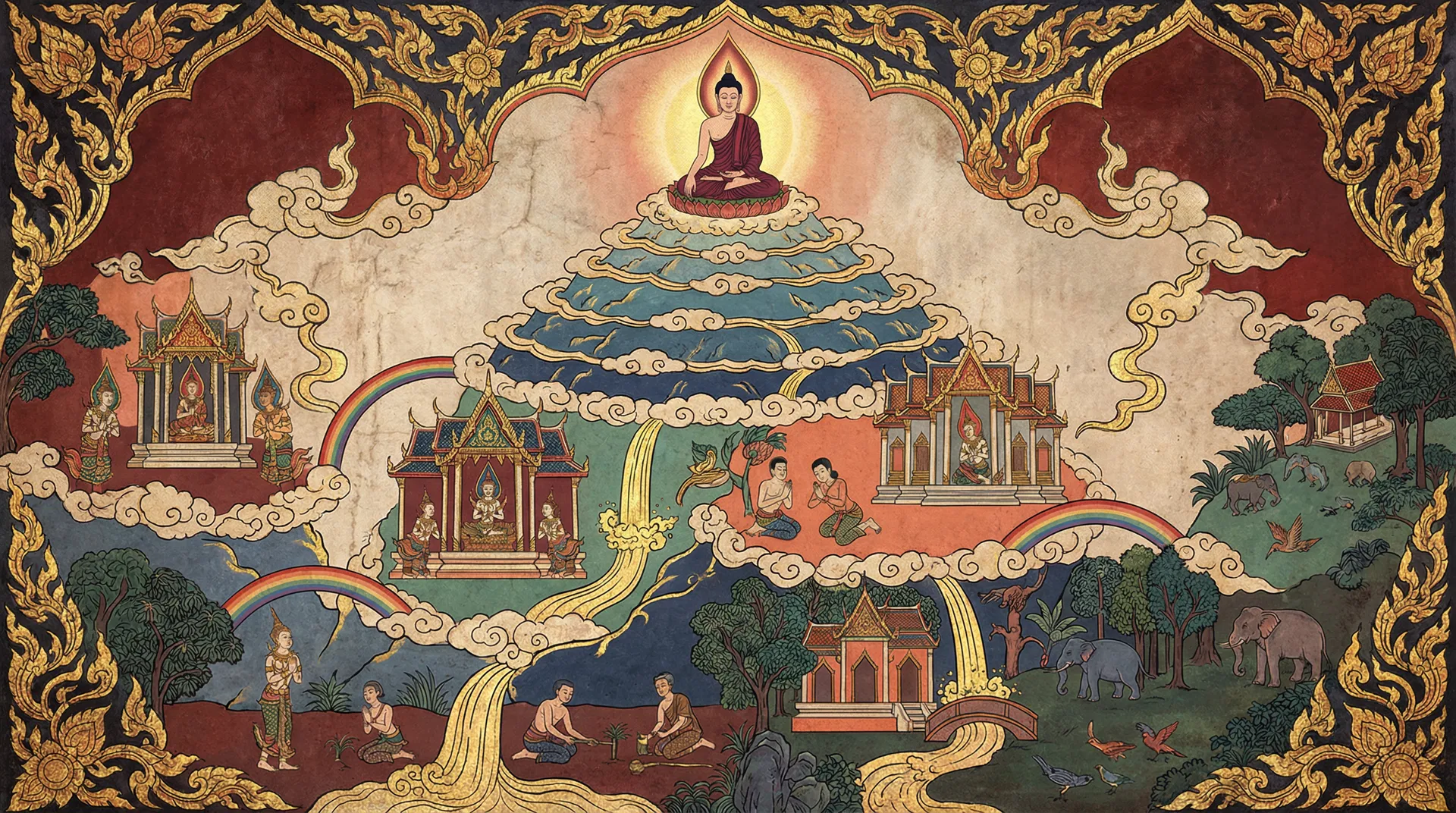
Sattigumba Jātaka
Sattigumba Jātaka
In the bustling city of Savatthi, renowned for its vibrant markets and the wisdom of its enlightened teachers, lived a wealthy merchant named Anathapindika. He was a man of immense generosity and deep faith, known throughout the land for his boundless charity. Yet, even in a life filled with such virtue, challenges arose, testing the resilience of his spirit.
One day, Anathapindika embarked on a trading expedition to a distant land. He traveled with a caravan of goods, his heart filled with anticipation for the business ahead and the opportunity to further practice his generosity. However, along the treacherous mountain passes, his caravan was ambushed by a band of ruthless robbers. These were not ordinary thieves; they were known as the ‘Sattigumba,’ the Spear-Graspers, a notorious group who used their sharp spears to disable travelers and seize their belongings.
The merchants, though brave, were no match for the ferocity and skill of the Sattigumba. Many were injured, and their precious cargo was plundered. Anathapindika, despite his own peril, did not succumb to despair. He observed the robbers’ tactics, their reliance on sudden, violent attacks, and their subsequent greed.
After the initial assault, the robbers, believing they had secured their prize, began to divide the spoils amongst themselves. This is where Anathapindika saw his opportunity. He noticed that in their haste and excitement, the robbers became less vigilant. Their spears, which were their primary weapons, were often laid aside as they rummaged through the goods.
Anathapindika, a man of quick wit and immense courage, devised a plan. He gathered the remaining merchants, who were dejected and fearful. “My friends,” he said, his voice steady despite the danger, “we have been grievously wronged. But despair is a luxury we cannot afford. These robbers rely on fear and surprise. Now, in their greed, they have let down their guard. We must use this moment.”
He proposed that they use the very goods that had been plundered to their advantage. They gathered sturdy ropes, lengths of cloth, and even some of the heavier merchandise. Under Anathapindika’s direction, they began to fashion makeshift nets and barricades, strategically placing them in the narrow mountain passes where the Sattigumba would have to pass to make their escape.
As the robbers, laden with their stolen wealth, attempted to flee through the treacherous paths, they were met with the merchants’ ingenious traps. The ropes, expertly cast, entangled their legs. The cloth, soaked with water from their own stolen barrels, made the ground slippery. The barricades, fashioned from crates and sacks, forced them to slow down and navigate carefully.
The Sattigumba, accustomed to swift and brutal attacks, found themselves disoriented and ensnared. Their spears, once so effective, were now a hindrance as they struggled to move through the improvised obstacles. The merchants, emboldened by their success, emerged from their hiding places, not to fight, but to reclaim their goods with firm resolve.
Anathapindika, at the forefront, confronted the lead robber. “You have taken what is not yours,” he declared, his voice ringing with righteous authority. “You rely on violence and fear. But true strength lies not in the sharpness of a spear, but in the cleverness of the mind and the courage of a determined heart.”
The robbers, caught off guard and unable to maneuver effectively, were disarmed. Anathapindika, true to his nature, did not seek revenge. Instead, he offered the robbers a choice: they could either face the King’s justice, or they could renounce their violent ways and work to repay their debt through honest labor. He proposed that they help rebuild the damaged caravan and assist in transporting the goods to their destination, earning a fair wage for their efforts.
Surprisingly, many of the Sattigumba, humbled by their defeat and touched by Anathapindika’s unexpected magnanimity, chose the latter. They realized that their life of crime had brought them nothing but fear and instability, while the merchant’s approach offered a path to redemption and a more secure future.
Anathapindika, with the help of the reformed robbers and his loyal merchants, successfully completed his journey. The goods were delivered, and the business was concluded. Upon his return to Savatthi, he shared the story of his encounter, not as a tale of violence averted, but as an example of how cleverness, courage, and compassion could transform even the most hardened criminals.
His act of turning adversaries into allies became a testament to his unwavering belief in the power of rehabilitation and the inherent goodness that could be awakened in every being, regardless of their past actions. The Sattigumba, forever changed by Anathapindika’s wisdom and kindness, abandoned their old ways, and many became respectable members of society, contributing to the prosperity of the land.
— In-Article Ad —
💡Moral of the Story
Cleverness, courage, and strategic thinking can overcome brute force, and compassion coupled with an opportunity for redemption can transform even the most hardened adversaries into contributors to society.
Perfection: Wisdom (Paññā) and Generosity (Dāna)
— Ad Space (728x90) —
More Jataka Tales You May Enjoy
 515Vīsatinipāta
Sujana Jataka
The Bodhisattva's Wisdom in Judging CharacterIn a bustling city renowned for its vibrant markets and...
💡 True character and knowledge are revealed through consistent actions, humble sincerity, and deep understanding, not merely through outward appearances or eloquent speech. Discernment requires looking beyond the superficial to the genuine substance.
 180Dukanipāta
Kacchapa Jātaka
Kacchapa JātakaIn a time long past, when the Himalayas stood as young giants and the rivers flowed w...
💡 Great efforts and noble intentions are essential, but they must be accompanied by discipline and the adherence to instructions. A single lapse in concentration or a breach of trust can undo immense progress and lead to tragic consequences.
 89Ekanipāta
The Tale of Añjana the Ascetic
In the ancient city of Benares, during a time long past, the Bodhisatta took birth as the venerable ...
💡 True lasting value is not found in the accumulation of wealth or the display of possessions, but in the merit created through acts of kindness, generosity, and wisdom. Inner virtues are treasures that cannot be lost.
99EkanipātaThe Tale of King Videha
In the prosperous city of Mithila, situated in the thriving kingdom of Videha, renowned for its comm...
💡 True wealth is found in selfless giving and compassion. Generosity, when offered with a pure heart, can bring about miracles and spiritual abundance.
135EkanipātaVessantara Jataka
The Tale of the Generous Prince Vessantara In the kingdom of Siwi, ruled a wise and benevolent king....
💡 True generosity extends beyond material possessions; it involves the willingness to sacrifice even the most cherished aspects of one's life for the sake of others and one's principles.
87EkanipātaJataka Tale No. 87: The Tale of the Wise Elephant
Jataka Tale No. 87: The Tale of the Wise Elephant In the annals of ancient wisdom, there are ta...
— Multiplex Ad —