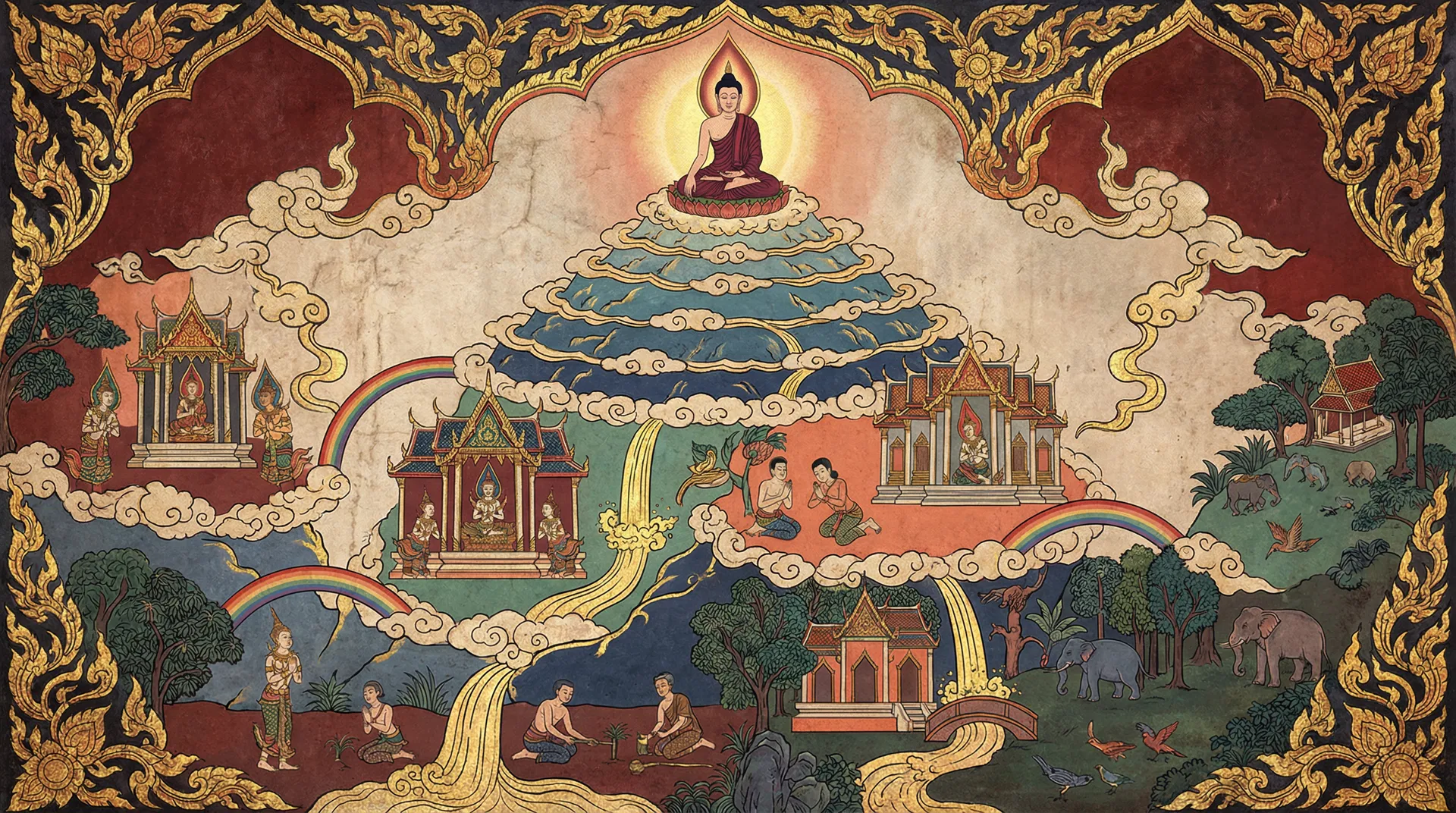
Mahā-Ummagga Jātaka
Mahā-Ummagga Jātaka
In the opulent city of Mithila, capital of the prosperous kingdom of Videha, reigned King Dighiti. He was a ruler of great renown, but his wisdom, though considerable, was eclipsed by that of his son, Prince Mahosadha. Even as a young boy, Mahosadha displayed an intellect so sharp and a foresight so profound that he was often called the “Great Tunnel” (Mahā-Ummagga), for he could see through any problem, digging to the very root of truth. His fame spread far and wide, reaching the ears of neighboring kingdoms.
One such kingdom was Magadha, ruled by the ambitious and formidable King Kalābu. King Kalābu, consumed by envy of King Dighiti’s success and Mahosadha’s brilliance, decided to provoke a war. He sent a message to King Dighiti, challenging him to a duel of wits disguised as a diplomatic envoy. The challenge was presented in the form of an intricately carved wooden bird, its wings outstretched, accompanied by a riddle: “If this bird flies, the kingdom is yours. If it falls, the kingdom is mine.”
King Dighiti, though a wise king, was perplexed by the riddle. He summoned his court scholars, but none could decipher its meaning. The King grew despondent, fearing the loss of his kingdom. It was then that Prince Mahosadha, barely a young man, stepped forward.
“Father,” he said, his voice calm and assured, “this is a challenge of strategy, not of magic. The bird is crafted from wood; it cannot fly on its own. The riddle implies that the kingdom will be won if the bird is made to fly. This can only be achieved by heat. If we can heat the wooden bird until it expands, its wings will lift, making it appear to fly.”
King Dighiti, amazed by his son’s insight, ordered his craftsmen to heat the wooden bird. As the wood expanded, the bird’s wings slowly rose, giving the illusion of flight. King Kalābu, receiving the news of his riddle’s solution, was both astonished and enraged. His plan to provoke war through trickery had failed, thanks to the young prince’s extraordinary intellect.
Undeterred, King Kalābu resorted to more direct means. He amassed a vast army and marched towards Mithila, intending to conquer Videha by force. King Dighiti, despite his son’s brilliance, was a man of peace and did not wish for war. He sent emissaries to King Kalābu, hoping to negotiate a peaceful resolution. However, Kalābu, blinded by his ambition, refused any terms other than complete surrender.
As the armies stood poised for battle, Prince Mahosadha devised a brilliant strategy. He knew that a direct confrontation would lead to great bloodshed. Instead, he proposed a series of intricate deceptions designed to sow confusion and discord within the enemy ranks. He instructed King Dighiti to have his soldiers dig numerous small, hidden pits around the battlefield, camouflaged with leaves and branches. He also ordered the construction of numerous scarecrows, dressed in the king’s armor, to be placed strategically on the ramparts.
When King Kalābu’s army advanced, they were met not with a direct assault, but with a bewildering array of traps. Soldiers stumbled into the hidden pits, their advance faltering. The sight of the numerous “soldiers” on the walls, seemingly prepared for battle, created an illusion of overwhelming numbers. Confusion and fear began to spread through Kalābu’s ranks. His commanders, unsure of their enemy’s true strength or strategy, grew hesitant.
Furthermore, Mahosadha employed psychological warfare. He had his men spread rumors within the Magadhan camp, whispering tales of divine omens and portents of defeat. He staged elaborate illusions at night, using fire and smoke to create phantom armies and terrifying apparitions.
King Kalābu, a man who relied on brute force, found himself outmaneuvered at every turn. His soldiers, demoralized and bewildered, began to desert. His commanders, unable to understand the Prince’s tactics, grew fearful. The once mighty army of Magadha was slowly disintegrating from within, not from a single decisive battle, but from a thousand clever stratagems.
Finally, seeing the utter disarray of his forces and realizing he was facing an opponent whose intellect far surpassed his own, King Kalābu was forced to retreat. He returned to Magadha in shame, his ambition thwarted and his army decimated by the brilliant mind of Prince Mahosadha.
King Dighiti, overjoyed and profoundly grateful, bestowed upon his son the title of Crown Prince and the position of chief advisor. Prince Mahosadha continued to serve his father and his kingdom with unwavering dedication, using his extraordinary intellect not for conquest, but for justice, prosperity, and the well-being of all his people. He established schools, promoted trade, and ensured that fairness prevailed in all matters. His reign, and the reign of his descendants, became known as an era of unparalleled peace and wisdom, all thanks to the boy who could see through any problem, the Great Tunnel of Mithila.
The tale of Mahosadha’s wisdom spread further, becoming a legend of how intellect, strategy, and foresight, when guided by a just heart, could overcome even the most formidable brute force. It showed that true power lay not in the strength of arms, but in the sharpness of the mind and the depth of one’s understanding.
— In-Article Ad —
💡Moral of the Story
Intelligence, foresight, and strategic thinking, when applied with justice and compassion, are more powerful than brute force and can overcome even the most formidable challenges, leading to peace and prosperity.
Perfection: Wisdom (Paññā)
— Ad Space (728x90) —
More Jataka Tales You May Enjoy
 39Ekanipāta
The Tale of the Proud Peacock
In a time long past, in the glorious city of Benares, King Brahmadatta ruled wisely. One day, as the...
💡 Wisdom and discernment, coupled with unwavering truthfulness, can expose deception and safeguard against manipulation.
114EkanipātaCūḷaka-Seṭṭhi Jātaka
Cūḷaka-Seṭṭhi Jātaka In the ancient city of Mithila, a bustling hub of trade and commerce, lived a w...
💡 True wealth is not measured by possessions, but by the generosity of spirit and the goodwill cultivated through acts of kindness. Giving with a pure heart brings greater abundance.
 196Dukanipāta
Mūtapāda Jātaka
The Tale of the Muddy-Footed ElephantIn the ancient kingdom of Mithila, there once lived a wise and ...
💡 True wisdom and the power to bring about positive change often come from selfless action and a compassionate heart, rather than from outward displays or material offerings.
188DukanipātaKacchapa Jataka
The Tale of the Steadfast TortoiseIn the heart of a vast, sun-drenched jungle, where ancient trees r...
💡 Steadfastness, patience, and unwavering determination are virtues that can overcome immense challenges and lead to salvation.
234DukanipātaPhra Ong Thammachak (The Bodhisatta as a Sage Who Established Justice)
Phra Ong Thammachak (The Bodhisatta as a Sage Who Established Justice) In the ancient land of Gandha...
💡 True justice is the foundation of a prosperous and harmonious society. Leadership must be guided by wisdom, compassion, and truth, ensuring fairness and equity for all.
247DukanipātaMuni Jataka
Muni JatakaLong ago, in the verdant kingdom of Kasi, there lived a sage named Muni. He was not an or...
💡 Inner peace and wisdom are the greatest remedies for all forms of suffering, and true strength lies in mastering one's own mind.
— Multiplex Ad —