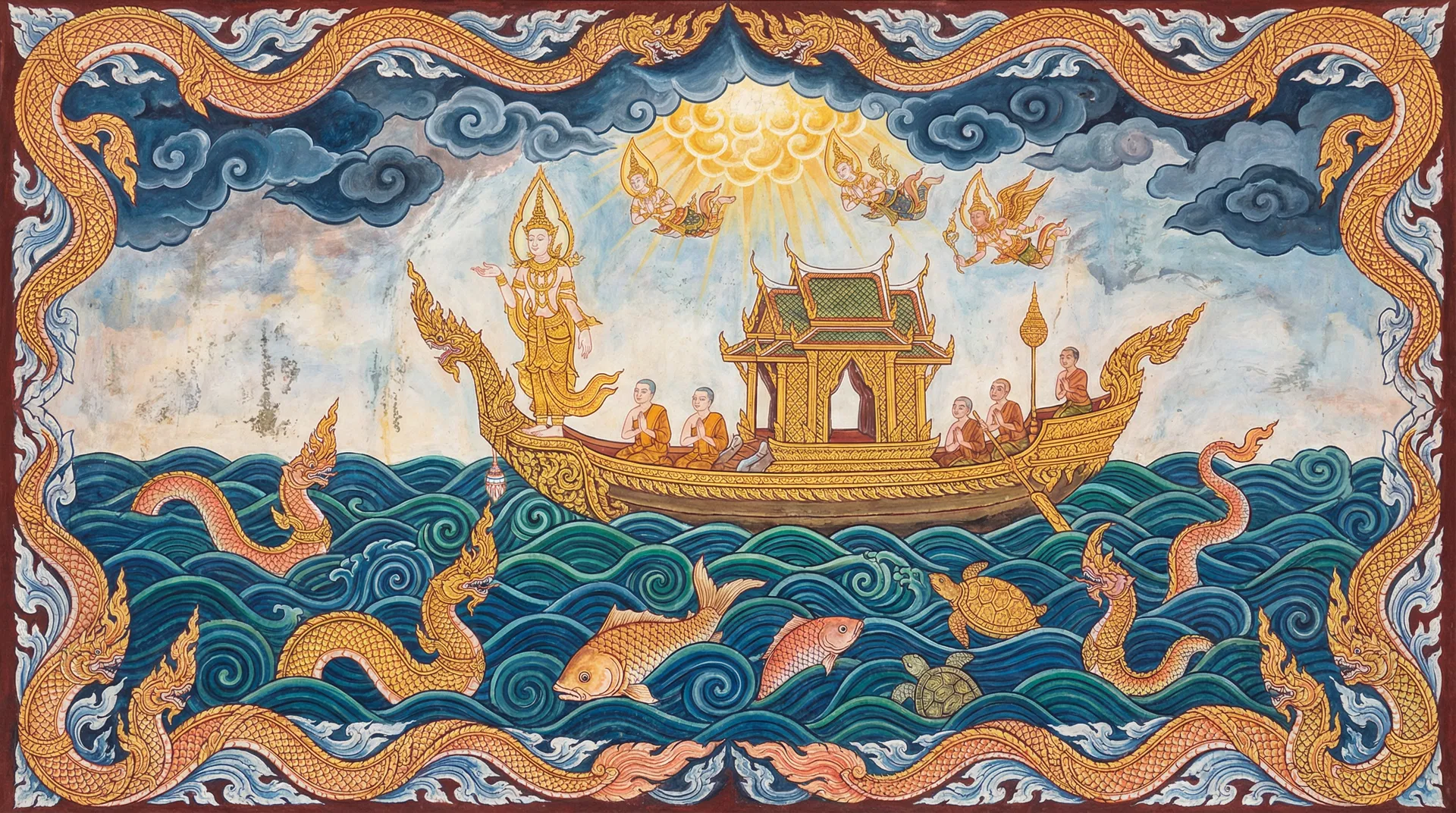
Mahāudambara Jātaka
The Tale of the Great Fig Tree
In the ancient kingdom of Mithila, nestled beside the mighty Ganges, lived a king named Brahmadatta. His reign was just, his heart noble, and his people prosperous. Yet, a shadow of discontent flickered in his court. The King, despite his wisdom, found himself inexplicably drawn to a single, magnificent fig tree that stood on the outskirts of his palace grounds. This tree, known as the Mahāudambara, was ancient and sprawling, its branches reaching towards the heavens like gnarled fingers, its leaves a vibrant emerald even in the dry season. It was said to possess a unique sweetness in its fruits, unlike any other.
The King’s fascination grew into an obsession. He would spend hours gazing at the tree, often neglecting his royal duties. His ministers, men of great experience and insight, grew concerned. They saw the King’s focus waver, his attention diverted from the affairs of state to the rustling leaves and the promise of sweet fruit. One day, the chief minister, a man named Pālaka, known for his courage and loyalty, approached the King. “Your Majesty,” Pālaka began, his voice respectful yet firm, “I see a great love for this fig tree in your heart. While it is a beautiful specimen, I fear it draws your mind from the welfare of the kingdom.”
King Brahmadatta, startled by his minister’s boldness, initially bristled. “Pālaka, you do not understand. There is a certain… peace that this tree brings me. Its fruits are a delicacy beyond compare. They nourish not only the body but the spirit.”
“Your Majesty,” Pālaka replied, unfazed, “a kingdom is nourished by justice, by wise governance, and by the security of its people. A single tree, however grand, cannot provide these. I have heard whispers among the people, Your Majesty. They see their King entranced by a tree, and they wonder if their needs are still foremost in your mind. Doubt, like a creeping vine, can choke the loyalty of even the most devoted subjects.”
The King, though proud, was not deaf to reason. He saw the truth in Pālaka’s words. He realized that his infatuation had indeed begun to overshadow his responsibilities. He decided to test the sincerity of his own desire. He declared to his court, “I shall make a great feast for all my subjects. We shall celebrate the bounty of our land, and I shall offer the fruits of the Mahāudambara tree as the centerpiece of this feast. But, there is a condition: only those who can truly appreciate the sweetness of these figs, those whose hearts are pure and free from greed, shall be allowed to taste them.”
The announcement sent ripples of excitement through Mithila. Preparations were made, and the people gathered, eager for the royal feast and the legendary figs. As the feast began, King Brahmadatta, accompanied by Pālaka, stood before the vast platters of glistening fig fruits. He called out, “Let all who are pure of heart and free from selfish desire come forth and partake!”
A crowd surged forward, eager to prove their worthiness. The King watched intently. He saw merchants pushing their way to the front, their eyes gleaming with the thought of selling the coveted figs. He saw courtiers seeking favor, hoping a taste would endear them to the King. He saw commoners, driven by simple hunger and the allure of something extraordinary. But as they approached, the King, with his heightened senses honed by his focus on the tree, could discern a subtle shift in the air, a faint aroma of desire and expectation that tainted the perceived purity.
Then, a small group of individuals, who had remained at the periphery, slowly made their way forward. They were simple folk: a weaver who had toiled honestly all his life, a farmer who nurtured his land with diligence, a teacher who guided young minds with patience, and a humble ascetic who sought no worldly gain. As they drew near, King Brahmadatta felt a different aura, a quiet contentment, a genuine appreciation for the simple act of sharing. He offered them the figs, and as they tasted, their faces lit up not with avarice, but with genuine delight and gratitude. They savored the sweetness, not for its rarity or its potential to impress, but for the simple joy it brought.
The King, observing this, understood. True appreciation did not stem from possession or exclusivity, but from a pure and unadorned heart. His obsession with the tree had been a test, not just for his people, but for himself. He realized that the true sweetness of life, like the sweetness of the fig, was best enjoyed when shared with a pure spirit, free from the bitterness of greed and selfishness. He returned to his duties with renewed vigor, his fascination with the Mahāudambara tree now tempered with wisdom. He still appreciated its beauty and its fruit, but he no longer allowed it to overshadow the greater responsibilities of his kingship. The kingdom flourished, and King Brahmadatta, guided by the unwavering counsel of Pālaka, ruled with a heart that truly understood the meaning of pure joy and selfless service.
True appreciation and joy are found not in the exclusive possession of something, but in the purity of heart with which it is shared and experienced. Greed and selfish desire cloud our ability to truly enjoy life's simple pleasures.
— In-Article Ad —
💡Moral of the Story
The true sweetness of life is found in sharing with a pure heart, free from greed and selfishness.
Perfection: Wisdom (Paññā)
— Ad Space (728x90) —
More Jataka Tales You May Enjoy
 316Catukkanipāta
Mugapakkha Jataka
Mugapakkha JatakaIn the heart of a lush forest, teeming with life and vibrant hues, there once lived...
💡 True leadership is demonstrated through selfless sacrifice for the well-being of others, even at great personal cost. Compassion and courage can overcome immense hardship.
 497Pakiṇṇakanipāta
Mahā-Ummagga Jātaka
Mahā-Ummagga JātakaIn the glorious city of Mithila, under the reign of King Brahmadatta, lived a pri...
💡 Intelligence, foresight, and strategic thinking are powerful tools that can overcome seemingly insurmountable challenges and bring about peace and prosperity.
 354Pañcakanipāta
Phanasa Jataka
Phanasa Jataka In the ancient city of Ujjeni, lived a kind and virtuous Bodhisattva who was born as ...
💡 Integrity, unity, and perseverance are essential virtues, especially in times of hardship. Greed and selfishness lead to downfall.
306CatukkanipātaMahā-Ummagga Jātaka
The Great Tunneling TaleLong ago, in the ancient city of Mithila, ruled a wise and just king named J...
💡 True wisdom lies not just in knowledge, but in the ability to apply it with perseverance and compassion to overcome adversity. Even the most daunting challenges can be surmounted with a clear vision, unwavering determination, and the unity of a community.
 406Sattakanipāta
Kacchapa Jataka
Kacchapa Jataka In the ancient land of Mithila, nestled beside the shimmering Ganges River, lived a ...
💡 True abundance and prosperity are not found in material wealth alone, but in the boundless compassion and generosity extended to all beings. When a leader embodies these virtues, they inspire a transformation that can bring forth healing and renewal, both for the land and its people.
320CatukkanipātaSaddanta Jataka
Saddanta JatakaIn the magnificent Himalayan forests, where snow-capped peaks kissed the azure sky an...
💡 True virtue and compassion are unshakeable, even in the face of extreme suffering and betrayal. The pursuit of selfish desires through violent means leads only to further suffering and is ultimately futile.
— Multiplex Ad —