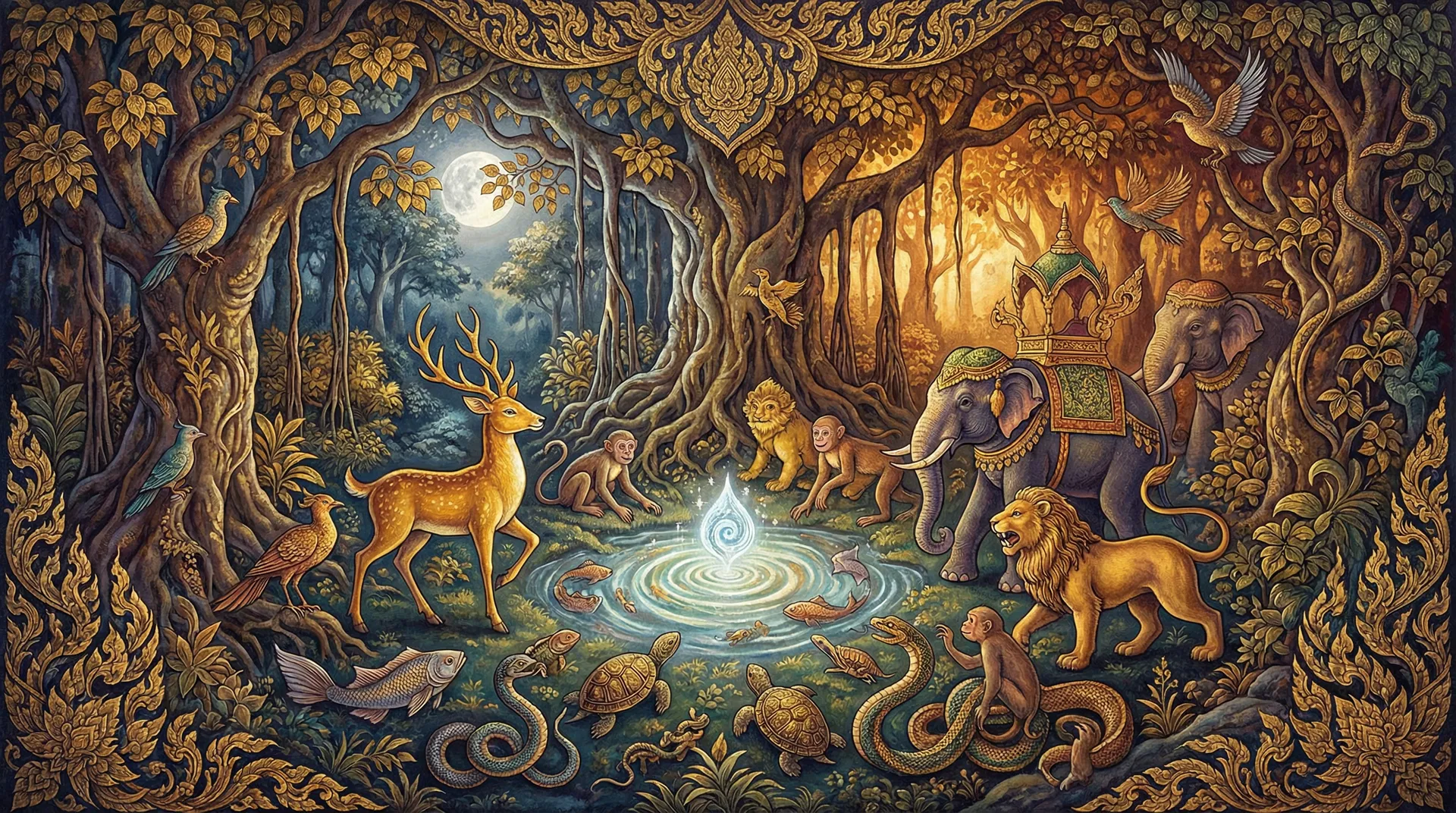
Mahosadha Jataka
Mahosadha Jataka
In the prosperous kingdom of Mithila, under the wise and just rule of King Vedeha, there lived a Bodhisattva named Mahosadha. In this lifetime, Mahosadha was born as a young Brahmin boy, gifted with an intellect so sharp and a wisdom so profound that he was destined to become the king's chief advisor. Even as a child, his uncanny ability to solve complex problems and his deep understanding of human nature set him apart.
The kingdom of Mithila was a beacon of prosperity, but it was often threatened by the ambitious neighboring kingdom of Kasi, ruled by the cunning King Culani Brahmadatta. King Culani, envious of Mithila's wealth and influence, constantly sought ways to undermine King Vedeha. He employed spies, spread rumors, and concocted elaborate schemes, but each time, Mahosadha's extraordinary intelligence thwarted his plans.
One of King Culani's most devious plots involved a challenge to King Vedeha's wisdom. He sent a message to Mithila, claiming that he possessed a magical chariot that could fly. He challenged King Vedeha to produce a chariot of equal or greater power, or face the humiliation of admitting defeat. This was a trick, as King Culani had no such chariot; he simply wanted to force King Vedeha into an impossible task.
King Vedeha, though wise, was perplexed by this challenge. He consulted his ministers, but none could devise a solution. In their despair, they turned to the young Mahosadha. Mahosadha, with a calm smile, listened to the king's predicament. He understood that the challenge was not about actual flying chariots, but about outsmarting the opponent.
Mahosadha instructed the king to have a magnificent chariot built, but with a special modification. He ordered that the wheels of the chariot be made incredibly large and heavy, and that the chariot itself be constructed with the finest materials, appearing grand and impressive. He then instructed the king to send a message back to King Culani, stating that the chariot was indeed ready, but it required a special wind to make it fly, a wind that would only blow when King Culani's own magical chariot was brought forth.
King Culani, expecting a direct confrontation with a flying chariot, was caught completely off guard. He had no flying chariot, and he realized that his trick had been exposed by Mahosadha's superior intellect. He was forced to admit defeat, much to the relief and admiration of King Vedeha and the people of Mithila.
Another time, King Culani attempted to sow discord within Mithila by sending messengers with identical gifts to all the noblemen. The gifts were small, inexpensive wooden boxes, each containing a single pea. The intention was to insult the noblemen and create resentment towards King Vedeha, who would be blamed for such stinginess. However, Mahosadha, anticipating this move, had already instructed the noblemen on how to respond.
When the gifts were distributed, Mahosadha advised the noblemen to accept the boxes with gratitude and then, in private, to plant the pea. He told them that the King, in his infinite wisdom, was providing them with the seeds of future prosperity. When the pea grew into a plant, and eventually a tree bearing many peas, the noblemen were able to present King Vedeha with a bountiful harvest, much to the consternation of King Culani, who saw his scheme backfire spectacularly.
Mahosadha's wisdom extended beyond outsmarting his enemies. He was a proponent of justice, compassion, and fair governance. He established systems of irrigation, promoted agriculture, and ensured that the laws were applied justly to all, regardless of their social standing. He resolved disputes with fairness, mediated conflicts with wisdom, and always prioritized the well-being of the people.
His keen intellect was not limited to grand strategies; he applied it to everyday matters as well. He could discern truth from falsehood, identify hidden motives, and offer solutions to seemingly insurmountable problems. He taught the people of Mithila the importance of critical thinking, the value of truthfulness, and the power of a well-reasoned mind.
The reign of King Vedeha, guided by Mahosadha's brilliance, became a golden age of peace, prosperity, and justice. The kingdom flourished, and its people lived in contentment, secure in the knowledge that their king, supported by his unparalleled advisor, was a protector of their welfare. Mahosadha's life was a testament to the profound impact that wisdom, when combined with compassion and a commitment to truth, can have on the destiny of a kingdom and the lives of its people.
Wisdom, when combined with compassion and a commitment to truth, is the greatest asset of any leader and the foundation of a prosperous society.
— In-Article Ad —
💡Moral of the Story
Profound wisdom, combined with compassion and strategic thinking, can overcome any challenge and lead to justice and prosperity.
Perfection: Wisdom (Panna Paramita)
— Ad Space (728x90) —
More Jataka Tales You May Enjoy
 1Ekanipāta
The Tale of the Great Lotus
The Tale of the Great Lotus In a time long past, when the world was a canvas of verdant forests and...
💡 Impatience is like a fire that burns everything, but wisdom and concentration are the tools that allow us to control situations and achieve goals with stability.
 374Pañcakanipāta
Mahādhammapāla Jātaka
Mahādhammapāla JātakaIn the verdant land of Kasi, where the sun cast a golden hue upon rolling hills...
💡 Deceptive gifts and false alliances often mask hidden agendas. True strength and victory are achieved through righteousness, wisdom, and genuine preparedness.
84EkanipātaUdapāna Jātaka
Udapāna Jātaka In a sun-scorched desert, where the sands stretched endlessly under a blazing sky, li...
💡 In times of hardship and despair, perseverance, faith, and collective effort are essential to overcoming challenges and finding solutions.
125EkanipātaMugapakkha Jataka
Mugapakkha Jataka In the ancient city of Uttarapancala, there lived a wise and just king named Dighi...
💡 True atonement and spiritual growth can be achieved through sincere repentance, mindful silence, and the cultivation of inner peace, leading to the rectification of past mistakes and the well-being of all.
110EkanipātaMora Jataka
The Tale of the King, the Queen, and the Golden Peacock In the prosperous kingdom of Varanasi, nestl...
💡 True beauty lies not in outward appearance but in inner virtues like wisdom, compassion, and kindness. Superficial fascination can blind us to the enduring value of character.
91EkanipātaNimi Jataka
Nimi JatakaIn the celestial realm, where clouds of pure gold drifted lazily across an endless sapphi...
💡 The pursuit of wisdom and righteousness leads to profound understanding and brings peace and prosperity not only to oneself but to all of society. Witnessing the consequences of karma provides powerful motivation for virtuous living.
— Multiplex Ad —