Mahādhammapāla Jātaka
Mahādhammapāla Jātaka
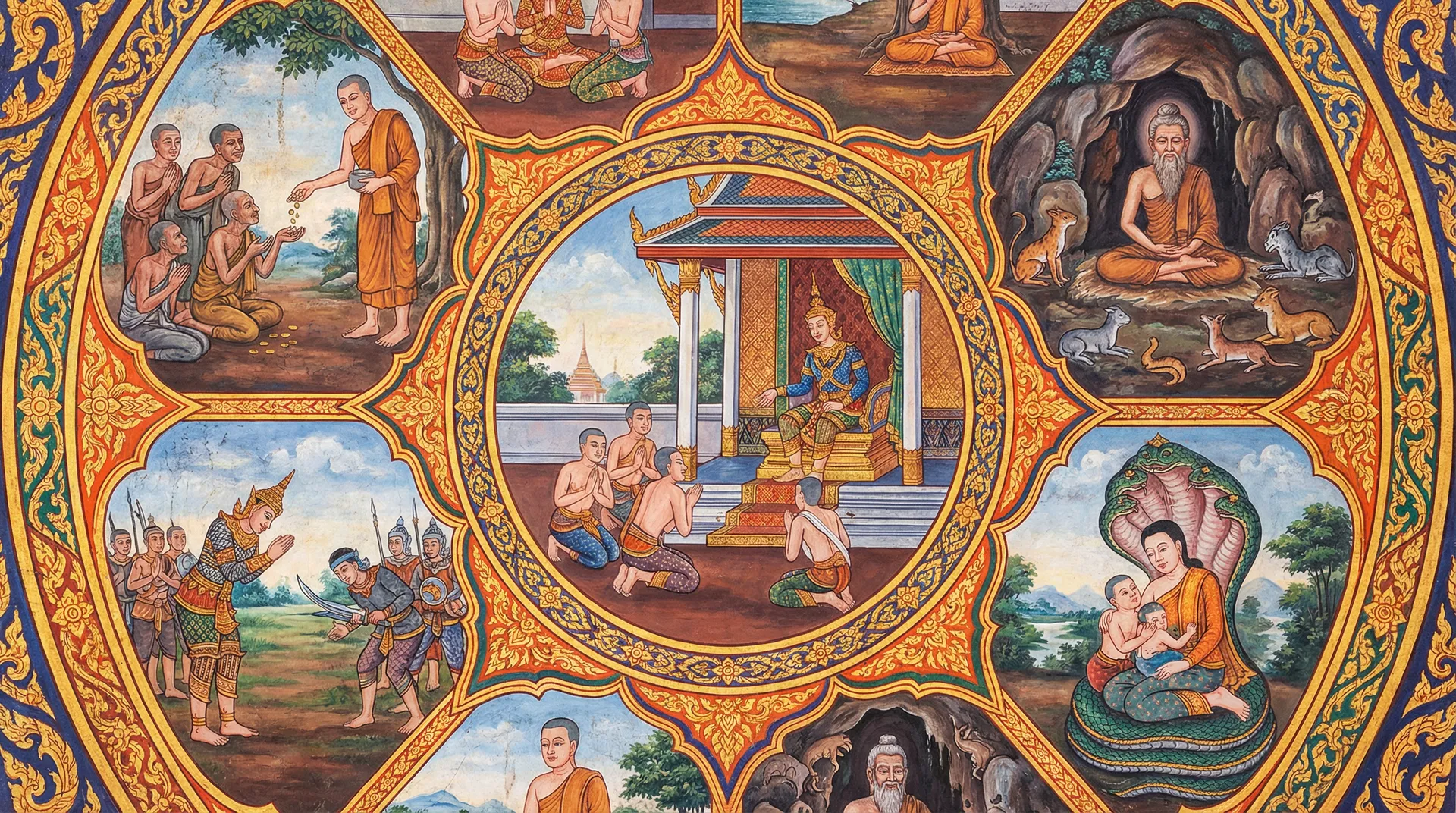
In the verdant land of Kasi, where the sun cast a golden hue upon rolling hills and shimmering rivers, there lived a noble king named Disa, a ruler whose heart was as vast as the sky and whose justice was as unwavering as the mountains. His reign was a beacon of righteousness, and his people lived in harmony, free from fear and want. However, even the most virtuous kingdoms can be tested by the shadows of ambition and the whispers of greed. A neighboring king, driven by envy and a lust for power, named Bhima, harbored a deep desire to conquer Disa's prosperous realm.
King Bhima, a ruler of immense military might but lacking in moral fiber, knew that a direct assault on King Disa's well-defended kingdom would be fraught with peril. He therefore devised a more insidious plan. He sent envoys to King Disa, bearing gifts and professions of friendship. Among these gifts was a magnificent, bejeweled sword, said to be imbued with the power to grant victory in battle. King Bhima, through his envoys, proposed a grand alliance, a pact of mutual defense and shared prosperity.
King Disa, however, was a man of profound discernment. He saw through the veneer of friendship, sensing the underlying ambition in King Bhima's overtures. The Bodhisatta, who at this time was King Disa's wise and trusted advisor, also perceived the deception. The Bodhisatta, known for his unwavering commitment to truth and justice, understood that King Bhima's true intention was not alliance, but conquest. The bejeweled sword was not a symbol of friendship, but a tool of deception, perhaps even a poisoned blade, designed to lure King Disa into a false sense of security.
The Bodhisatta, addressing his king, said, "Your Majesty, the gifts of King Bhima are like honey mixed with poison. His professions of friendship are but a veil for his covetous eyes. This sword, though glittering, carries the scent of treachery. To accept it would be to invite ruin upon our kingdom. True strength lies not in accepting the weapons of our enemies, disguised as gifts, but in the steadfast adherence to righteousness and the preparedness of our own forces."
King Disa, deeply valuing his advisor's insight, followed his counsel. He politely declined King Bhima's offer of alliance and refused the bejeweled sword. He sent word back to King Bhima, stating that his kingdom was content and sought no external pacts, and that his own sword, forged with justice, was sufficient for his protection.
King Bhima, enraged by the rejection of his overtures and the exposure of his deceit, decided to launch a surprise attack. He gathered his armies and marched towards King Disa's borders. However, King Disa, forewarned by the Bodhisatta's wisdom and guided by his own vigilance, was fully prepared. His armies were well-trained, his defenses were strong, and his people were united in their resolve to protect their just kingdom.
The ensuing battle was fierce, but King Disa's forces, fighting with the courage of conviction and the strength of righteousness, repelled King Bhima's invading army. King Bhima, defeated and humbled, was forced to retreat, his ambitions shattered. King Disa, having defended his kingdom not through deceit but through wisdom and preparedness, continued to rule with justice, his kingdom flourishing even more brightly.
The Mahādhammapāla Jātaka teaches that true victory is not achieved through cunning or the acceptance of deceptive gifts, but through unwavering adherence to truth, the cultivation of wisdom, and the preparedness that stems from righteousness. It highlights the importance of discernment in recognizing and rejecting the insidious plans of those who seek to exploit or conquer.
— In-Article Ad —
💡Moral of the Story
Deceptive gifts and false alliances often mask hidden agendas. True strength and victory are achieved through righteousness, wisdom, and genuine preparedness.
Perfection: Wisdom (Prajna)
— Ad Space (728x90) —
More Jataka Tales You May Enjoy
 47Ekanipāta
The Bodhisatta as the King of the Monkeys
The Bodhisatta as the King of the MonkeysIn a verdant forest so vast that its trees seemed to scrape...
💡 Wisdom, courage, and self-sacrifice are the most effective defenses against malice and greed.
75EkanipātaThe Tale of Subahu the White Fox
In ages past, when the Bodhisatta was yet a bodhisatta, he was born as a white fox of immaculate fur...
💡 True wisdom lies in sharing and compassion, recognizing that collective well-being is the greatest wealth.
 246Dukanipāta
Kosiya Jataka
Kosiya JatakaIn the ancient city of Mithila, nestled amidst lush gardens and bustling marketplaces, ...
💡 True wealth is not measured in material possessions, but in the depth of one's compassion and the extent of one's generosity towards others.
 273Tikanipāta
Assaka Jataka
Assaka JatakaIn the heart of a vast and ancient kingdom, there once lived a king named Assaka. King ...
💡 True leadership is not determined by birthright or status, but by demonstrated character, inner strength, humility, and a commitment to serving others.
 530Mahānipāta
Samyuttakapālajātaka
The Tale of the Broken Pot In the heart of a vibrant city, known for its skilled artisans and bustli...
💡 Anger can be destructive, preventing us from seeing new possibilities. When faced with setbacks and brokenness, it is important to manage our anger, adapt, and look for new ways to create and find beauty.
253TikanipātaKusa-Jātaka
Kusa-JātakaIn the kingdom of Kampilla, nestled beside the sacred River Ganges, lived a king named Ud...
💡 Jealousy and hasty judgments can lead to terrible suffering and separation. True love is tested by adversity, and forgiveness is essential for healing and reconciliation. Patience, inner strength, and understanding are virtues that can overcome even the most profound injustices.
— Multiplex Ad —