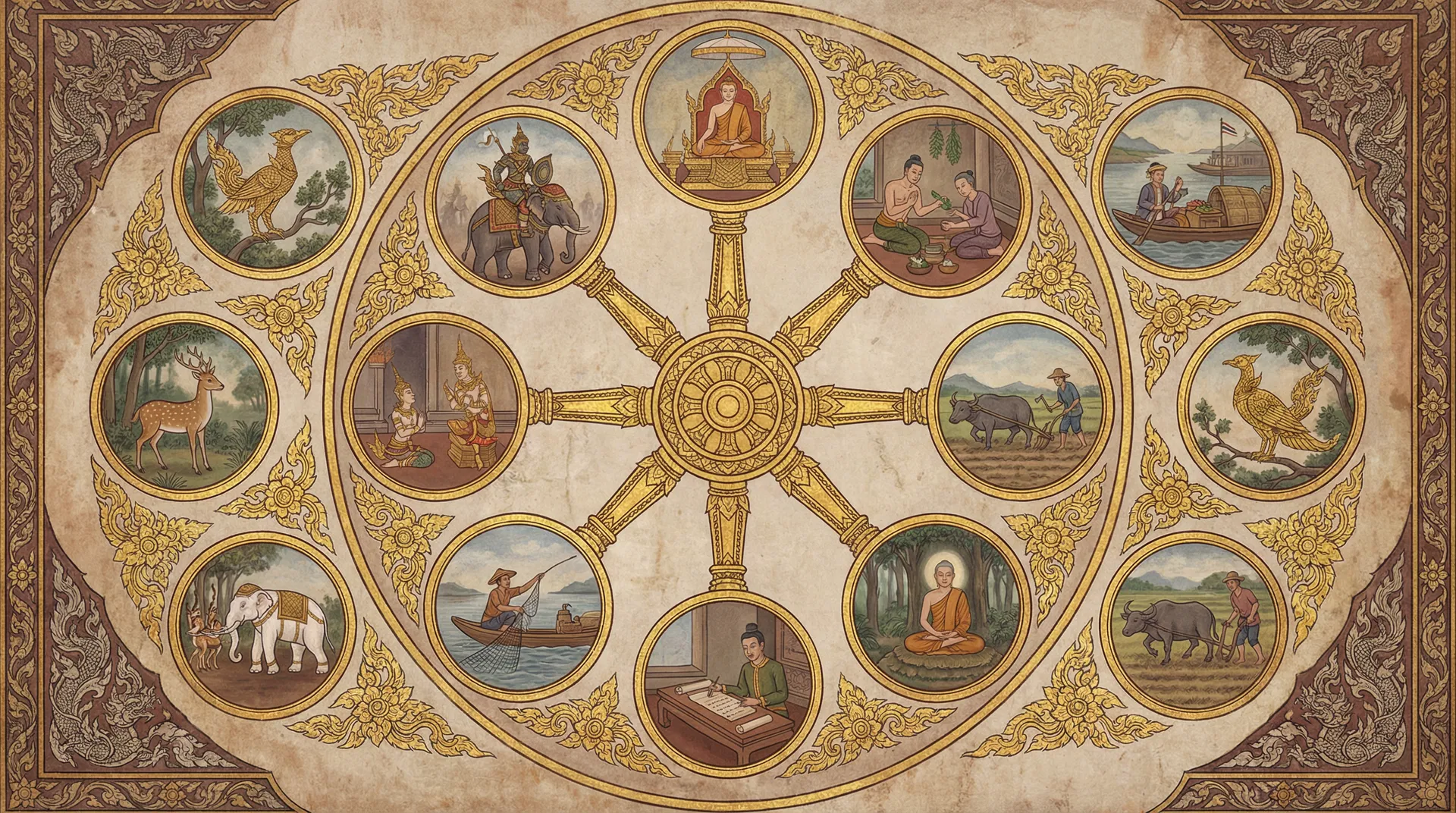
Sattigumba Jātaka
The Spear-Bearer's Grove Jātaka (Sattigumba Jātaka)
In the flourishing kingdom of Kosala, lived a prince named Jotipāla, a being of immense compassion and integrity. Prince Jotipāla was known throughout the land for his unwavering commitment to truth and justice. One day, a terrible drought struck the kingdom, withering crops and parching the earth. The people cried out in despair.
The king, a well-meaning but indecisive ruler, summoned his advisors. "What can be done to appease the heavens and bring rain?" he asked, his brow furrowed with worry.
One advisor, a man named Bhaddasāla, suggested a grand sacrifice. "Your Majesty," he proposed, "let us offer a great feast to the gods. We shall gather the finest beasts and prepare a lavish offering. This will surely earn us their favor."
Another advisor, a more pragmatic man named Somadatta, disagreed. "Sacrifice is not the answer, Your Majesty. We must look to the earth itself. Perhaps there is a hidden spring or a forgotten well that can sustain us." But his words were largely ignored.
Prince Jotipāla, overhearing the discussions, felt a pang of sorrow. He knew that true solutions did not come from appeasing deities with bloodshed or superficial remedies. He had a vision, guided by his Bodhisattva wisdom, of a different path.
He approached the king. "Father," he said, his voice clear and resonant, "the earth is suffering, and so are its people. We must seek the source of life, not through ritual, but through understanding and action." The king, though hesitant, trusted his son’s innate goodness and granted him permission to seek his own solution.
Prince Jotipāla, accompanied by a small retinue, ventured into the parched wilderness. He possessed an uncanny ability to sense the life force within the earth. He wandered for days, his thirst growing, but his resolve unwavering. He was searching for a legendary grove, spoken of in hushed whispers, a place where even in the harshest drought, life persisted.
Finally, guided by an inner knowing, he arrived at a secluded, ancient grove. The trees, though weathered, stood tall. At its center, he discovered a hidden spring, its waters pure and life-giving, though its flow was diminished. Surrounding the spring were peculiar, thorny bushes, their branches thick with sharp spears, hence the name, the Spear-Bearer's Grove.
As Jotipāla drank from the spring, he noticed that the thorny bushes seemed to draw sustenance from the very water, yet they also seemed to protect the spring itself. He realized that this was not just a physical place, but a metaphor for how true sustenance and protection arise from a balanced approach.
He understood that the harsh thorns were a deterrent, preventing the careless or greedy from exploiting the precious water source. The grove itself, in its wild, untamed state, represented nature’s resilience and self-preservation.
Jotipāla decided that the people needed not just water, but also the wisdom to cherish and protect it. He ordered his men to carefully clear a path to the spring, without disturbing the protective thorns excessively. He instructed them to build a simple, respectful channel to bring the water closer to the city, ensuring that it would be shared equitably.
He then returned to the city and gathered the people. "The gods do not answer with rain when we offer violence," he declared. "The earth provides when we respect its balance. I have found a hidden spring, guarded by nature itself. We must approach it with humility and gratitude, understanding that its bounty must be shared and protected."
The people, inspired by Jotipāla's words and the promise of water, followed him to the grove. They saw the spring, its waters a miracle in the parched land. Guided by Jotipāla, they drank with reverence, sharing the water equitably. They understood the lesson of the thorny bushes – that protection and sustainability require careful management and respect.
The water from the Spear-Bearer's Grove, though not a deluge, was enough to sustain the kingdom until the rains eventually returned. The drought had been a harsh teacher, but through Prince Jotipāla’s wisdom, the people learned the importance of resourcefulness, respect for nature, and equitable sharing. The grove, once a hidden secret, became a symbol of hope and resilience, reminding everyone that the greatest treasures are often guarded by nature's own defenses, and require a wise hand to access and cherish.
— In-Article Ad —
💡Moral of the Story
True solutions often lie in understanding and working with nature's principles, rather than resorting to superficial rituals or force. Resourcefulness, respect for natural balance, and equitable sharing are key to overcoming hardship.
Perfection: Wisdom (Paññā) and Resourcefulness (Upassama)
— Ad Space (728x90) —
More Jataka Tales You May Enjoy
 285Tikanipāta
Mūga-pakkhaya Jātaka
Mūga-pakkhaya JātakaIn a serene hermitage nestled amidst the verdant hills, lived a Bodhisattva know...
💡 True wisdom is often found in silence and deep contemplation, rather than in endless debate or attachment to one's own opinions. Be open to questioning your own understanding.
 424Aṭṭhakanipāta
Sarabhaṅga Jātaka
Sarabhaṅga JātakaIn the ancient land of Gandhāra, nestled amidst snow-capped mountains and whisperin...
💡 True peace is cultivated from within and achieved through understanding, compassion, and wisdom, not through violence or the imposition of power. Inner resilience is the greatest defense against external aggression.
 400Sattakanipāta
Mahosadha Jataka
Mahosadha JatakaIn the ancient kingdom of Mithila, a city famed for its wise ruler, King Vedeha, the...
💡 Exceptional intelligence, when coupled with foresight, justice, and compassion, is the greatest asset for ensuring the well-being, prosperity, and peace of a kingdom and its people.
403SattakanipātaMaha-Ummaga Jataka
Maha-Ummaga JatakaIn the ancient kingdom of Videha, nestled beside the flowing river Candravati, lay...
💡 True wisdom lies not only in intellect but also in using that intelligence with integrity and for the welfare of others, discerning truth from deception.
273TikanipātaAssaka Jataka
Assaka JatakaIn the heart of a vast and ancient kingdom, there once lived a king named Assaka. King ...
💡 True leadership is not determined by birthright or status, but by demonstrated character, inner strength, humility, and a commitment to serving others.
 102Ekanipāta
Sattigumba Jātaka
The Story of the Spear-Bearing Tree In a time long past, when the world was wilder and the whispers ...
💡 Distrust and suspicion, while seemingly protective, ultimately lead to isolation and inner barrenness. True security and fulfillment come from cultivating trust, understanding, and genuine connection with others.
— Multiplex Ad —