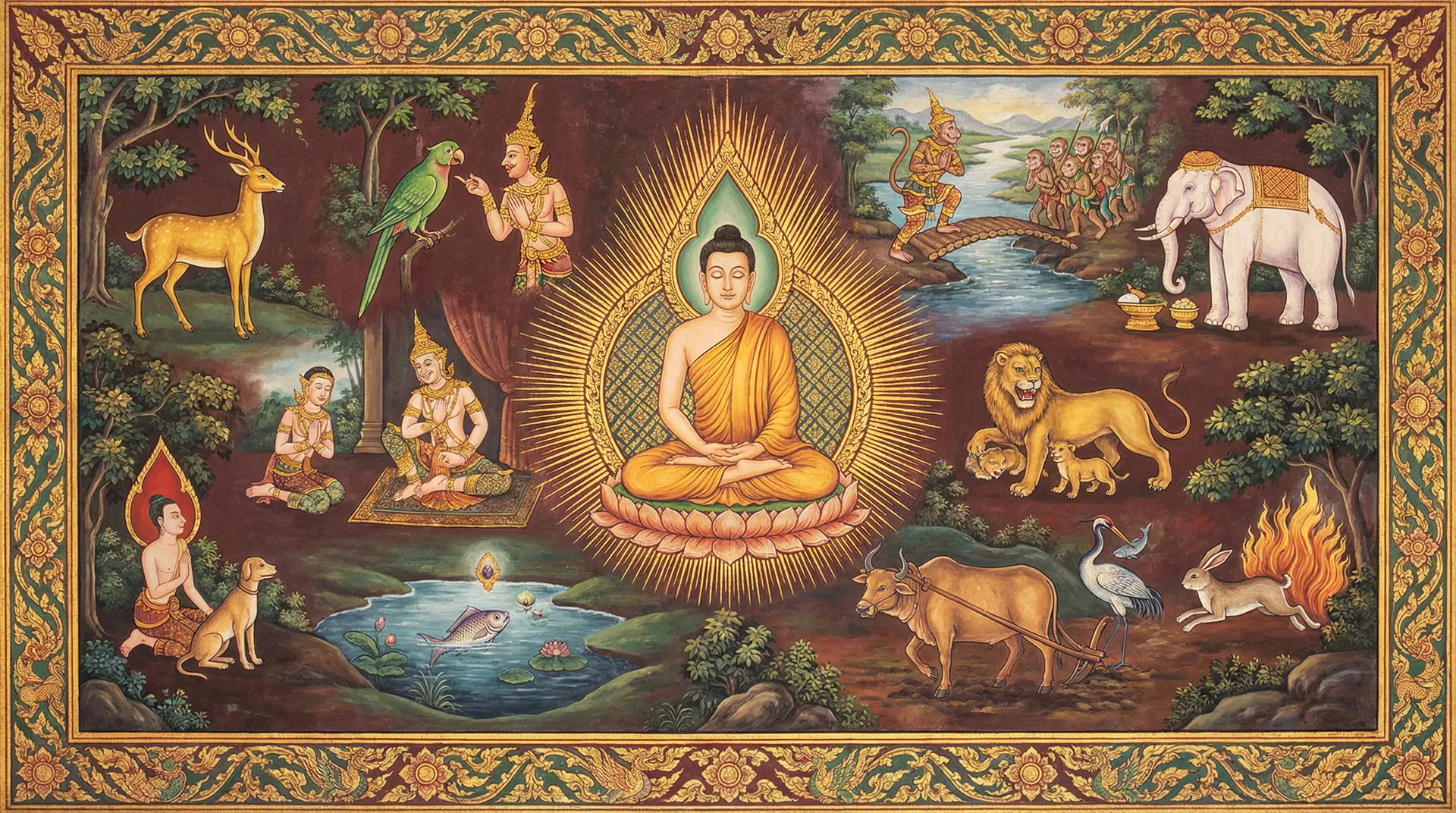
Assaka Jataka
Assaka Jataka
In the verdant kingdom of Kalinga, nestled beside the mighty river Ganges, lived a king named Assaka. He was a ruler of exceptional patience and a profound sense of justice. His reign was marked by peace and prosperity, and his people loved him dearly. Yet, the path of a virtuous king is often strewn with challenges that test the very foundations of his character. This is the story of how King Assaka’s patience was put to the ultimate test.
The neighboring kingdom, ruled by a proud and envious king named Brahmadatta, harbored a deep resentment towards Kalinga's flourishing state. Brahmadatta, consumed by his jealousy, decided to provoke King Assaka. He sent his emissaries to the court of Kalinga, bearing a message of blatant insult. "Your Majesty," the chief emissary declared, his voice dripping with disdain, "King Brahmadatta believes your kingdom's prosperity is a mere fluke, a temporary fortune. He challenges your right to rule, and demands that you prove your worth by enduring his every whim, no matter how degrading."
The court of Kalinga gasped. Such audacity was unheard of! King Assaka, however, remained remarkably calm. His face, usually serene, showed a flicker of sadness, but no anger. He looked at his advisors, who were clamoring for retaliation. "My lords," King Assaka said, his voice steady, "we shall not meet insult with insult. We shall meet it with patience. I accept King Brahmadatta's challenge."
From that day on, King Brahmadatta unleashed a torrent of vexations upon King Assaka. He sent messengers with absurd demands: to fill the royal stables with peacocks that sang like nightingales, to collect dew from the moonbeams, to gather air from the highest mountains and bottle it. Each demand was designed to humiliate and exhaust King Assaka and his kingdom. Yet, with incredible ingenuity and unwavering patience, King Assaka fulfilled each request.
His people, initially bewildered, soon came to admire their king's steadfastness. They worked tirelessly, finding creative solutions to seemingly impossible tasks. For the peacocks, they trained ordinary peacocks to mimic nightingale songs through diligent practice and ingenious sound devices. For the moonbeam dew, they devised a system of collecting morning mist on special cloths, presenting it as the captured essence of moonlight. For the mountain air, they gathered fragrant herbs from high altitudes and placed them in finely crafted urns, claiming the scent was the bottled air.
King Brahmadatta, growing increasingly frustrated by King Assaka's success, escalated his torment. He ordered the excavation of a vast lake, but decreed that it be filled with the tears of sorrow shed by the people of Kalinga. The people, though weary, did not weep with sorrow; instead, they wept with laughter at the sheer absurdity of the demand, and King Assaka presented the king with urns filled with the 'tears' of joy and amusement, each drop a testament to their resilience.
Finally, King Brahmadatta, defeated and bewildered by King Assaka's unyielding patience and the ingenuity of his people, sent one last message. "I have exhausted all my means to break your spirit, King Assaka. Yet, you stand firm. Tell me, what is the secret behind your incredible fortitude?"
King Assaka, receiving this final message, did not gloat. He sent back a simple reply: "The secret, King Brahmadatta, is not in the strength of my arms, but in the steadfastness of my heart. Patience is not the absence of action, but the ability to act with wisdom and resilience in the face of adversity. Your attempts to provoke me have only served to strengthen my resolve and unite my people. True strength lies not in aggression, but in enduring with grace." King Brahmadatta, humbled by this profound response, finally understood the error of his ways. He sought forgiveness from King Assaka, and the two kingdoms, once at odds, learned to coexist in peace, bound by the lesson of patience.
— In-Article Ad —
💡Moral of the Story
Unwavering patience and resilience are powerful tools that can overcome even the most malicious provocations.
Perfection: Patience (Khanti)
— Ad Space (728x90) —
More Jataka Tales You May Enjoy
 83Ekanipāta
Sihaccha Jātaka
Sihaccha Jātaka In the ancient city of Vārāṇasī, there lived a king named Dhṛtarāṣṭra, a ruler known...
💡 Pride can blind us to wisdom. True strength lies in humility and the willingness to learn from others, regardless of their status or perceived intelligence.
 385Chakkanipāta
Sākhāmbaga Jātaka
Sākhāmbaga Jātaka In the ancient city of Savatthi, a hub of commerce and culture, lived a king named...
💡 Honest inquiry and sincere intention, rather than anger and pride, are the keys to resolving disputes and revealing the truth.
 324Catukkanipāta
Kusa Jataka
Kusa JatakaIn the ancient kingdom of Mithila, there lived a king named Kusa. He was a wise and just ...
💡 Pride and anger lead to injustice and suffering. True strength and leadership are found in wisdom, compassion, patience, and the humility to admit one's mistakes and seek forgiveness.
337CatukkanipātaTitthira Jataka
Titthira Jataka In the ancient forests of India, where colossal trees reached towards the heavens an...
💡 Vigilance, foresight, and cooperation are essential for overcoming dangers. Even the smallest creatures can achieve great things when they unite and act with wisdom. It is better to prepare for potential threats than to be caught unaware.
307CatukkanipātaSūci-Jātaka
The Needle's TaleIn the vibrant city of Kosambi, lived a king named Bhimasena. He was known for his ...
💡 True value is found not in the material itself, but in the skill, patience, and mindfulness with which it is used. Every action should be purposeful, flowing seamlessly into the next, minimizing waste and maximizing the impact of our efforts.
391ChakkanipātaNimi Jataka
Nimi JatakaLong ago, in a kingdom of ancient India, lived King Nimi, a ruler renowned for his righte...
💡 True happiness is found in inner peace and wisdom, not fleeting pleasures. The ultimate goal is liberation from suffering.
— Multiplex Ad —