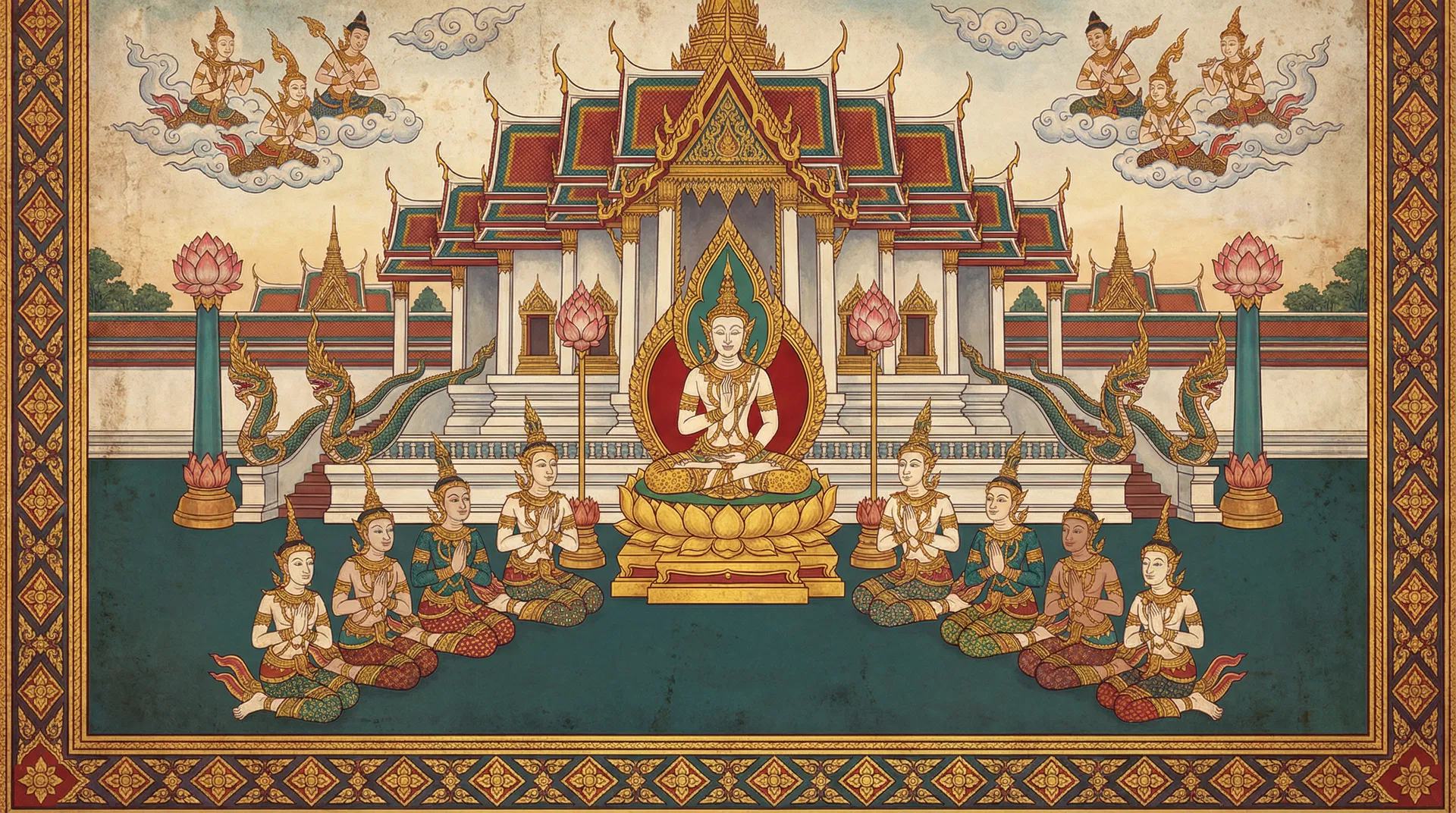
Mugapakkha Jataka
Mugapakkha Jataka
In the ancient kingdom of Videha, ruled a just and benevolent king. Yet, despite his righteousness, a shadow of doubt lingered in the hearts of his ministers. They whispered amongst themselves, questioning the king's wisdom, particularly his unwavering faith in a particular hermit who lived in the royal gardens. This hermit, known for his profound meditation and ascetic practices, was the Bodhisatta in a former life. He had taken a vow of silence, communicating only through gestures and written words, a practice that bred suspicion among the less enlightened.
The chief minister, a man of sharp intellect but a pragmatic, perhaps even cynical, outlook, was the most vocal. "Your Majesty," he ventured one day, his voice laced with feigned concern, "this silent sage, while perhaps holy, offers no counsel. How can we be sure of his guidance? His silence breeds uncertainty. Perhaps it is time we sought wisdom from those who can speak, those whose words can be tested by reason."
The king, a man of deep respect for spiritual leaders, listened patiently. "My minister," he replied, his tone gentle but firm, "you underestimate the power of silent contemplation. True wisdom often speaks without a voice. This hermit has been a source of peace and insight for many years. His silence is not emptiness, but a depth of understanding that words cannot always capture."
However, the minister's seed of doubt, watered by the doubts of others, began to sprout. He hatched a plan, a cunning stratagem to expose the hermit's perceived folly. He approached the king with a proposal: "Let us test the hermit, Your Majesty. Let us present him with a dilemma, a riddle that requires not just contemplation, but a clear, spoken answer. If he can solve it, his wisdom is indeed profound. If not, perhaps it is time we reconsider his influence."
The king, though hesitant, was persuaded by the minister's earnestness. He agreed to the test. The minister, eager to prove his point, prepared a complex philosophical question, one that delved into the nature of existence and the path to liberation. He also added a cruel twist: the hermit was to be given a plate of the most delicious, forbidden foods, a temptation designed to break his ascetic vows.
On the appointed day, the court assembled. The hermit, serene and undisturbed, was brought before the king. The minister, with a flourish, presented the plate of delicacies, the aroma wafting through the hall, and then posed the question. He watched, a smug smile playing on his lips, expecting the hermit to falter, to succumb to the temptation, or to remain silent in confusion.
But the Bodhisatta hermit was a being of immense spiritual fortitude. He looked at the food, his gaze calm, unperturbed by its allure. He then looked at the question, his eyes filled with understanding. He picked up a piece of charcoal and on a clean piece of parchment, he began to write. His movements were deliberate, his hand steady.
The court watched in hushed anticipation. The minister leaned forward, his smugness beginning to waver. The hermit finished writing and presented the parchment to the king. On it, in elegant script, was not an answer to the philosophical question, but a single, profound statement: "The greatest pleasure is in the absence of desire, and the greatest wisdom is in understanding that all attachments lead to suffering." He then gently pushed the plate of food away, a silent but powerful rejection.
The hall fell silent. The minister stared at the parchment, his plan unraveling before his eyes. The king, however, beamed. He understood the depth of the hermit's response. The hermit had not only answered the philosophical question indirectly, but he had also demonstrated his mastery over temptation. He had shown that true wisdom lay not in succumbing to worldly pleasures, but in transcending them.
The king turned to his minister, his eyes shining with admiration for the Bodhisatta. "You see, my minister?" he said softly. "The hermit's silence is not ignorance, but a testament to his profound understanding. He has answered your riddle not with words, but with an action that speaks louder than any discourse. He has shown us the path to true contentment, a path paved with self-control and detachment."
The minister, humbled and ashamed, bowed his head. He had sought to expose a perceived weakness, but instead, he had witnessed an unparalleled display of strength. He realized that true wisdom cannot always be measured by eloquent speech or the ability to conquer worldly temptations. It lies in the quiet strength of the spirit, in the unwavering commitment to one's principles.
From that day forward, the minister's doubts vanished. He, along with the rest of the court, came to deeply respect the silent hermit. They understood that his silence was not a void, but a vast ocean of wisdom, accessible to those who were willing to look beyond the surface and listen with their hearts. The Bodhisatta, through his silent strength and unwavering resolve, taught them a lesson that echoed through the kingdom: that true enlightenment often resides in the quiet spaces, in the profound depths of inner peace.
— In-Article Ad —
💡Moral of the Story
True wisdom is often found in silence and inner strength, not necessarily in eloquent speech or worldly possessions. One's ability to resist temptation is a powerful indicator of spiritual development.
Perfection: Patience (Khanti), Wisdom (Prajna)
— Ad Space (728x90) —
More Jataka Tales You May Enjoy
 238Dukanipāta
Kusa Jataka
Kusa JatakaIn the verdant kingdom of Videha, there lived a king named Kusa, a monarch of great virtu...
💡 Trust and truth are the cornerstones of any strong relationship. Succumbing to suspicion and gossip can lead to devastating regrets. True love endures and forgives.
 527Mahānipāta
Mahā-susukajātaka
The Tale of the Contented Monkey In a lush, verdant forest teeming with life, where ancient trees sc...
💡 True happiness and contentment are found not in the abundance of external possessions, but in appreciating what one already has and choosing to find joy in the present moment.
 323Catukkanipāta
Sasa Jataka
Sasa JatakaIn the long-forgotten past, when the Bodhisattva was born as a noble white hare, there la...
💡 True generosity is selfless and boundless, willing to sacrifice even one's own life for the sake of others. Compassion and virtue are the highest treasures, inspiring all beings when remembered.
 354Pañcakanipāta
Phanasa Jataka
Phanasa Jataka In the ancient city of Ujjeni, lived a kind and virtuous Bodhisattva who was born as ...
💡 Integrity, unity, and perseverance are essential virtues, especially in times of hardship. Greed and selfishness lead to downfall.
353PañcakanipātaSama Jataka
Sama Jataka In the verdant foothills of the Himalayas, nestled beside a crystal-clear river, lived a...
💡 Selfless devotion, compassion, and understanding the consequences of one's actions are paramount.
 414Sattakanipāta
Anusa-Jataka
Anusa-JatakaIn the ancient land of Kashi, where the mighty Ganges flowed majestically, lived a king ...
💡 Virtuous upbringing, self-awareness, and a steadfast commitment to compassion and justice can overcome even the most dire prophecies. Destiny is not merely predetermined, but shaped by our choices and actions.
— Multiplex Ad —