Asadisa Jataka
The Tale of the Unrivaled Gift
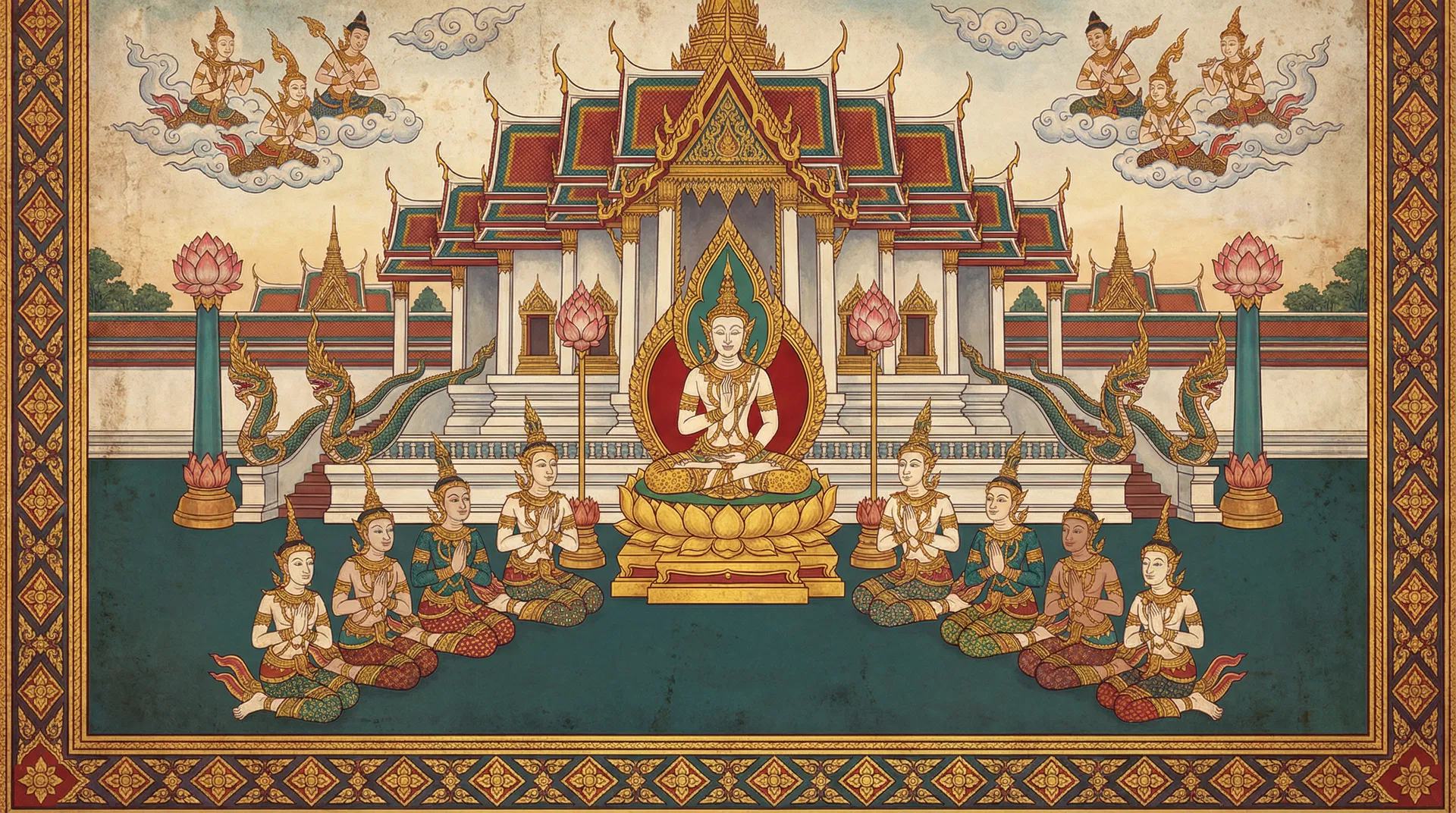
In the magnificent city of Savatthi, there lived a king named Supparaka. King Supparaka was renowned throughout the land not for his military might or his vast riches, but for his unparalleled generosity. His palace gates were always open to the needy, his granaries were always full for the hungry, and his heart was always overflowing with compassion.
One day, a humble mendicant, his body emaciated and his robes tattered, arrived at the city gates. He had traveled for many days, seeking alms, but had found little sustenance. His strength was failing, and despair was setting in. He heard tales of King Supparaka's boundless charity and made his way to the royal palace.
As he approached the palace, he saw a sight that filled him with awe. The king, dressed in simple attire, was personally distributing food to a long line of the poor and destitute. He spoke to each person with kindness, his eyes reflecting their suffering and his smile offering them hope.
The mendicant, his knees trembling, joined the end of the line. When it was his turn, he extended his alms bowl, his hand shaking. King Supparaka looked at him, his gaze gentle and understanding. 'My son,' the king said softly, 'you look weary. Have you eaten today?'
The mendicant, unable to speak, could only nod his head weakly. The king, without a moment's hesitation, took a large portion of the finest rice, mixed with ghee and fragrant spices, from his own plate and placed it into the mendicant's bowl. Then, seeing that the mendicant was too weak to walk, the king offered him a place to rest and a cool drink of water.
As the mendicant ate, his strength slowly returned. He looked at the king, his heart filled with gratitude. 'Your Majesty,' he said, his voice clear now, 'your generosity is truly unmatched. I have traveled far and wide, and I have never witnessed such selfless giving.'
King Supparaka smiled. 'It is not I who am generous, good sir,' he replied. 'It is merely my duty. True generosity is a gift that is given without expectation of return, without seeking praise, and without any thought of the giver's own comfort. It is a gift that springs from a heart that understands the interconnectedness of all beings.'
The mendicant, who was a Bodhisatta in a previous life, was deeply moved by the king's words and actions. He had seen countless acts of charity, but this was different. This was pure, unadulterated giving, motivated by compassion alone. The king's gift was not just food; it was a gift of love, a gift of shared humanity.
Later, the king was visited by a wealthy merchant who had heard of his legendary generosity. The merchant, a proud man who believed he was the most charitable person in the kingdom, brought a lavish gift of silks and jewels. 'Your Majesty,' the merchant declared, 'I have brought you the finest treasures. Surely, no one in this kingdom can match my generosity!'
King Supparaka accepted the gifts with a gracious nod. 'Your offerings are indeed magnificent, noble merchant,' he said. 'But tell me, when you gave these gifts, did you do so expecting something in return? Did you feel a sense of pride in your giving?'
The merchant puffed out his chest. 'Of course! I am a renowned patron of the arts and a pillar of the community! My gifts are known throughout the land!'
The king then recounted the story of the mendicant. 'I gave him my own meal,' the king explained, 'without any thought of reward or recognition. My only desire was to alleviate his suffering. That, merchant, is a gift that is truly unrivaled. For a gift given with a pure heart, expecting nothing in return, is the greatest gift of all. It is a gift that nourishes not only the recipient but also the giver, filling the heart with peace and contentment.'
The merchant, humbled by the king's wisdom, realized the difference between charity motivated by ego and true, selfless giving. He left the palace with a newfound understanding of generosity.
King Supparaka continued to rule with his extraordinary kindness, his acts of generosity becoming legendary. His unwavering commitment to giving without expectation, pure and simple, became the benchmark for true charity, a gift that enriched not only his kingdom but the spiritual landscape of all who heard his story.
— In-Article Ad —
💡Moral of the Story
True generosity is selfless and unconditional. It is given without expectation of reward, without seeking praise, and without any thought of the giver's own comfort. Such giving nourishes both the recipient and the giver, bringing peace and contentment.
Perfection: Generosity (Dana)
— Ad Space (728x90) —
More Jataka Tales You May Enjoy
 277Tikanipāta
Mahilamuga Jataka
The Tale of the Lion King and the Cowardly Jackal Deep within the dense forests of ancient India, wh...
💡 True courage is not the absence of fear, but the ability to act in its presence. Lies and deception thrive on doubt, but can be overcome by truth and steadfastness.
 250Dukanipāta
Sasa Jataka
Sasa JatakaIn a time long past, when the world was young and the forests were vast and untamed, ther...
💡 The greatest gift one can offer is oneself, given freely and with boundless compassion, for the benefit of all.
 547Mahānipāta
Mahāsutasoma Jātaka
The Tale of the Great Sutasoma In the city of Indapatta, ruled a wise and just king named Pāṭaliputt...
💡 The unwavering commitment to truth, even in the face of death, possesses a transformative power that can overcome the deepest darkness and bring about profound change.
 13Ekanipāta
The Steadfast Brahmin
The Steadfast BrahminIn the ancient city of Varanasi, a beacon of spiritual learning, lived a devout...
💡 Unwavering steadfastness and a pure heart can inspire others and lead to rebuilding.
249DukanipātaSarabhanga Jataka
Sarabhanga JatakaIn the ancient land of Gandhara, amidst rolling hills and fertile valleys, lived a ...
💡 True strength lies not in external power or worldly achievements, but in the unwavering discipline and mastery of one's own mind.
67EkanipātaThe Bodhisatta's Compassion for His Foes
In the glorious city of Rājagaha, the capital of Magadha, in an age when kingdoms were often rife wi...
💡 True strength is a combination of physical power, wisdom, and restraint. It is important to protect oneself and one's domain, but to do so without unnecessary violence.
— Multiplex Ad —