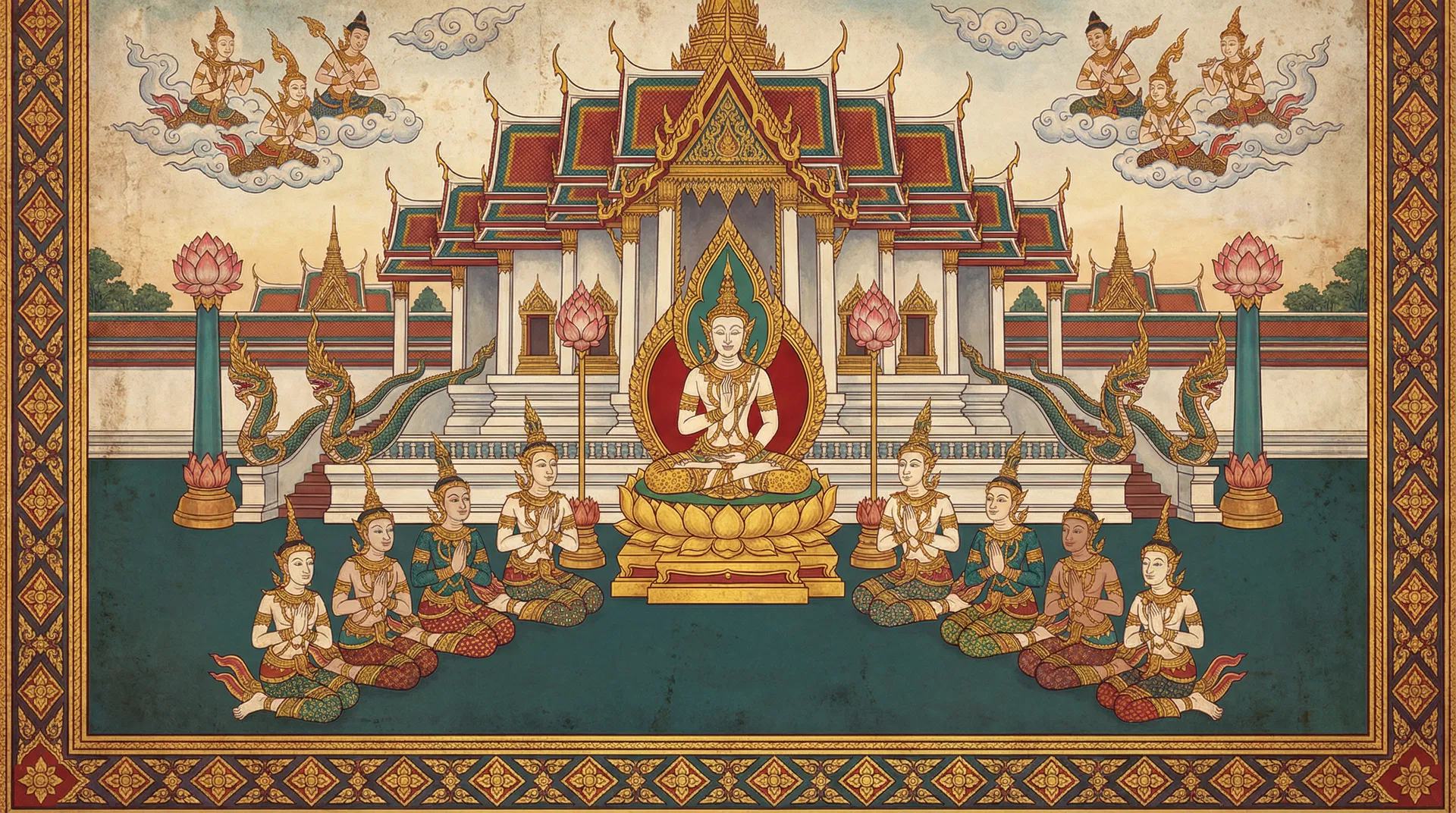
Mahasutasoma Jataka
The Tale of Prince Mahasutasoma
In the ancient kingdom of Kasi, nestled beside the sacred River Ganges, ruled a just and virtuous king. His son, Prince Mahasutasoma, was a young man of exceptional character, renowned for his sharp intellect, his unwavering truthfulness, and his profound understanding of justice. He had studied the ancient scriptures and mastered the art of debate, yet his heart was always inclined towards peace and non-violence.
One day, a neighboring kingdom, ruled by a tyrannical king named Kalasa, launched an unprovoked attack on Kasi. King Kalasa was a brute, driven by greed and a lust for power. His army, a fearsome force, descended upon Kasi, sowing destruction and terror.
The king of Kasi, though valiant, was outnumbered. He knew that to resist would lead to immense bloodshed and suffering for his people. He summoned his son, Prince Mahasutasoma, whose wisdom was already highly respected.
'My son,' the king said, his voice heavy with sorrow, 'Kalasa's army is upon us. I cannot bear the thought of my people being slaughtered. I have decided to offer myself as a sacrifice to spare them. I will go to Kalasa and offer my life in exchange for peace.'
Prince Mahasutasoma was horrified. 'Father, you cannot do this!' he pleaded. 'Your life is precious to our kingdom. We must find another way.'
'There is no other way, my son,' the king replied, his eyes filled with grim resolve. 'My duty is to protect my people. I will go to Kalasa and offer myself.'
Seeing his father's unwavering decision, Prince Mahasutasoma made a courageous vow. 'If you are determined to go, Father, then I shall accompany you. But I will not go as a prince seeking to appease a tyrant. I will go as a warrior of truth. If Kalasa seeks a life, he shall have mine, but only after I have tested his resolve and his understanding of justice. I will not allow you to be sacrificed without a fight for what is right.'
The prince, accompanied by his father, rode to the enemy camp. King Kalasa, arrogant and dismissive, sneered when he saw them. 'So, the King of Kasi offers himself as tribute? You are wise to do so. Your kingdom is mine.'
Prince Mahasutasoma stepped forward, his voice clear and firm. 'Hold, King Kalasa! You come with an army, seeking to claim our land through violence. But true kingship is not built on brute force, but on justice and wisdom. Before you shed more blood, I challenge you to a contest of wits and truth. If you can defeat me in a battle of words, if you can prove your claim to be just, then you may have our kingdom. But if I prevail, you will turn your army back and leave Kasi in peace.'
Kalasa, amused by the prince's audacity, agreed. He was confident in his power and believed he could easily crush this young prince. The two kings and their courts gathered, and Prince Mahasutasoma began his discourse.
He spoke of the principles of righteous kingship, of the suffering caused by war, and of the inherent value of every life. He questioned Kalasa's motives, pointing out the injustice of his aggression. He argued that a king's true strength lay not in the size of his army, but in the righteousness of his rule and the well-being of his people.
'A kingdom built on violence is like a house built on sand,' the prince declared. 'It will inevitably crumble. True power comes from compassion, from fairness, and from a commitment to truth. You seek to conquer Kasi, but what will you gain? More land to govern, more people to oppress, more suffering to endure. Is this the legacy you wish to leave?'
King Kalasa, accustomed to fear and obedience, found himself unable to counter the prince's eloquent arguments. His own advisors, witnessing the prince's wisdom and the hollowness of Kalasa's claims, began to murmur their doubts.
The prince continued, his voice gaining strength. 'If you truly wish to be a great king, then prove it not by conquest, but by compassion. Turn your army back, make peace with Kasi, and let us build a future based on mutual respect, not on fear. This is the path of true strength, the path of a king who serves his people, not his own ego.'
The debate raged on, with Prince Mahasutasoma skillfully dismantling Kalasa's justifications for war. He spoke of the unity that true justice fostered, and the division that violence inevitably brought. He appealed to the basic humanity within Kalasa, reminding him of the suffering his actions had already caused.
Finally, King Kalasa, defeated not by the sword but by the power of truth and reason, fell silent. He looked at his army, who seemed hesitant and weary of war. He looked at his own advisors, who were clearly impressed by the prince. The prince's words had struck a chord, revealing the futility and injustice of his ambition.
With a heavy heart, Kalasa finally spoke. 'Prince Mahasutasoma,' he admitted, his voice devoid of its former arrogance, 'you have defeated me. Your wisdom is indeed unrivaled. I have been a fool, blinded by my own ambition. I will turn my army back. I will make peace with your father.'
A great sigh of relief swept through the assembled people. Prince Mahasutasoma, having secured peace through his unwavering commitment to truth and justice, bowed to his father. The king of Kasi, tears of gratitude streaming down his face, embraced his son. The two kingdoms, instead of being plunged into war, began a new chapter of peaceful coexistence, thanks to the courage and wisdom of Prince Mahasutasoma.
The prince's victory became a legend, a testament to the fact that true strength does not lie in physical might, but in the power of truth, wisdom, and compassion. He demonstrated that even the most formidable challenges can be overcome not by violence, but by the unyielding pursuit of justice and the courage to speak truth to power.
— In-Article Ad —
💡Moral of the Story
True strength lies not in physical might or conquest, but in the power of truth, wisdom, and compassion. Justice and righteous reasoning can overcome violence and tyranny, preserving peace and the well-being of all.
Perfection: Truthfulness (Sacca), Determination (Adhitthana), Wisdom (Prajna)
— Ad Space (728x90) —
More Jataka Tales You May Enjoy
 424Aṭṭhakanipāta
Sarabhaṅga Jātaka
Sarabhaṅga JātakaIn the ancient land of Gandhāra, nestled amidst snow-capped mountains and whisperin...
💡 True peace is cultivated from within and achieved through understanding, compassion, and wisdom, not through violence or the imposition of power. Inner resilience is the greatest defense against external aggression.
 113Ekanipāta
Mahāgovinda Sutta Jātaka
Mahāgovinda Sutta Jātaka In the opulent city of Varanasi, a kingdom blessed with peace and prosperit...
💡 True wisdom lies in maintaining balance and equanimity in the face of both pleasure and adversity. Integrity and unwavering loyalty are the foundations of trust.
87EkanipātaJataka Tale No. 87: The Tale of the Wise Elephant
Jataka Tale No. 87: The Tale of the Wise Elephant In the annals of ancient wisdom, there are ta...
84EkanipātaUdapāna Jātaka
Udapāna Jātaka In a sun-scorched desert, where the sands stretched endlessly under a blazing sky, li...
💡 In times of hardship and despair, perseverance, faith, and collective effort are essential to overcoming challenges and finding solutions.
 176Dukanipāta
Mahāsuka Jātaka
Mahāsuka JātakaIn the ancient city of Mithila, nestled amidst lush gardens and bustling marketplaces...
💡 True happiness is not found in external possessions or fleeting pleasures, but in the cultivation of inner peace, wisdom, and virtue. The greatest treasure is the joy of a contented mind, free from the bondage of insatiable desires.
246DukanipātaKosiya Jataka
Kosiya JatakaIn the ancient city of Mithila, nestled amidst lush gardens and bustling marketplaces, ...
💡 True wealth is not measured in material possessions, but in the depth of one's compassion and the extent of one's generosity towards others.
— Multiplex Ad —