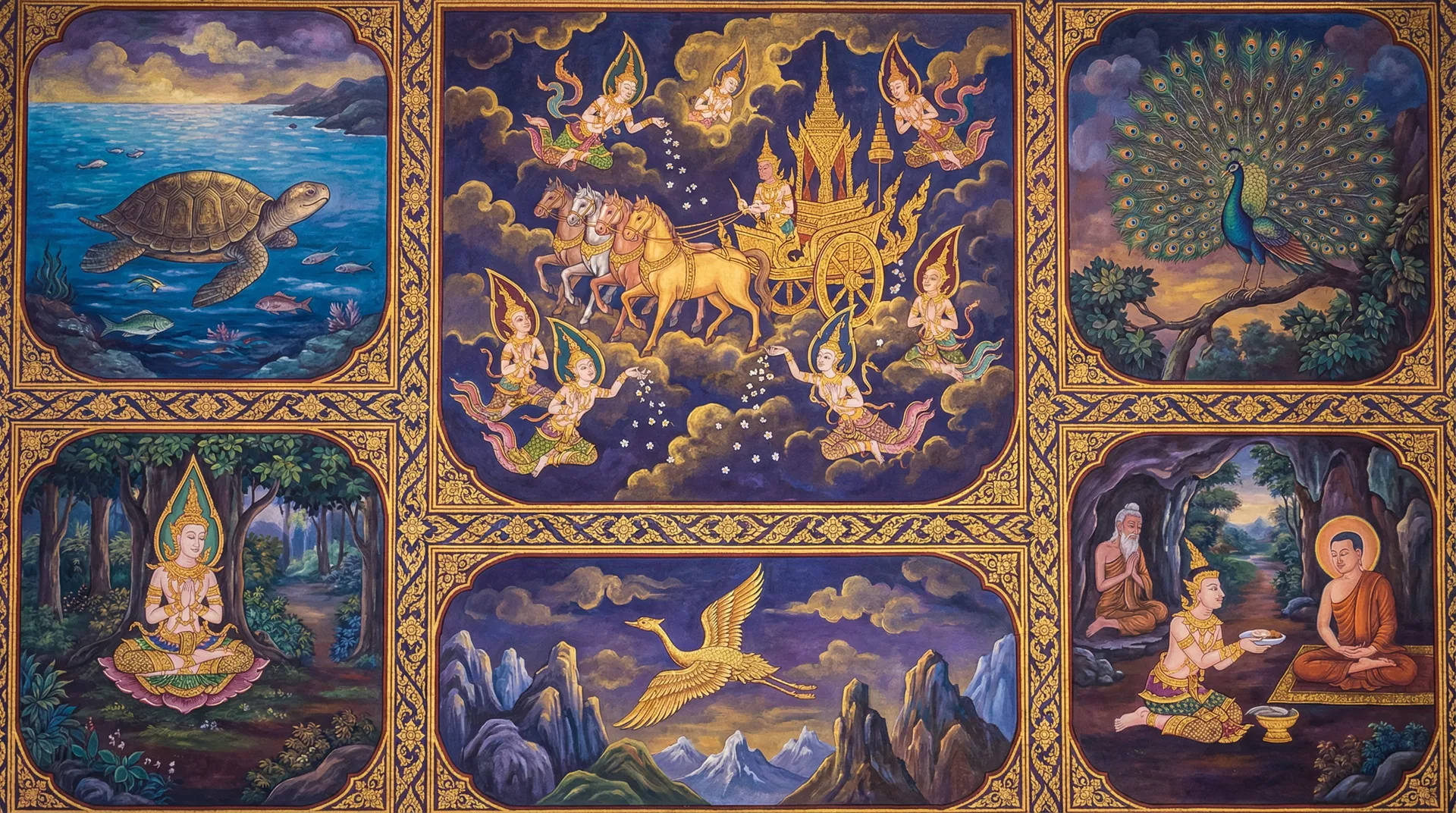
Sankha-Jataka
Sankha-Jataka
In the bustling city of Varanasi, amidst a labyrinth of narrow lanes and vibrant marketplaces, lived a wealthy merchant named Dhanapala. He was a man of great repute, known not only for his vast fortune amassed through shrewd trading but also for his unwavering honesty and generosity. His heart was as open as his coffers, and he was always ready to lend a helping hand to those in need. However, even the most virtuous can face trials that test the very core of their being.
Dhanapala had a son, named Sankha, who, while inheriting his father's good looks, lacked his father's discerning wisdom. Sankha was easily swayed by flattery and prone to impulsive decisions, often leading him down paths of folly. Dhanapala, though he loved his son dearly, often worried about his son's immaturity and his susceptibility to bad influences.
One day, a notorious rogue, known for his cunning and deceitful nature, infiltrated Dhanapala's household. This rogue, named Malaka, disguised himself as a humble servant, waiting for an opportune moment to exploit Sankha's naivety. He befriended Sankha, showering him with praise and indulging his every whim. "Oh, young master," Malaka would coo, "you are destined for greatness! Your father's wealth is but a fraction of what you deserve. Such a brilliant mind as yours should be managing vast enterprises, not being confined by the cautious ways of an old merchant."
Sankha, flattered by Malaka's words, began to feel restless. He believed Malaka's pronouncements and started to question his father's judgment. He yearned for adventure and a taste of the extravagant life Malaka described.
One evening, while Dhanapala was away on a trading expedition, Malaka seized his chance. "Master Sankha," he whispered conspiratorially, "your father has hidden a secret treasure, a hoard of jewels that would make you the richest man in Varanasi. I know where it is hidden, but we must act quickly before anyone else discovers it." He led a bewildered Sankha to a secret chamber in their mansion, a chamber filled not with jewels, but with ancient scrolls and rare artifacts that Dhanapala had meticulously collected over the years, each holding immense cultural and historical value.
Malaka, feigning excitement, pointed to a particularly ornate chest. "This, young master, contains the most precious jewels!" Sankha, blinded by greed and Malaka's manipulative words, eagerly opened it. Inside, instead of glittering gems, they found a collection of rare medicinal herbs and ancient texts on healing, painstakingly gathered by Dhanapala for the sole purpose of aiding the sick and needy in the community.
Malaka, pretending to be disgusted, exclaimed, "What a disappointment! These are mere herbs and books! Where are the jewels? Your father has deceived you!" He then convinced Sankha that his father was hoarding the real treasure for himself and that they should take what they could and flee.
In his haste and misguided anger, Sankha, under Malaka's influence, began to dismantle his father's collection, carelessly scattering the precious herbs and texts. Malaka, meanwhile, secretly pocketed a few valuable, albeit small, artifacts he found amidst the confusion.
When Dhanapala returned, he was devastated. He found his study in disarray, his life's work disrupted, and his son, Sankha, confessing his misguided actions, tears streaming down his face. Dhanapala, though heartbroken, did not scold his son harshly. Instead, he sat Sankha down and explained the true value of what had been scattered. "My son," he said, his voice filled with sorrow, "these were not ordinary herbs or books. These were the tools of compassion, meant to alleviate suffering. Each herb held the power to heal, and each text contained wisdom to guide us in caring for the sick. The true treasure was not gold or jewels, but the ability to help those in need."
He then revealed that Malaka was a notorious swindler who had taken advantage of Sankha's youthful impetuosity. The small artifacts Malaka had stolen were of little monetary value, but their sentimental importance to Dhanapala was immense, representing years of dedicated work and service to the community.
Sankha, realizing the gravity of his mistake and the depth of his father's kindness, was filled with remorse. He vowed to dedicate himself to understanding the true meaning of wealth and service. With his father's guidance, Sankha began to learn about the medicinal properties of the herbs and the wisdom contained within the ancient texts. He worked tirelessly to restore his father's collection and, under Dhanapala's tutelage, learned to use the herbs to heal the sick, becoming a skilled healer and a compassionate caregiver.
The people of Varanasi rejoiced as Sankha, transformed by his experience, dedicated his life to the practice of healing and service, following in his father's virtuous footsteps. The story of Sankha became a reminder that true wealth lies not in material possessions, but in the knowledge and compassion that allow us to serve others and alleviate suffering.
— In-Article Ad —
💡Moral of the Story
True wealth is not measured in material possessions, but in the knowledge and compassion that enable us to serve others and alleviate suffering. Youthful impetuosity, if unchecked, can lead to great regret.
Perfection: Wisdom (Prajna Paramita), Patience (Khanti Paramita), Compassion (Karuna Paramita)
— Ad Space (728x90) —
More Jataka Tales You May Enjoy
 306Catukkanipāta
Mahā-Ummagga Jātaka
The Great Tunneling TaleLong ago, in the ancient city of Mithila, ruled a wise and just king named J...
💡 True wisdom lies not just in knowledge, but in the ability to apply it with perseverance and compassion to overcome adversity. Even the most daunting challenges can be surmounted with a clear vision, unwavering determination, and the unity of a community.
 529Mahānipāta
Mahā-pattakajātaka
The Tale of the Generous King In the ancient land of Kalinga, renowned for its fertile fields and pr...
💡 The greatest act of generosity is the selfless offering of oneself for the well-being of others. True giving comes from the heart and involves sacrifice.
 369Pañcakanipāta
MULAKAPAKSIYA JATAKA
MULAKAPAKSIYA JATAKAIn the vast and verdant forests of India, where ancient trees whispered secrets ...
💡 Pride and overconfidence can lead to great danger. True strength lies in wisdom, caution, humility, and collective effort. Learning from mistakes and cooperating with others are essential for survival and well-being.
310CatukkanipātaSamkicca Jātaka
The Humble Merchant's ResolveIn the bustling city of Varanasi, there lived a merchant named Samkicca...
💡 True strength lies not in physical might or aggression, but in unwavering resolve, unity, and the courage to face adversity with a determined spirit. Collective action and inner fortitude can overcome even the most daunting threats.
313CatukkanipātaSasa Jataka
Sasa JatakaIn the dappled sunlight of a vast forest, where ancient trees whispered secrets to the wi...
💡 Selfless sacrifice and boundless compassion are the highest virtues, offering the greatest merit and inspiring all beings.
 49Ekanipāta
The Bodhisatta as the Bodhi Tree
The Bodhisatta as the Bodhi TreeIn a tranquil corner of the great forest, where the air was thick wi...
💡 True patience and generosity are unwavering, offering sanctuary and life, and inspire others to choose compassion over destruction.
— Multiplex Ad —