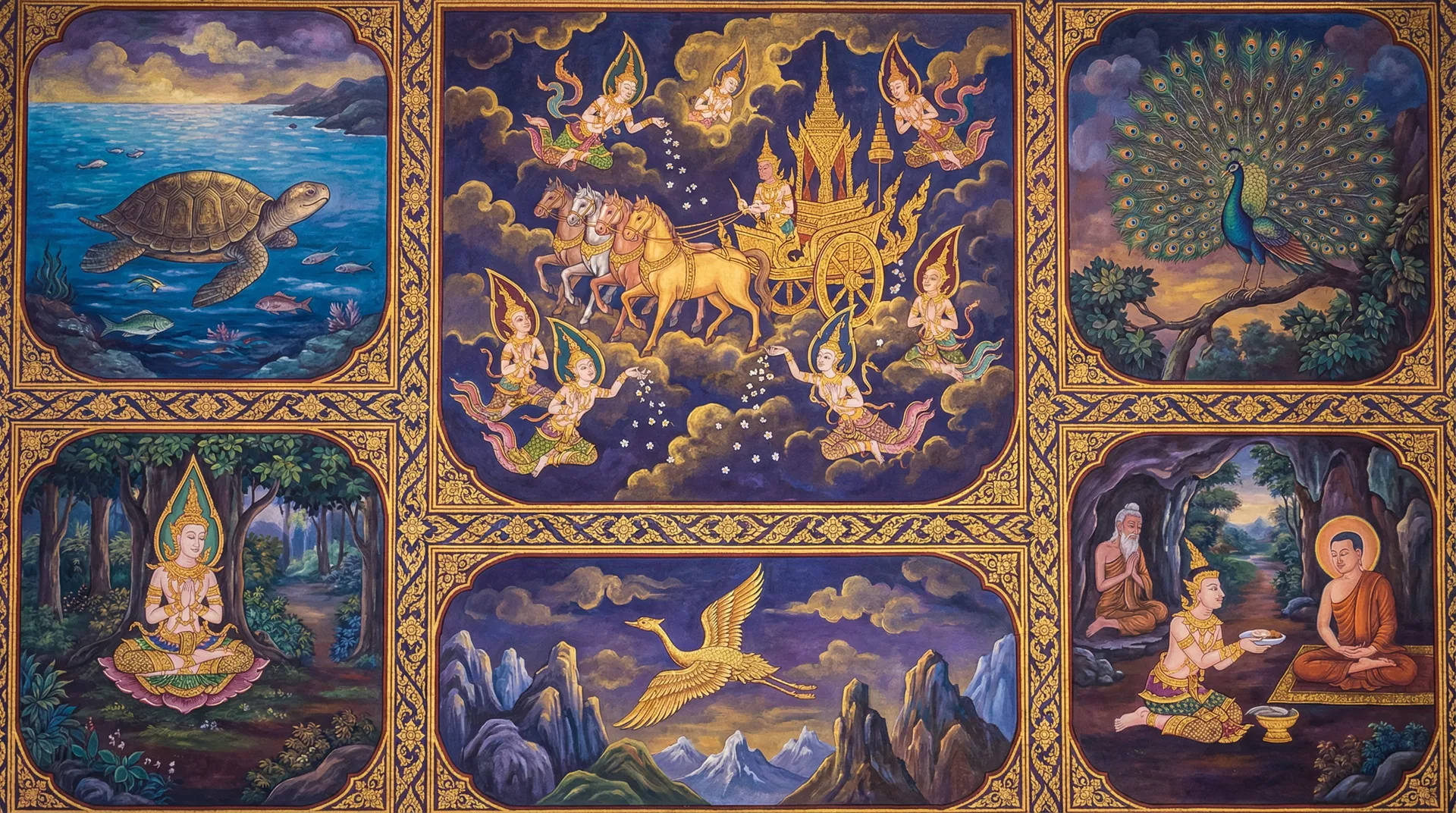
Sama Jataka
Sama Jataka
In the tranquil foothills of the Himalayas, where the air was crisp and the scent of pine needles filled the forest, lived a young hermit named Sama. His parents, an elderly couple who had long renounced worldly life to seek spiritual enlightenment, had settled in a secluded hermitage. Sama, devoted and dutiful, was their sole caregiver. He would venture into the dense jungle each day to gather fruits, roots, and medicinal herbs for his aging parents, and fetch pure water from a crystal-clear stream. His life was one of simplicity, devotion, and profound filial piety.
One sweltering afternoon, as Sama was returning to his hermitage, his arms laden with provisions, he stopped by the stream to quench his thirst. As he bent down to drink, a hunter, hidden in the dense foliage, mistook the glint of the water he had disturbed for the movement of prey. Without a second thought, the hunter loosed an arrow. The arrow, swift and true, struck Sama in the chest, and he fell to the ground, mortally wounded.
The hunter, realizing his tragic mistake, emerged from his hiding place. He was a rough man, hardened by the harshness of his life, but upon seeing the young hermit lying in his blood, a flicker of shock and regret crossed his face. Sama, in his final moments, with immense compassion and concern, spoke not of his own pain, but of his parents.
"Good sir," Sama whispered, his voice weak, "I am Sama, a hermit's son. My parents are old and infirm. They depend entirely on me for their sustenance. Please, I beg you, go to my hermitage and inform them of my fate. Tell them that their son has met with an accident." He could barely breathe, but his only thought was for the sorrow his death would bring to his beloved parents.
The hunter, deeply moved by Sama's selfless concern and his lack of anger, felt a profound sense of shame. He had never encountered such purity of heart. He promised to deliver the message and rushed to the hermitage. Upon hearing the terrible news, Sama's parents were grief-stricken. The mother, overcome with sorrow, cried out, "Oh, my son! Our only light! If Sama is gone, what shall become of us?" The father, equally devastated, lamented, "Our years are many, and our strength is gone. Without Sama, we cannot survive."
In their immense grief, the mother prayed to the gods, "If we have lived a life of virtue and devotion, if our lives have been pure, then may our son be restored to us!" The father, echoing her plea, added, "May our righteousness grant our son life!"
As their sincere prayers filled the air, a divine intervention occurred. The arrow that had pierced Sama, imbued with the power of his parents' unwavering virtue and his own profound filial piety, miraculously dissolved. Sama, who had been on the brink of death, found his wounds healing. He felt a surge of strength and life returning to him. He rose to his feet, whole and unharmed, as if nothing had happened.
He rushed back to the hermitage, where his parents wept with joy and relief at his miraculous return. They embraced him tightly, tears of happiness flowing freely. The hunter, who had witnessed this extraordinary event from a distance, was astounded. He approached the family, bowed deeply, and begged for forgiveness. Sama, true to his compassionate nature, forgave him, and the hunter, deeply touched by the family's virtue and forgiveness, vowed to change his ways and never again harm another living being.
The family continued to live in their secluded hermitage, their bond of love and devotion strengthened by the ordeal. Sama's story became a legend, a testament to the power of filial piety, the purity of selfless love, and the efficacy of sincere prayer born from a life of virtue. It taught all who heard it that unwavering devotion to one's parents and a life lived with righteousness can bring about miracles and protect one from harm.
— In-Article Ad —
💡Moral of the Story
Filial piety (devotion to parents) and a life lived with unwavering virtue and sincerity possess immense power, capable of overcoming even the gravest of misfortunes.
Perfection: Devotion to Parents (Mata-Pita Bhakti) and Truthfulness (Sacca)
— Ad Space (728x90) —
More Jataka Tales You May Enjoy
 526Mahānipāta
Mūga-pakkhajātaka
The Tale of the Silent Swan In the ancient kingdom of Mithila, nestled amidst rolling hills and verd...
💡 True wisdom can be cultivated in silence, and the ability to observe and understand is a powerful weapon. Sometimes, the most profound insights come from those who listen more than they speak.
 198Dukanipāta
Mahosadha Jātaka
The Tale of the Brilliant Sage MahosadhaIn the magnificent city of Mithila, there lived a Bodhisattv...
💡 True ownership is demonstrated through genuine care, responsibility, and concern for the well-being of what one possesses, rather than mere assertion of claim or possession.
171DukanipātaMahīsosaka Jātaka
Mahīsosaka JātakaIn the ancient kingdom of Mithila, nestled amongst rolling hills and verdant forest...
💡 True loyalty and affection cannot be bought or coerced. The worth of a creature, or a person, is not determined by external forces but by their inner spirit and their bonds with those who truly care for them.
159DukanipātaNimi Jataka
Nimi JatakaIn the ancient land of Videha, there ruled a king named Nimi. King Nimi was a paragon of ...
💡 Understanding the law of karma and the consequences of one's actions is essential for cultivating virtue and progressing towards liberation.
 118Ekanipāta
Udaya Jataka
Udaya Jataka In the kingdom of Mithila, a land renowned for its skilled artisans and vibrant markets...
💡 True wisdom lies in discerning truth from falsehood, and in valuing integrity and honesty above material gain or superficial promises. Appearances can be deceiving; a sharp mind and a pure heart are the best defenses against deception.
172DukanipātaKacchapa Jātaka
Kacchapa JātakaIn the heart of a lush jungle, where ancient trees whispered secrets to the wind and ...
💡 Deception and trickery may offer temporary amusement, but they ultimately lead to suffering. True wisdom lies in honesty, integrity, and using one's abilities for the good of all.
— Multiplex Ad —