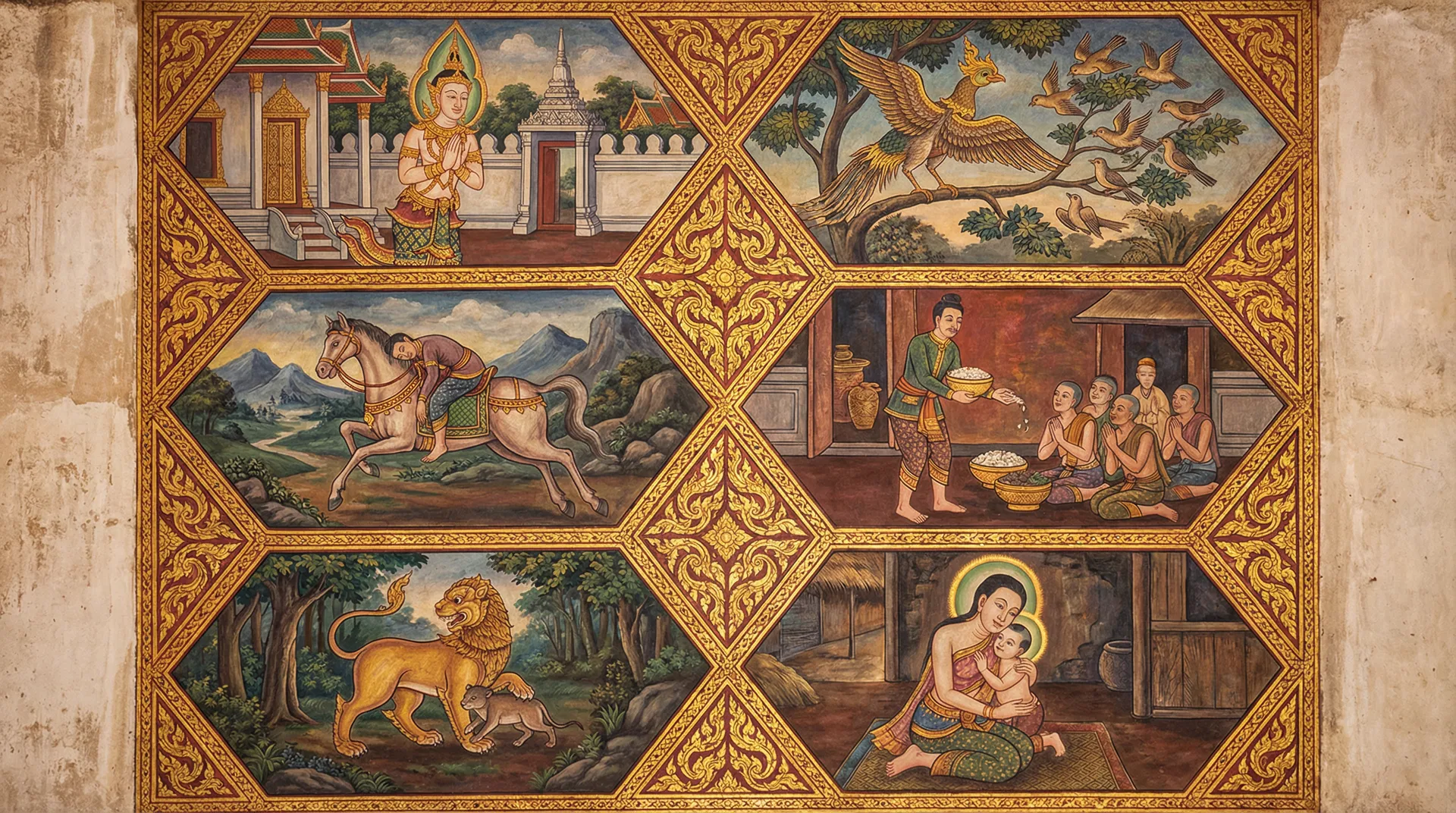
Mugapakkha Jataka
Mugapakkha Jataka
In the heart of a lush, ancient forest, where sunlight dappled through emerald canopies and the air hummed with the symphony of unseen creatures, there once lived a wise and compassionate Bodhisatta. In this lifetime, he was born as a king, a just ruler named King Mugapakkha, whose reign was marked by unparalleled peace and prosperity. His kingdom was a haven, a place where even the smallest sparrow felt safe and the mightiest lion walked with gentle paws. The King himself was a paragon of virtue, his wisdom as deep as the ocean and his kindness as boundless as the sky.
However, even in such a perfect realm, the whispers of envy and deceit could not be silenced. The King had a younger brother, Prince Aggipakkha, whose heart was a dark cavern filled with ambition and resentment. While the King ruled with an open hand and a loving heart, Prince Aggipakkha schemed in the shadows, his eyes fixed on the throne. He resented his brother's popularity, his wisdom, and the love the people showered upon him. 'Why should he, so gentle and mild, rule when I possess the strength and the will?' he would often muse, his voice a venomous hiss in the quiet chambers.
One day, Prince Aggipakkha, unable to bear his envy any longer, devised a treacherous plan. He approached the King with a feigned smile, his eyes glinting with malice. 'My dearest brother,' he began, his voice dripping with false affection, 'I have heard tales of a magnificent jewel, a gem of unparalleled beauty, said to be hidden deep within the treacherous peaks of Mount Gandhamadana. It is said that this jewel has the power to bestow eternal youth and unmatched strength upon its possessor. I wish to embark on a perilous journey to find it, for the good of our kingdom, so that our reign may be strengthened.'
King Mugapakkha, whose heart was pure and trusting, saw no deceit in his brother's words. He was a man who believed in the inherent goodness of all beings. 'My brother,' he replied, his voice warm and encouraging, 'your courage and your dedication to our kingdom are commendable. I shall offer you my full support. Take with you the finest of our warriors and the most abundant provisions. May your quest be fruitful and your return swift.'
Prince Aggipakkha, however, had no intention of returning. His plan was far more sinister. He gathered a contingent of loyal, yet misguided, soldiers and set off towards Mount Gandhamadana. He led them through winding paths and treacherous ravines, far from any known routes. After several days of arduous travel, they reached a desolate, rocky plateau, far from any signs of civilization. Here, Prince Aggipakkha revealed his true intentions.
'My loyal followers,' he announced, his voice echoing with a chilling authority, 'our journey ends here. I have no interest in any mythical jewel. My true desire is the throne of our kingdom, and to achieve it, my brother, King Mugapakkha, must be removed.' The soldiers, bound by loyalty and perhaps fear, were shocked. Some questioned his madness, while others, swayed by promises of power and riches, nodded in agreement.
Meanwhile, back in the kingdom, King Mugapakkha, ever the concerned ruler, felt a strange unease. Days turned into weeks, and still, no word came from his brother. He sent out scouts to search for him, but they returned with no news. The King's heart grew heavy with a premonition of disaster. He decided to set out himself, disguised as a humble traveler, accompanied by only a few trusted, silent guards. He wanted to understand what had delayed his brother and if any harm had befallen him.
The King, following the faint trail left by his brother's large entourage, eventually arrived at the desolate plateau. He heard the murmur of voices and, concealing himself behind a cluster of boulders, he witnessed a horrifying scene. Prince Aggipakkha was addressing his soldiers, his face contorted with ambition, revealing his plot to usurp the throne and likely harm the King. King Mugapakkha's heart ached, not with anger, but with profound sorrow. He had always believed in his brother, in the bond of blood, and this betrayal cut him deeply.
As Prince Aggipakkha was about to give his final command to his soldiers, King Mugapakkha stepped out from his hiding place. His presence startled everyone. Prince Aggipakkha, his face paling, stammered, 'Brother! What are you doing here?'
King Mugapakkha, his voice calm and sorrowful, spoke, 'Aggipakkha, I came seeking you, worried for your safety. But instead, I find a brother plotting against his own kin, against his kingdom.' He looked at the soldiers, his gaze filled with compassion. 'And you, brave warriors, are you so easily swayed by greed and ambition that you would betray your sworn duty and your people?'
Prince Aggipakkha, cornered and enraged, drew his sword. 'You speak of duty and people? I speak of power! And it shall be mine!' He lunged at the King. The King, though a man of peace, was not without skill. He expertly dodged his brother's frenzied attacks, his movements fluid and controlled. His guards, seeing their King in danger, moved to intervene, but the King held up a hand, signaling them to stand down. He wanted to resolve this without further bloodshed if possible.
During the struggle, Prince Aggipakkha, in his blind fury, stumbled and fell. As he lay on the ground, defeated and humiliated, the King stood over him, not with triumph, but with a deep sadness. 'Aggipakkha,' the King said softly, 'look at what your ambition has led you to. You have betrayed your family, your people, and your own noble spirit. Is this the life you envisioned?'
The soldiers, witnessing their prince's downfall and the King's magnanimity, began to murmur amongst themselves. They saw the King's unwavering composure, his compassion even in the face of betrayal. They realized the error of their ways and bowed their heads in shame.
Prince Aggipakkha, stripped of his pride and his power, finally saw the abyss into which he had nearly plunged. The King, seeing a flicker of remorse in his brother's eyes, offered him a choice. 'You may return with me, and we shall work to heal this rift, or you may go your own way, but know that the path of deceit leads only to ruin.'
Humbled and broken, Prince Aggipakkha chose to return. The King, true to his benevolent nature, did not punish him harshly. Instead, he guided his brother, helping him to understand the true meaning of leadership and brotherhood. He taught him that true strength lies not in wielding a sword, but in wielding compassion and wisdom. Prince Aggipakkha, under his brother's patient tutelage, gradually shed his envy and ambition, eventually becoming a loyal and helpful prince.
The kingdom rejoiced at the King's safe return and his unwavering compassion. The tale of King Mugapakkha and his brother spread far and wide, a testament to the power of forgiveness and the enduring strength of a benevolent heart. The King continued to rule his kingdom with justice and kindness, his reign a beacon of hope and peace, forever remembered for his profound patience and his ability to see the good, even in the darkest of hearts.
— In-Article Ad —
💡Moral of the Story
True strength lies not in power or ambition, but in compassion, forgiveness, and unwavering virtue. Even the deepest betrayal can be overcome by a benevolent heart.
Perfection: Patience (Khanti) and Forgiveness (Khama)
— Ad Space (728x90) —
More Jataka Tales You May Enjoy
 322Catukkanipāta
Mahamora Jataka
Mahamora JatakaIn a lush and verdant forest, teeming with life and vibrant with the songs of countle...
💡 True wealth and lasting happiness are not found in material possessions or the satisfaction of greed, but in wisdom, contentment, compassion, and a life lived virtuously. Wisdom and compassion have the power to transform even the most hardened hearts.
 183Dukanipāta
Muḷapariyāya Jātaka
The Tale of the Root of All EvilIn the ancient and prosperous city of Varanasi, ruled a king named B...
💡 The root of all suffering and evil lies within the human mind, stemming from craving, attachment, and ignorance. True peace is found by understanding and overcoming these internal afflictions.
177DukanipātaKuṅku Jātaka
Kuṅku JātakaIn the verdant plains of Kosala, where emerald rice paddies stretched as far as the eye ...
💡 True strength and peace originate from within. External objects, however comforting, cannot replace inner resilience, wisdom, and the courage to face adversity with integrity. Letting go of attachments, even cherished ones, can be an act of liberation.
209DukanipātaSona Nataka
Sona Nataka In the ancient kingdom of Uttarapatha, nestled between rugged mountains and vast plains,...
💡 True worth is measured not only by skill and achievement but by the depth of one's compassion and the willingness to prioritize the well-being of others, especially during times of hardship.
 76Ekanipāta
The Tale of the Fragrant Tree
The Tale of the Fragrant Tree In the heart of a vast and ancient forest, where sunlight dappled thr...
💡 Curiosity, coupled with the courage to learn new things, can lead to great discoveries that benefit society.
 260Tikanipāta
Mahākapi Jātaka
Mahākapi JātakaIn the verdant kingdom of Benares, ruled a just and wise king named Brahmadatta. His ...
💡 True leadership is defined by selfless sacrifice and unwavering protection of one's followers.
— Multiplex Ad —