
Mahākapi Jātaka
Mahākapi Jātaka
In the verdant kingdom of Benares, ruled a just and wise king named Brahmadatta. His reign was prosperous, but his heart was filled with a profound curiosity about the nature of leadership and the sacrifices it entails. One evening, as he gazed at the moonlit Ganges River, he pondered the qualities of a true leader. His chief queen, a woman of immense intelligence and foresight, suggested they recall the story of the Mahākapi Jātaka, a tale from a previous existence that illuminated the path of selfless leadership.
Long, long ago, in a time when the world was a wild and wondrous place, the Bodhisattva was born as a great ape, a magnificent king of the monkeys, who ruled over a vast troop in the dense forests of the Himalayas. This was no ordinary ape; he was the king of all the monkeys, a creature of immense strength, intelligence, and unwavering compassion. His fur was the colour of the deepest night, and his eyes held the wisdom of ages.
The monkey king and his troop lived in a beautiful grove of mango trees that grew on the banks of the river, their sweet fruits providing sustenance for all. The king guarded his troop fiercely, ensuring their safety and well-being. He was a just ruler, his decisions always prioritizing the welfare of his followers.
One day, the king of Benares, Brahmadatta, was hunting in the forest. He ventured further than usual and stumbled upon the monkey king's grove. Entranced by the abundance of ripe mangoes and the sheer beauty of the place, he and his men began to feast, plucking mangoes with abandon.
The monkey king, seeing the disruption and the potential danger to his troop, emerged from the trees. He did not attack the humans, for he understood the difference between necessity and greed. Instead, he gathered his troop and led them to a higher, more secluded part of the forest, far from the riverbank, to escape the intrusion.
However, King Brahmadatta, angered by the monkeys' flight and driven by a desire to capture their magnificent leader, ordered his hunters to pursue them. The monkeys, terrified, scattered in all directions. The monkey king, seeing his troop in peril, knew he had to act.
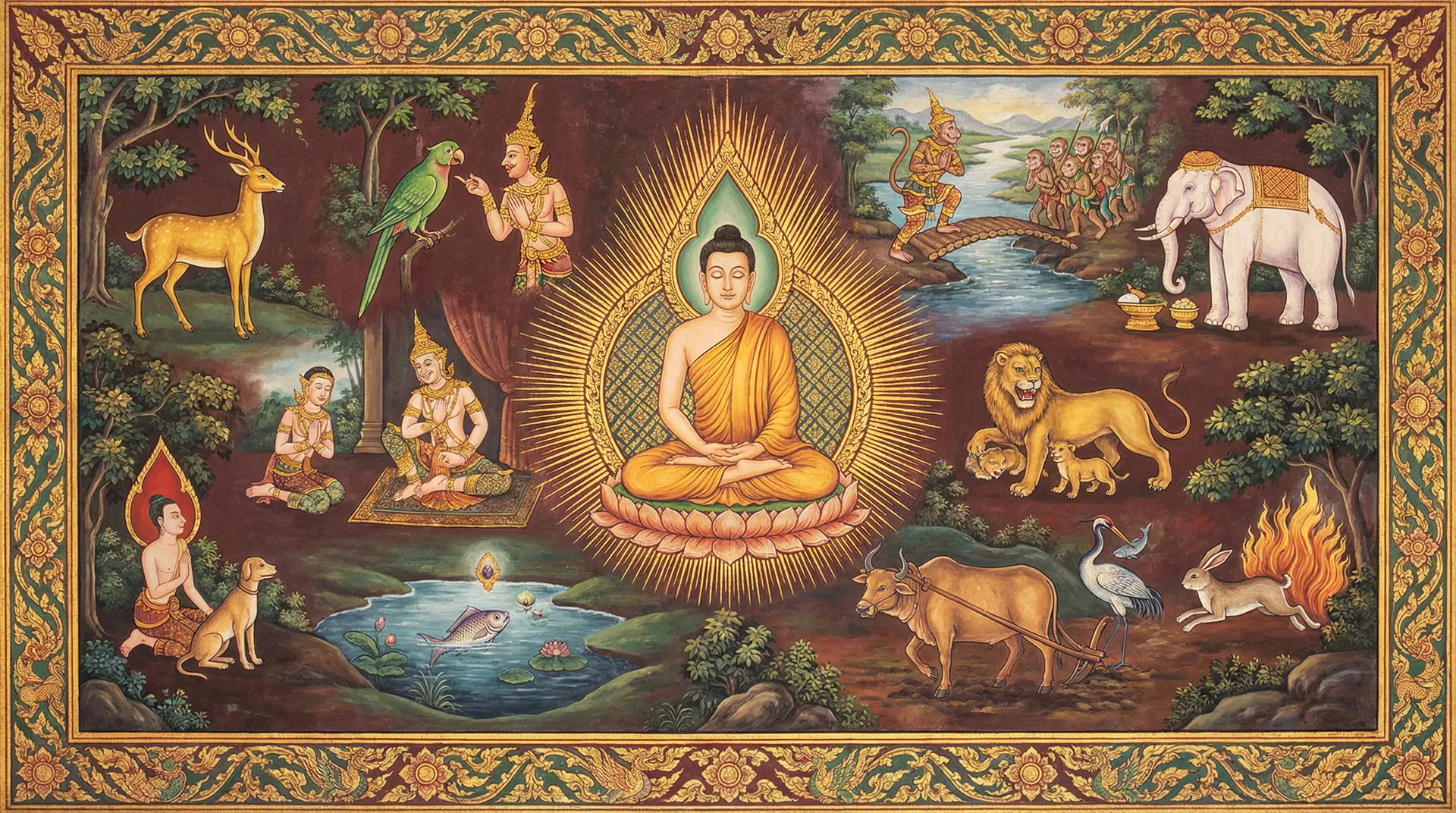
He devised a daring plan. He climbed to the highest branch of a tall tree that stood on the edge of the precipice overlooking the river. He then stretched himself out, grasping the tree with his feet, and extended his body across the chasm. His intention was to create a living bridge, a path for his troop to escape across the river to safety, while he himself would bear the brunt of the king's men's attention.
As he held his position, King Brahmadatta, seeing this extraordinary act, realized the immense sacrifice the ape was willing to make. The monkey king's body was stretched taut, his muscles straining, his life hanging precariously in the balance. He was a living bridge, a symbol of ultimate selflessness.
The king's men, armed with weapons, were about to charge across the ape's body when the monkey king, with his last ounce of strength, called out to the king. "O King! I have saved my troop. Now, you have me. If you wish to capture me, do so. But know that I have acted out of compassion for my followers, and this act is my testament."
King Brahmadatta was profoundly moved. He saw not an animal, but a leader of unparalleled courage and dedication. He witnessed a sacrifice so profound that it shook him to his core. He realized that this ape embodied qualities of leadership he himself had strived for but never fully achieved.
With tears in his eyes, the king ordered his men to stand down. He approached the monkey king, who, exhausted from his incredible effort, began to lose his grip. The king gently caught the Bodhisattva ape as he fell, preventing him from hitting the ground. He treated the injured ape with the utmost respect and care.
The monkey king, though weakened, looked at the king with eyes full of wisdom. "O King," he said, his voice raspy, "true leadership is not about power or conquest, but about protecting those who depend on you, even at the cost of your own life. It is about understanding the needs of your followers and acting with compassion and courage."
The king of Benares, humbled by the ape's wisdom and sacrifice, learned a valuable lesson. He realized that his pursuit of fame and conquest was hollow compared to the profound nobility of selfless service. He returned to his kingdom with a changed heart, resolving to rule with greater compassion and to prioritize the well-being of his subjects above all else.
Queen Yasodhara concluded her story to King Brahmadatta. "The Bodhisattva, in his life as the great monkey king, demonstrated the ultimate act of selfless leadership. His willingness to offer his own body as a bridge to save his troop exemplified the highest form of protective compassion and courage. This sacrifice, witnessed by the king, transformed his understanding of true kingship, inspiring him to rule with greater empathy and dedication."
King Brahmadatta, reflecting on the tale, understood the profound truth of the monkey king's words. He resolved to embody the spirit of selfless leadership, understanding that the true measure of a ruler was not in the extent of their power, but in the depth of their compassion and the sacrifices they made for their people.
— In-Article Ad —
💡Moral of the Story
True leadership is defined by selfless sacrifice and unwavering protection of one's followers.
Perfection: Compassion (Karunā) and Courage (Viriyā)
— Ad Space (728x90) —
More Jataka Tales You May Enjoy
 444Dasakanipāta
Mahasutasoma Jataka
Mahasutasoma JatakaIn the glorious city of Indapatta, the Bodhisatta was born as a prince named Maha...
💡 True prosperity and spiritual advancement come from inner transformation, compassion, and the renunciation of selfish desires, not from violence or external rituals.
 98Ekanipāta
The Bodhisattva as Prince Kumara
In the magnificent city of Varanasi, under the benevolent reign of King Brahmattata, who upheld the ...
💡 True wisdom lies in understanding the consequences of actions and choosing the path of righteousness, rather than succumbing to anger, hatred, or fear.
82EkanipātaKaccāpabha Jātaka
Kaccāpabha Jātaka In the ancient land of Kāsi, nestled beside a mighty river, lay a prosperous city ...
💡 Do not let unfounded fears or superstitions dictate your actions. Seek to understand the true nature of things through reason and observation.
144EkanipātaMaca Hamsa Jataka
The Tale of the Golden Swan King In the realm of the Himalayas, amidst snow-capped peaks and crystal...
💡 True wealth lies in inner virtue, wisdom, and compassion, not in material possessions which are transient.
 180Dukanipāta
Kacchapa Jātaka
Kacchapa JātakaIn a time long past, when the Himalayas stood as young giants and the rivers flowed w...
💡 Great efforts and noble intentions are essential, but they must be accompanied by discipline and the adherence to instructions. A single lapse in concentration or a breach of trust can undo immense progress and lead to tragic consequences.
56EkanipātaThe Jataka of Dighavu, the Wrathful Prince
In the magnificent city of Savatthi, in days long past, there reigned a king named Koravya. He posse...
💡 Beware of those who speak with honeyed words but harbor venom in their hearts. True wisdom lies not in seeking external remedies but in cultivating inner truth and understanding.
— Multiplex Ad —