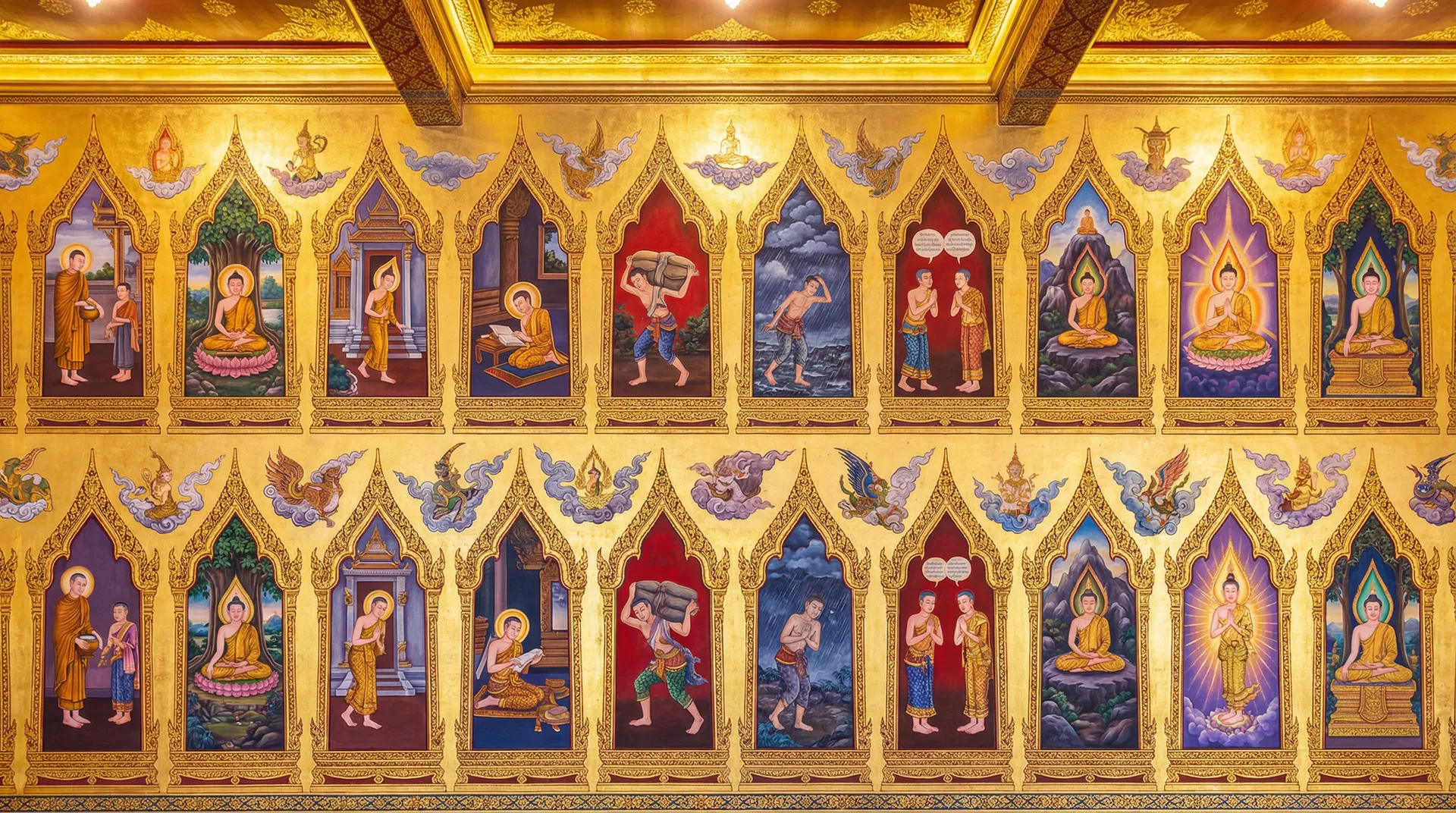
Mahājanaka Jātaka
Mahājanaka Jātaka
In the ancient kingdom of Mithila, nestled beside the great ocean, lived a wise and benevolent king named Suppāraka. His reign was marked by peace and prosperity, but a dark cloud loomed: the king had no heir. One fateful day, as the king meditated upon his kingdom's future, a celestial voice whispered a prophecy: his queen would soon bear a son, a prince destined for greatness, but one who would face immense trials before claiming his rightful throne.
True to the prophecy, Queen Maddī gave birth to a son, Prince Mahājanaka. The kingdom rejoiced, celebrating the arrival of their future king. Prince Mahājanaka grew into a young man of remarkable intellect and strength, trained in the arts of statecraft and warfare. However, the whispers of the prophecy, though unheard by most, weighed heavily on the young prince's mind. He felt an inexplicable pull towards the unknown, a sense of destiny that transcended the comfortable life of royalty.
One day, a desperate plea reached the palace. A neighboring kingdom, ruled by a tyrannical usurper, was on the brink of collapse. The rightful heir, a young princess, had been overthrown and was in hiding. The people, yearning for justice, sent emissaries to King Suppāraka, hoping for his intervention. Though King Suppāraka was old and weary, he saw in this plea a chance for his son to hone his leadership skills and fulfill his potential.
He summoned Prince Mahājanaka. 'My son,' the king began, his voice raspy with age, 'a grave injustice has befallen our neighbors. Their kingdom cries out for a righteous leader. I believe this is a path your destiny has laid before you. Will you answer their call?'
Prince Mahājanaka, though a prince, had always possessed a spirit of adventure and a deep sense of duty. He bowed his head. 'Father, I shall go. I will do all in my power to restore justice to their land.'
With a heavy heart, King Suppāraka blessed his son and dispatched him with a small contingent of his bravest warriors. As they journeyed towards the beleaguered kingdom, Prince Mahājanaka felt a growing sense of purpose. He knew this was not merely a political mission, but a test of his character, a crucible in which his true mettle would be forged.
Upon arriving at the border, they were met with a scene of desolation. Villages lay in ruins, and the faces of the people were etched with fear and despair. The usurper's reign had been one of cruelty and oppression. Prince Mahājanaka, seeing this suffering, was filled with righteous anger. He knew he had to act swiftly.
He rallied the downtrodden populace, his words a beacon of hope in their darkest hour. He spoke of courage, of unity, and of the enduring strength of a just cause. The people, inspired by his conviction and bravery, pledged their allegiance to him. They had found a leader they could believe in.
The ensuing campaign was fraught with peril. The usurper, a ruthless warlord named Kamsa, commanded a formidable army. Battles raged, and Prince Mahājanaka, leading from the front, displayed extraordinary courage and strategic brilliance. He fought not for glory, but for the liberation of the innocent. Many times, his life hung in the balance, but each time, he emerged victorious, his resolve only strengthened.
During one particularly fierce engagement, Prince Mahājanaka found himself surrounded by Kamsa's elite guards. His warriors had fallen, and he stood alone, his sword stained with the blood of his enemies. Kamsa himself, a hulking brute with a cruel sneer, advanced towards him. 'So, the little prince thinks he can defy me?' Kamsa taunted, his voice a low growl. 'You will soon learn the futility of your rebellion.'
Prince Mahājanaka, though weary, stood tall. 'Tyranny will never triumph over justice, Kamsa. Your reign of terror ends today!' he declared, his voice ringing with authority. A fierce duel ensued. Kamsa fought with brute force, but Prince Mahājanaka countered with agility and skill, his movements precise and deadly. The fate of the kingdom hung in the balance, the clash of their swords echoing through the battlefield.
In the end, Prince Mahājanaka, through sheer determination and a well-timed maneuver, disarmed Kamsa and stood over him, his sword at the tyrant's throat. Kamsa, defeated and disgraced, begged for his life. Prince Mahājanaka, though tempted by vengeance, remembered his teachings of compassion. He spared Kamsa, but banished him from the kingdom, stripping him of all power and influence.
With Kamsa gone, Prince Mahājanaka restored order to the land. He brought justice to the people, rebuilt the destroyed villages, and reinstated the rightful princess to her throne. The kingdom rejoiced, showering Prince Mahājanaka with gratitude and praise. They offered him the crown, but he humbly refused, stating that his duty was fulfilled, and his heart belonged to his own kingdom.
Upon his return to Mithila, King Suppāraka was overjoyed to see his son safe and victorious. Prince Mahājanaka had not only proven himself a capable leader but had also demonstrated the qualities of a true king: courage, compassion, and unwavering integrity. He had faced his trials and emerged stronger, wiser, and more resolute than ever before. The prophecy was fulfilled, not through destiny alone, but through his own unwavering efforts and virtuous actions.
— In-Article Ad —
💡Moral of the Story
True leadership is not about claiming power, but about serving others with courage, compassion, and unwavering integrity. Even in the face of overwhelming adversity, one's determination and virtuous actions can lead to victory and justice.
Perfection: Courage (Virya), Generosity (Dana), Wisdom (Prajna)
— Ad Space (728x90) —
More Jataka Tales You May Enjoy
 406Sattakanipāta
Kacchapa Jataka
Kacchapa Jataka In the ancient land of Mithila, nestled beside the shimmering Ganges River, lived a ...
💡 True abundance and prosperity are not found in material wealth alone, but in the boundless compassion and generosity extended to all beings. When a leader embodies these virtues, they inspire a transformation that can bring forth healing and renewal, both for the land and its people.
 128Ekanipāta
Kusa Jataka
Kusa JatakaIn the kingdom of Videha, ruled a wise and benevolent king named King Okkaka. His court w...
💡 Wisdom and courage, when combined with patience and self-sacrifice, can overcome even the most difficult and unjust circumstances, leading to truth and liberation.
120EkanipātaSibi Jataka
Sibi Jataka In the ancient kingdom of Sibi, nestled amidst fertile plains and blessed with bountiful...
💡 The highest form of compassion and truthfulness involves selfless sacrifice for the well-being of others. True virtue transcends natural laws and personal comfort, earning immeasurable merit and inspiring all.
 204Dukanipāta
Mahosadha Jataka
Mahosadha Jataka In the prosperous kingdom of Mithila, nestled amidst fertile plains and bordered by...
💡 Wisdom, foresight, and compassion are more powerful than aggression. Addressing the root causes of conflict with understanding and kindness can lead to lasting peace.
180DukanipātaKacchapa Jātaka
Kacchapa JātakaIn a time long past, when the Himalayas stood as young giants and the rivers flowed w...
💡 Great efforts and noble intentions are essential, but they must be accompanied by discipline and the adherence to instructions. A single lapse in concentration or a breach of trust can undo immense progress and lead to tragic consequences.
14EkanipātaThe Bodhisatta as a Hunter
The Bodhisatta as a HunterIn the dense, untamed wilderness of the Himalayas, where snow-capped peaks...
💡 True compassion transcends self-preservation, and great sacrifices bring immeasurable blessings.
— Multiplex Ad —