
The Bodhisatta as the Wise Prince Kumara
The Bodhisatta as the Wise Prince Kumara
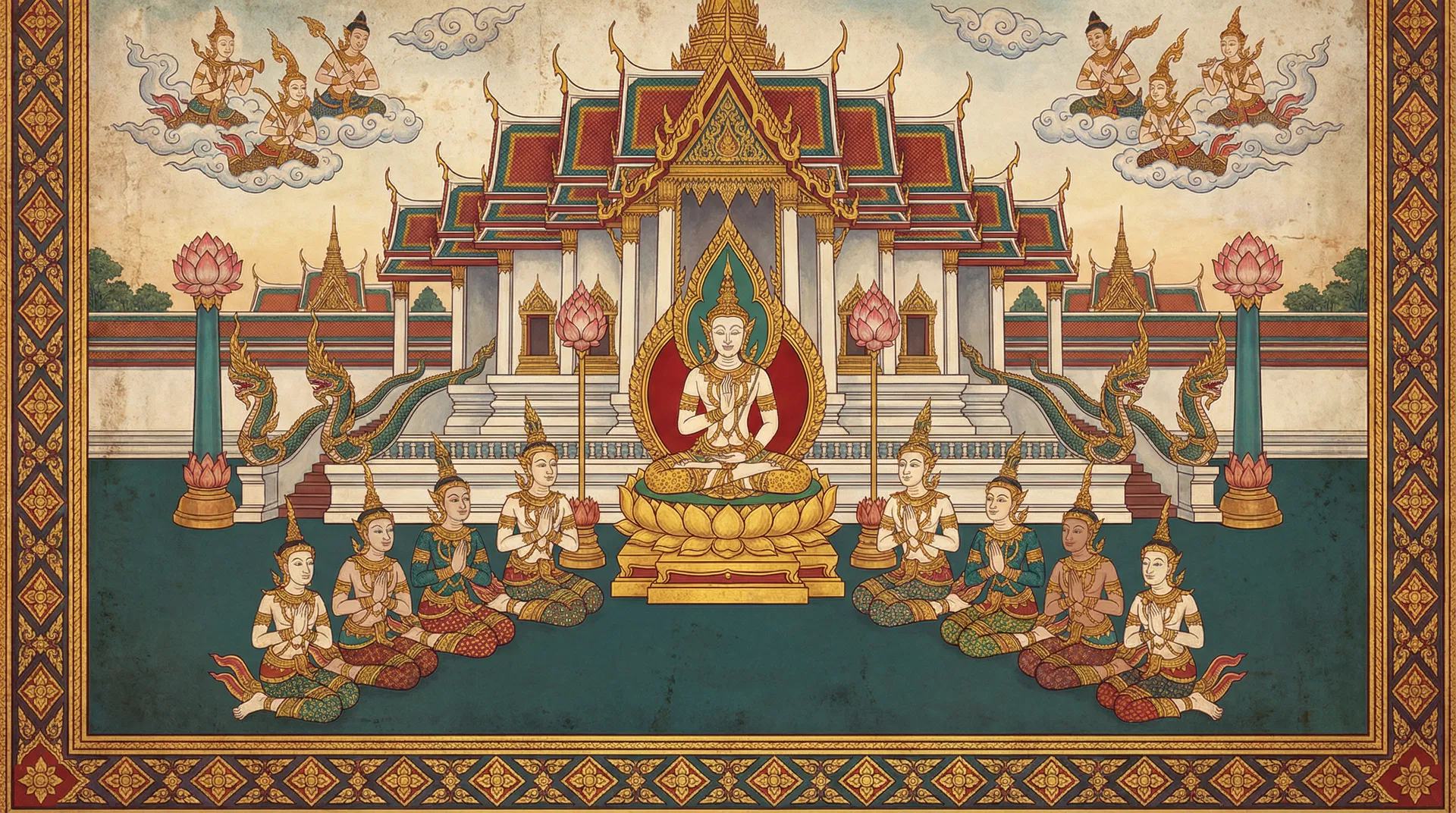
In the ancient kingdom of Mithila, nestled amidst verdant plains and kissed by the gentle caress of the Ganges, ruled a just and benevolent king. His reign was marked by prosperity and peace, and his heart was as expansive as the kingdom itself. Yet, despite his many blessings, a shadow of sorrow lingered in his heart: the absence of a son to inherit his throne and carry on his noble lineage. He and his queen, a woman of unparalleled grace and virtue, prayed ceaselessly, their earnest pleas reaching the heavens.
Their devotion was finally rewarded. The queen, radiant with newfound joy, announced her pregnancy. The kingdom rejoiced, and preparations for the arrival of the royal heir were made with great fanfare. As the auspicious day approached, the queen gave birth to a son, a prince whose radiant countenance seemed to hold the very light of the sun. He was named Kumara, a name that spoke of youth and brilliance, and indeed, he possessed a wisdom far beyond his tender years.
From the moment he could walk and speak, Prince Kumara displayed an extraordinary intellect. He absorbed knowledge like a thirsty sponge, mastering all the traditional arts and sciences with remarkable ease. He conversed with scholars and philosophers, engaging them in debates that often left them in awe of his profound understanding. His father, the king, watched with paternal pride, knowing that his son would be a ruler of exceptional caliber.
However, as Prince Kumara matured, he began to observe the complexities of human nature and the often-deceitful machinations of those who surrounded the throne. He noticed the subtle whispers of intrigue, the veiled ambitions lurking behind polite smiles, and the insidious spread of falsehoods that could poison even the most harmonious court. He saw how easily people could be swayed by flattery and how quickly trust could be eroded by suspicion.
One day, a grave matter arose within the kingdom. A wealthy merchant, renowned for his honesty and integrity, was falsely accused of treason by a rival who coveted his fortune. The accusation was presented to the king with such conviction and fabricated evidence that even the king, usually discerning, began to harbor doubts. The merchant, a man of simple needs and a clear conscience, was brought before the royal court, his face etched with bewilderment and fear.
The accuser, a man named Vasudeva, with his oily words and feigned sincerity, painted a damning picture of the merchant's supposed treachery. He presented forged documents and produced witnesses, their testimonies carefully rehearsed, all designed to ensnare the innocent man. The court buzzed with apprehension, and the king's brow furrowed with concern.
Prince Kumara, though young, was present at the hearing. His sharp eyes scanned the faces in the court, observing the subtle shifts in expression, the nervous flickers of the eyes, the forced smiles. He saw the fear in the merchant's eyes, a genuine and unfeigned terror, and the smug satisfaction that flickered across Vasudeva's face. His young heart felt a surge of indignation at the injustice that was about to befall an innocent man.
When the king sought his opinion, Prince Kumara rose, his small frame exuding an unexpected gravitas. His voice, though clear and youthful, carried the weight of conviction. "Father," he began, "this accusation bears the scent of deceit. The evidence presented, though seemingly substantial, lacks the true fragrance of truth."
Vasudeva scoffed, his arrogance evident. "Young prince, what knowledge do you possess of state affairs? This is a matter for seasoned minds, not for childish pronouncements!"
Prince Kumara turned his unwavering gaze upon Vasudeva. "Wisdom, sir, is not measured by the years one has lived, but by the clarity of one's discernment. You speak of treason, yet you offer no proof that cannot be fabricated by a skilled hand. You present witnesses, but their eyes betray a nervousness that speaks not of truth, but of fear or coercion."
The king, intrigued by his son's pronouncements, encouraged him to continue. "Speak, my son. What is your counsel?"
Prince Kumara’s voice grew stronger. "Let us not be hasty in judgment. Let us seek the true path to truth. I propose a test, a simple yet revealing one, that will expose the falsehood and reveal the innocent."
Vasudeva, confident in his carefully constructed lie, readily agreed, seeing no possibility of his deception being uncovered. "A test? What folly is this? I have provided ample proof!"
Prince Kumara ignored his outburst. "We shall gather all the accused, the merchant and his accuser, and all those who have testified. Then, we shall present them with a sacred vow. Each shall be asked to swear, on the most sacred relics of our kingdom, that they have spoken nothing but the absolute truth. And as they swear, a single, perfect lotus flower shall be placed in their hand. If they speak truth, the flower shall remain pristine. But if they utter even a single falsehood, the flower shall wither and crumble to dust in their grasp."
The court was abuzz with murmurs. The idea was unusual, yet it possessed a strange, almost magical, appeal. The king, seeing the wisdom in his son's proposal, nodded in agreement. "So be it. The test shall be administered as the prince has decreed."
The next day, the appointed hour arrived. The royal court was filled with anticipation. The merchant, his heart filled with a fragile hope, stood with his head held high. Vasudeva, outwardly composed but inwardly agitated, stood beside him, his eyes darting around nervously. The witnesses, their faces pale, clustered together.
The king, with Prince Kumara by his side, addressed the assembled group. "You are here to swear an oath of absolute truth. Let the sacred relics bear witness to your words. A single lotus flower will be placed in each of your hands. Speak truthfully, and the flower will remain as it is. Speak falsely, and it will reveal your deception."
One by one, the witnesses were brought forward. As each swore their false testimonies, holding the pristine white lotus, their hands began to tremble. The petals of the flowers, one by one, began to curl, to brown, and then, with a soft rustle, they disintegrated into a fine powder, leaving their shame exposed.
The murmurs in the court grew louder, a tide of disbelief and dawning realization. Vasudeva's face contorted with a mixture of shock and fury as he witnessed the fate of each witness's flower.
Finally, it was Vasudeva's turn. He stepped forward, his resolve hardening. He looked at the king, then at Prince Kumara, a flicker of defiance in his eyes. He opened his mouth to utter his fabricated claims, his hand reaching for the lotus. But as his fingers brushed against the delicate petals, a searing heat shot through his palm. The flower, as if repulsed by his inherent dishonesty, instantly withered, its petals curling inward and dissolving into a cloud of black dust before it could even touch his skin.
A gasp rippled through the court. Vasudeva cried out in pain and surprise, recoiling his hand as if burned. His guilt was laid bare for all to see. He stammered, his carefully constructed facade crumbling around him.
Then, the merchant was brought forward. With a steady hand and a clear conscience, he approached the flower. He looked at it, a symbol of his innocence, and as he spoke his honest words, the lotus remained perfectly formed, its petals dewy and vibrant, a testament to his unwavering truth.
The king, his heart brimming with relief and admiration for his son, declared, "Vasudeva, your deceit has been revealed by the very truth you sought to suppress. You have falsely accused an honest man and sought to enrich yourself through treachery. You shall be punished according to the law."
Vasudeva, utterly disgraced and exposed, was led away to face his just deserts. The merchant, his reputation restored and his honor vindicated, bowed deeply to the king and to Prince Kumara, his eyes shining with gratitude.
The court erupted in applause, their cheers echoing through the halls. They marveled at the wisdom of Prince Kumara, a child who had unraveled a complex web of deceit with such simple yet profound insight. From that day forward, Prince Kumara was revered not only for his noble birth but for his extraordinary wisdom and his unwavering commitment to justice.
The king, witnessing the efficacy of his son's judgment, knew that Mithila was in capable hands. He entrusted more and more responsibilities to Prince Kumara, who handled each task with grace, diligence, and an unerring sense of fairness. The kingdom flourished under his burgeoning influence, and the people knew that their future was bright.
The tale of Prince Kumara and the withered lotus spread throughout the land, becoming a legend that inspired truthfulness and discouraged deceit. It served as a constant reminder that even the most elaborate lies eventually crumble in the face of unwavering honesty, and that true wisdom lies in the ability to discern the truth, no matter how cleverly it is hidden.
The moral of the story is: Truth, like a pure lotus, will always remain untarnished, while falsehood, like withered petals, will inevitably reveal its decay. Discernment and honesty are the surest paths to justice.
— In-Article Ad —
💡Moral of the Story
Greed and evil thoughts erode virtue and goodness, like poison destroying the fragrance of the Kandapala tree. Deceiving others leads to ruin.
Perfection: The Perfection of Effort
— Ad Space (728x90) —
More Jataka Tales You May Enjoy
 437Navakanipāta
Samuddriya Jataka
The Voyage of the Steadfast MerchantLong ago, in the bustling port city of Supparaka, there lived a ...
💡 True leadership is demonstrated not in times of ease, but in the face of adversity. Steadfastness, courage, and unwavering integrity are the anchors that guide one through the most turbulent storms of life, inspiring trust and ensuring survival.
37EkanipātaThe Golden Peacock Jataka
In a verdant land of Kasi, blessed with abundant forests and mountains, the Bodhisatta was once rebo...
💡 True wisdom lies in understanding different paths and cultivating inner peace and resilience, rather than clinging to narrow prejudices.
 154Dukanipāta
Mātanga Jātaka
Mātanga JātakaIn the ancient city of Mithila, there lived a young woman of unparalleled beauty and g...
💡 True wisdom is accompanied by humility and compassion; superficial knowledge, when fueled by ego, leads to arrogance.
155DukanipātaMahājanaka Jātaka
Mahājanaka JātakaIn the glorious kingdom of Mithila, there once lived a prince named Mahājanaka. He ...
💡 True strength lies not in resisting the inevitable, but in accepting what cannot be changed with equanimity and maintaining one's principles regardless of circumstances.
112EkanipātaMūga-Pakkhaya Jātaka
Mūga-Pakkhaya Jātaka In the ancient city of Mithila, renowned for its scholars and philosophers, liv...
💡 True understanding comes from listening more than speaking. Selfless sacrifice, even of something deeply cherished, can lead to profound healing and growth.
78EkanipātaThe Jataka Tale of the Lion's Wisdom
The Jataka Tale of the Lion's Wisdom In the ancient city of Varanasi, a place renowned for its gran...
💡 Intelligence, the ability to see opportunities, and the courage to face risks can lead to wealth and benefit society.
— Multiplex Ad —