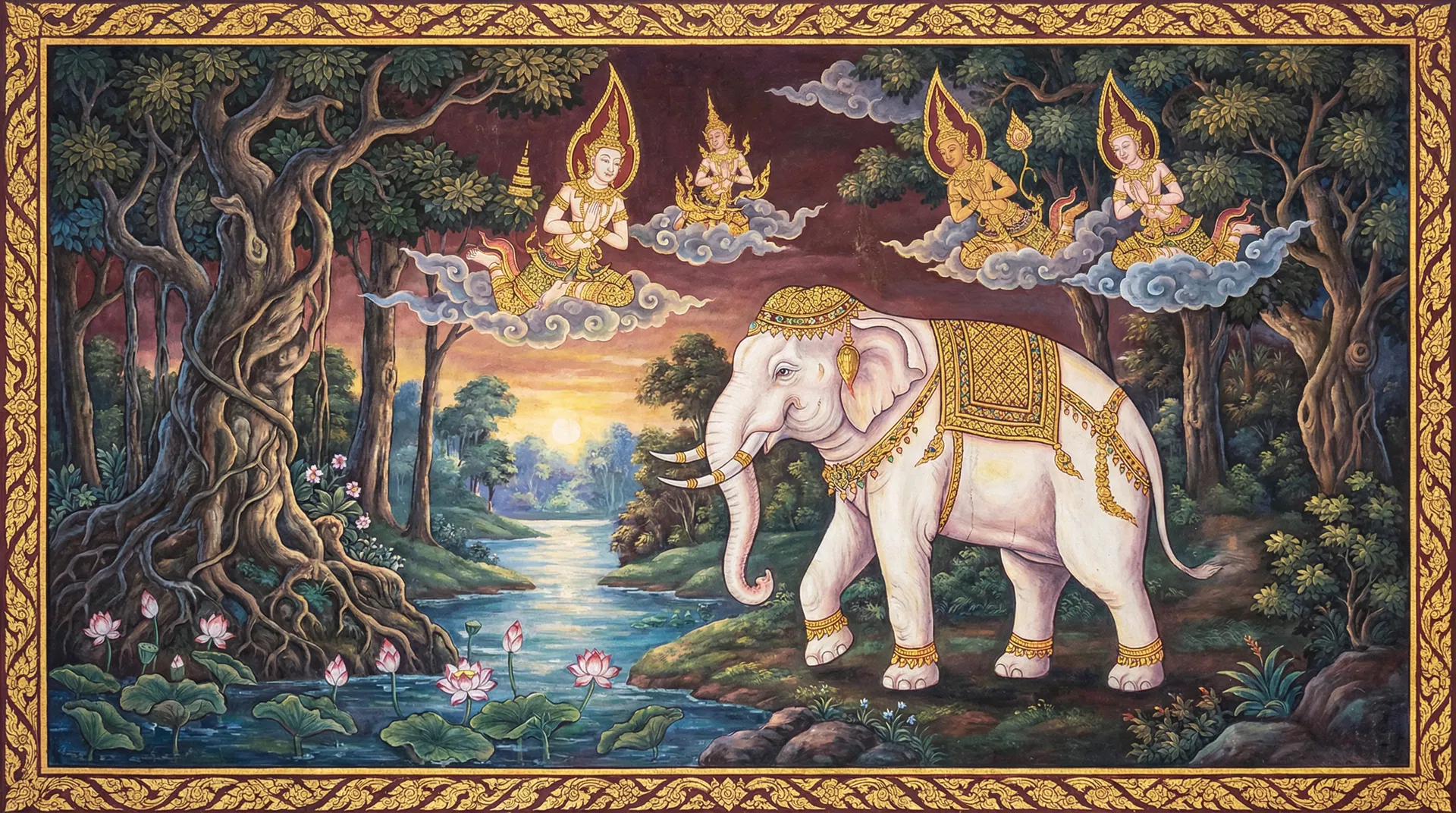
Maha-Ummagga Jataka
Maha-Ummagga Jataka
In the bustling and prosperous city of Mithila, there reigned a king named Vedeha. He was a king of considerable intellect and enjoyed engaging in intellectual games and riddles. However, he possessed a restless mind, often seeking stimulation through clever stratagems and elaborate challenges. His court was filled with scholars and wise men, all vying for the king's favor by presenting him with intricate puzzles and paradoxes.
One day, King Vedeha declared a grand competition: whoever could present him with the most ingenious riddle, the most profound insight, or the most cunning stratagem would be greatly rewarded and honored. The scholars of the land were abuzz with excitement, each preparing their most brilliant offerings.
Among the king's subjects was a young man of extraordinary intelligence and wisdom, named Mahosadha. Though still young, Mahosadha possessed a mind that far surpassed that of the seasoned scholars. He was known for his profound understanding of the world and his ability to solve the most complex problems with simple, elegant solutions. He lived in the village of Dolagiri, renowned for his wisdom and foresight.
When Mahosadha heard of the king's competition, he was not driven by a desire for personal gain or glory, but by a wish to serve his king and his people. He recognized that true wisdom lay not in creating elaborate illusions or complex puzzles, but in understanding the true nature of things and applying that understanding for the welfare of all.
Mahosadha devised a plan, not to present a riddle, but to demonstrate a profound act of wisdom that would benefit the entire kingdom. He instructed his villagers to dig a vast and intricate tunnel system, a veritable underground labyrinth, beneath the city of Mithila. This tunnel network was designed with multiple entrances and exits, secret passages, and cleverly concealed chambers. It was a feat of engineering and foresight, intended to provide refuge and safety for the citizens in times of crisis.
While the villagers worked diligently on the tunnels, King Vedeha and his scholars were engrossed in their intellectual duels. They presented riddles about the nature of time, the secrets of the stars, and the logic of paradoxes. The king was entertained, but his mind, ever seeking something truly remarkable, remained somewhat unsatisfied. He felt that these intellectual games, while clever, lacked practical application and true depth.
Finally, Mahosadha, accompanied by the elders of his village, approached the king. He did not present a riddle or a complex argument. Instead, he spoke calmly, "Your Majesty, while your scholars offer you words and thoughts, I have brought you something tangible, something that will ensure the safety and prosperity of Mithila for generations to come."
King Vedeha, intrigued by the young man's confidence, asked, "And what have you brought me, young Mahosadha?"
Mahosadha then led the king and his court to a hidden entrance of the magnificent tunnel system. He explained, "Your Majesty, these tunnels have been dug for the protection of your people. In times of war, famine, or any other calamity, your citizens can find safe refuge within these passages. They are designed to be a sanctuary, a testament to foresight and preparedness."
The king and his scholars were utterly astonished. They had been so caught up in abstract intellectual pursuits that they had failed to consider the practical needs of their kingdom. The scale and ingenuity of the tunnel system were beyond anything they could have imagined. It was a demonstration of wisdom that was both practical and profound.
King Vedeha, realizing the immense value of Mahosadha's contribution, was deeply impressed. He saw that Mahosadha's wisdom was not just about cleverness, but about genuine concern for the well-being of others. He declared Mahosadha the winner of the competition, not for a riddle, but for an act of unparalleled foresight and benevolence.
Mahosadha became the king's chief advisor, and his counsel was instrumental in governing Mithila with justice and wisdom. He continued to use his extraordinary intelligence to solve problems, mediate disputes, and ensure the welfare of the kingdom. He introduced innovative solutions to agricultural challenges, devised fair legal systems, and promoted education and harmony among the people.
Throughout his life, Mahosadha remained humble and dedicated to serving others. He understood that true intelligence was not merely about knowing many things, but about using that knowledge for the betterment of humanity. His wisdom, often expressed through clever but practical means, became legendary, guiding King Vedeha and his successors towards a golden age of peace and prosperity for Mithila. The tunnels, a symbol of his foresight, remained a testament to his profound understanding of true wisdom – the wisdom that serves and protects.
— In-Article Ad —
💡Moral of the Story
True wisdom is practical, applied for the benefit and welfare of others. Foresight, ingenuity, and a genuine concern for the well-being of the community are far more valuable than mere intellectual cleverness or abstract knowledge.
Perfection: Wisdom (Panna)
— Ad Space (728x90) —
More Jataka Tales You May Enjoy
 492Pakiṇṇakanipāta
The Tale of the Grateful Swan
The Tale of the Grateful Swan Once upon a time, in a kingdom blessed with verdant forests and sparkl...
💡 Kindness shown to any living being, no matter how small or seemingly insignificant, is never wasted and can return to us in unexpected and miraculous ways. Gratitude is a powerful force for healing and good.
 379Chakkanipāta
Kumbha-jātaka
Kumbha-jātakaIn a serene monastery nestled on the slopes of a gentle hill, lived a community of monk...
💡 True skill and service are not merely about outward performance or confidence, but about complete awareness, humility, and a deep respect for the task and its surroundings. Pride can be a greater source of failure than lack of ability.
 354Pañcakanipāta
Phanasa Jataka
Phanasa Jataka In the ancient city of Ujjeni, lived a kind and virtuous Bodhisattva who was born as ...
💡 Integrity, unity, and perseverance are essential virtues, especially in times of hardship. Greed and selfishness lead to downfall.
 281Tikanipāta
Mahājanaka Jātaka
Mahājanaka JātakaIn the ancient city of Mithila, nestled beside the sacred river Aciravatī, reigned ...
💡 Even in the face of overwhelming adversity, perseverance and unwavering courage can lead to success. Never give up on your dreams, no matter how difficult the path may seem.
332CatukkanipātaMahā-Ummagga Jātaka
Mahā-Ummagga JātakaIn the ancient kingdom of Videha, nestled beside the great river Ganges, stood th...
💡 Supreme intelligence, coupled with unwavering determination and compassionate leadership, can overcome the greatest of challenges and bring prosperity.
322CatukkanipātaMahamora Jataka
Mahamora JatakaIn a lush and verdant forest, teeming with life and vibrant with the songs of countle...
💡 True wealth and lasting happiness are not found in material possessions or the satisfaction of greed, but in wisdom, contentment, compassion, and a life lived virtuously. Wisdom and compassion have the power to transform even the most hardened hearts.
— Multiplex Ad —