
Khaggavisana Jataka
The Horned Solitary One
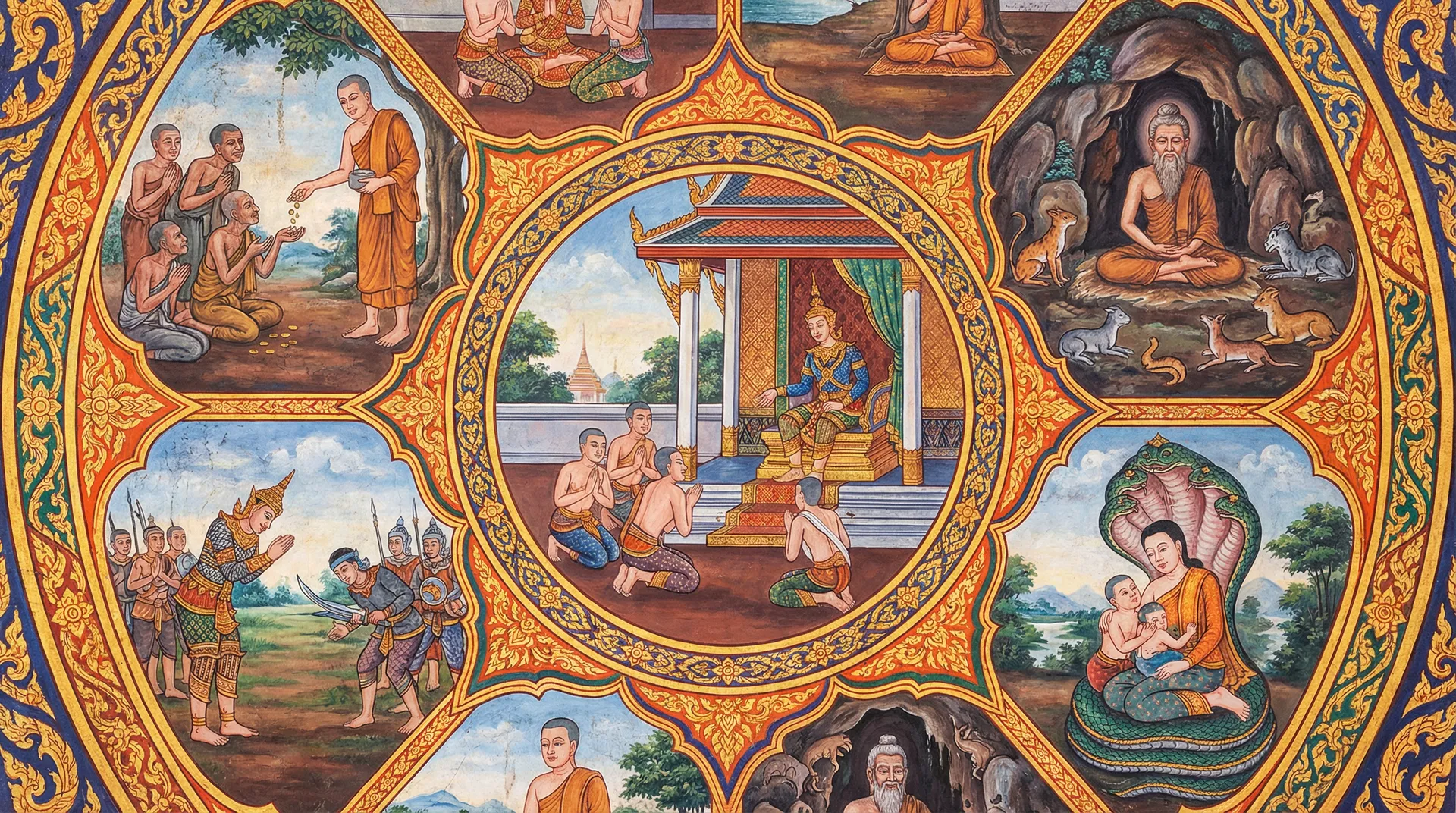
In the ancient city of Mithila, nestled amidst lush gardens and bustling marketplaces, lived a wise and benevolent king. He ruled his kingdom with justice and compassion, ensuring peace and prosperity for all his subjects. Yet, despite his worldly success, the king often felt a pang of longing, a yearning for something more profound. He would spend his evenings gazing at the stars, contemplating the mysteries of existence.
One day, a venerable sage, with eyes that held the wisdom of ages and a beard as white as snow, arrived at the royal court. The king, with deep respect, welcomed him and inquired about the path to true happiness and enlightenment. The sage, whose name was Vasudeva, smiled gently and spoke of the ultimate peace found in solitude and detachment.
"Your Majesty," Vasudeva began, his voice like the soft rustling of leaves, "the world offers many fleeting pleasures, but true contentment lies not in external possessions or worldly accolades. It is found within, through the cultivation of wisdom and the practice of mindfulness. The greatest happiness is achieved by walking the path of a solitary wanderer, free from the entanglements of desire and attachment."
The king, deeply moved by the sage's words, pondered them. He had everything a man could wish for – wealth, power, a loving family, and loyal subjects. Yet, the sage's description of the solitary wanderer, the one who found ultimate peace, resonated with a deep truth within him. He envisioned a life of simplicity, of quiet contemplation, unburdened by the responsibilities of kingship.
The sage continued, "Imagine a single rhinoceros, walking alone in the forest. Its horn is its strength, its defense, its unwavering companion. It needs no one else. It is self-sufficient, content in its own nature. This is the path of the wise – to be like the solitary rhinoceros, strong in their inner resolve, seeking truth and wisdom independently."
The king listened intently. He understood that the sage was not literally advocating for him to become a rhinoceros, but was using the metaphor to illustrate a profound spiritual truth. The rhinoceros's horn represented the sharp intellect, the unwavering determination, and the self-reliance that comes from inner cultivation. The solitude represented freedom from distractions and the ability to focus solely on the path of enlightenment.
Vasudeva then shared an ancient verse, a teaching passed down through generations of ascetics: 'Let a man wander alone, like the horn of a rhinoceros. Let him seek wisdom with a resolute mind. Let him be detached from worldly pleasures, and find solace in his own being.'
The king, inspired, decided to dedicate himself to the pursuit of wisdom. He did not abdicate his throne, for he understood his duty to his people. Instead, he resolved to rule with the detachment and wisdom of a solitary wanderer, even while fulfilling his kingly duties. He began to spend more time in meditation and study, seeking to understand the nature of suffering and the path to its cessation.
He established a sanctuary within his palace, a quiet space for reflection and learning. He invited scholars, ascetics, and wise men from far and wide to share their knowledge. He practiced non-attachment, understanding that his possessions, his power, and even his family were impermanent. He learned to find joy not in what he had, but in his own inner peace and understanding.
Years passed. The king grew old, but his mind remained sharp and his heart serene. His kingdom flourished under his just rule, and his people admired his wisdom and compassion. He had learned to live a life of purpose and meaning, embracing the spirit of the solitary wanderer, the rhinoceros with its unwavering horn, finding strength and contentment not in the external world, but in the boundless expanse of his own awakened mind.
The sage Vasudeva, now very old, visited the king one last time. He saw the king’s profound peace and contentment, a testament to his dedication. "You have understood, Your Majesty," Vasudeva said, his voice filled with a gentle pride. "You have walked the path, not by abandoning the world, but by mastering yourself within it. You are indeed like the solitary rhinoceros, strong, wise, and free."
The king, with a grateful heart, bowed to the sage. He knew that the greatest journey was the one taken within, the journey towards self-realization. And in his heart, he carried the image of the solitary rhinoceros, a symbol of his unwavering commitment to wisdom and inner peace, a beacon guiding him through the complexities of life until his final days.
— In-Article Ad —
💡Moral of the Story
True happiness and peace are found through inner cultivation, detachment from worldly desires, and self-reliance, much like a solitary rhinoceros finds strength in its own horn.
Perfection: Wisdom (Panna)
— Ad Space (728x90) —
More Jataka Tales You May Enjoy
156DukanipātaDhopa Jataka
Dhopa JatakaIn the ancient kingdom of Mithila, renowned for its flourishing arts and discerning popu...
💡 Do not be fooled by superficial allurements and intoxicating fragrances; seek that which is pure, genuine, and lasting.
 356Pañcakanipāta
Kosiya Jataka
Kosiya Jataka In the ancient city of Varanasi, nestled beside the sacred river Ganges, lived a wealt...
💡 True wisdom lies not just in intellectual knowledge, but in a contented mind, compassionate actions, and the generosity of spirit. Pride blinds us to deeper truths, while humility opens the door to genuine understanding.
 16Ekanipāta
The Monkey King's Courage
The Monkey King's CourageIn the heart of a verdant jungle, teeming with life and vibrant with the ch...
💡 True courage lies in facing fear and acting for the protection of others, regardless of the odds.
14EkanipātaThe Bodhisatta as a Hunter
The Bodhisatta as a HunterIn the dense, untamed wilderness of the Himalayas, where snow-capped peaks...
💡 True compassion transcends self-preservation, and great sacrifices bring immeasurable blessings.
52EkanipātaThe Bodhisatta as the King of the Pigeons
The Bodhisatta as the King of the PigeonsIn the bustling heart of a vibrant city, where grand palace...
💡 The power of truth, even from the humblest of sources, can overcome deceit and injustice, leading to righteousness.
8EkanipātaThe Wise King of Birds
The Wise King of BirdsPerched atop the highest peak of the Himalayas, where the air was thin and cry...
💡 True wisdom lies in selfless compassion, and the greatest sacrifices bring about miraculous salvation.
— Multiplex Ad —