
The Bodhisatta's Compassion in Times of Famine
The Bodhisatta's Compassion in Times of Famine
In the ancient kingdom of Benares, a time of unprecedented hardship descended upon the land. The skies, once generous with life-giving rain, had turned a brazen, unyielding blue for months on end. The sun, a fiery orb of relentless heat, baked the earth into a cracked, barren canvas. Rivers dwindled to muddy trickles, wells ran dry, and the once-lush fields lay withered and desolate. A terrible famine, a specter of starvation, stalked the kingdom, casting a long shadow of despair over every village and town.
Amidst this widespread suffering, a wealthy merchant named Bodhisatta, whose heart overflowed with boundless compassion and wisdom, resided in Benares. He was not merely a man of riches; he was a beacon of hope, a pillar of generosity. His granaries, though vast, were not hoarded for personal gain. Instead, they were a testament to his foresight and his deep-seated desire to alleviate the suffering of others. He had, in anticipation of lean times, meticulously stored an abundance of grain, his foresight now proving to be a lifeline for thousands.
As the famine tightened its grip, the cries of the hungry echoed through the streets. Families, their faces gaunt and etched with worry, huddled together, their meager rations dwindling to nothing. The once-vibrant marketplace was now a scene of desolation, merchants shutters closed, their wares long since sold or spoiled. Desperation gnawed at the hearts of the people, and their eyes, once bright with the promise of a good harvest, were now filled with a haunting emptiness.
It was in this grim atmosphere that Bodhisatta, clad in simple, unadorned robes, his brow furrowed with concern, began his benevolent work. He would emerge from his magnificent mansion, not with the pomp of a lord, but with the quiet determination of a healer. He would summon his trusted servants, men and women whose loyalty was as unwavering as his own resolve, and together they would embark on a mission of mercy.
“Prepare the carts,” Bodhisatta would instruct, his voice gentle yet firm. “Fill them with the finest grains from our stores. We must not let a single soul in this city suffer the pangs of hunger if it is within our power to prevent it.”
His servants, witnessing his unwavering commitment, would work tirelessly, their hearts swelling with a shared sense of purpose. They would load sacks upon sacks of rice, wheat, and other grains onto sturdy carts, the scent of nourishment a stark contrast to the prevailing aroma of dust and despair.
Then, the procession would begin. Bodhisatta, often walking alongside his carts, would lead them through the parched streets. He would stop at every corner, at every cluster of desperate faces, his presence a balm to their aching souls. His eyes, filled with a profound empathy, would meet theirs, and in that silent exchange, a flicker of hope would ignite.
“Good people,” he would announce, his voice carrying a warmth that could melt the frost of despair. “The land may be barren, but the hearts of the generous are not. Take what you need. Share with your neighbors. Let this sustenance be a testament to our shared humanity.”
He would instruct his servants to distribute the grain freely, not in meager portions, but in quantities that would truly sustain them. There were no questions asked, no judgments passed. Bodhisatta’s only concern was to fill the empty bellies and to rekindle the spark of life in those who were on the brink of succumbing to despair.
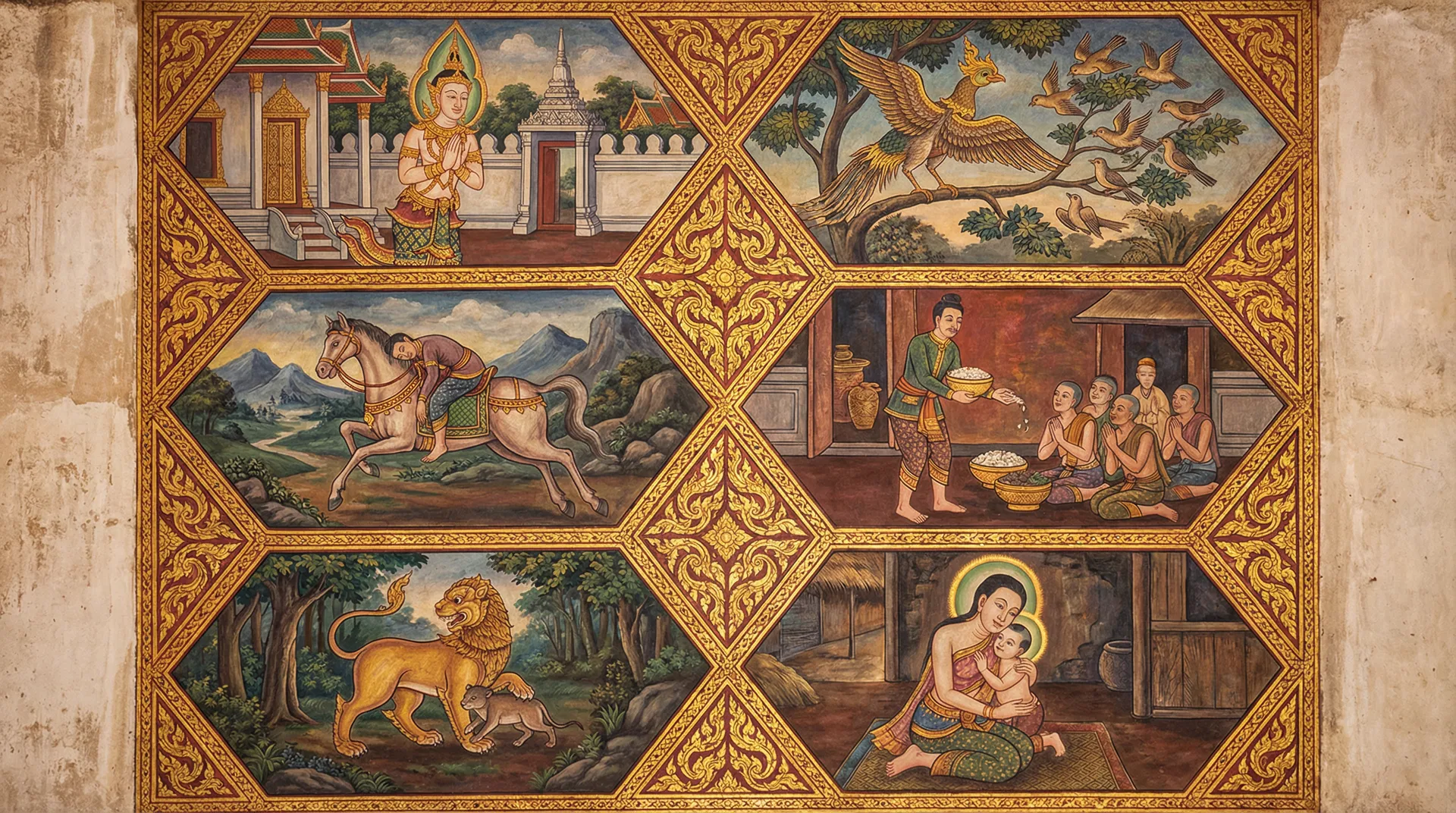
One day, as Bodhisatta was distributing grain in a particularly impoverished district, he noticed a small group of children, their ribs protruding, their eyes hollow. They were huddled together, their faces a picture of utter desolation, too weak even to beg. A young boy, no more than seven years old, clutched a tiny, emaciated bird in his hands, its feathers dull, its body trembling.
Bodhisatta’s heart ached. He knelt beside the children, his movements slow and gentle, so as not to frighten them. “Little ones,” he said softly, offering them a generous portion of grain. “Eat. Let this give you strength.”
The children, their movements sluggish, began to scoop the grain into their mouths, their initial hesitation quickly giving way to ravenous consumption. The young boy, however, did not immediately partake. He continued to cradle the bird, his small brow furrowed with a deep sadness.
Bodhisatta, noticing this, asked, “My dear child, why do you not eat? This grain will nourish you.”
The boy looked up at Bodhisatta, his eyes filled with a heartbreaking plea. “Sir,” he whispered, his voice barely audible, “this little bird is my friend. It is as hungry as I am, and it is too weak to find food. If I eat all this, it will surely die.”
A wave of profound emotion washed over Bodhisatta. He saw in this young boy a reflection of his own selfless spirit, a nascent compassion that mirrored his own. He understood that true generosity was not just about giving, but about extending kindness to all living beings, no matter how small or insignificant they might seem.
He gently took a small amount of grain and, with his own hands, placed it before the bird. “Here, little one,” he murmured. “This is for you.”
The bird, its tiny beak trembling, pecked at the grain, a flicker of life returning to its eyes. The boy’s face lit up with a radiant smile, a smile that, in the midst of the famine, shone brighter than any jewel.
Bodhisatta, witnessing this simple act of shared sustenance, felt a profound sense of fulfillment. He saw that the boy’s compassion, though born of his own suffering, was a testament to the inherent goodness that resided in all creatures. He realized that even in the darkest of times, the light of kindness could still find its way to bloom.
He continued his rounds, his heart buoyed by this encounter. He understood that his duty extended beyond merely feeding the hungry. It was also about nurturing the seeds of compassion, about reminding people of their interconnectedness, of their shared responsibility to care for one another and for all living beings.
As the days turned into weeks, Bodhisatta’s tireless efforts began to make a tangible difference. The gaunt faces began to fill out, the hollow eyes regained their sparkle, and a sense of hope, fragile yet persistent, began to weave its way back into the fabric of Benares. His generosity was not a fleeting act; it was a consistent, unwavering commitment that served as a lifeline for the entire kingdom.
The king of Benares, witnessing the extraordinary benevolence of Bodhisatta and the profound impact it had on his people, was deeply moved. He summoned Bodhisatta to his court, not to bestow rewards, but to express his heartfelt gratitude and admiration.
“Bodhisatta,” the king declared, his voice filled with reverence, “you have proven yourself to be a true guardian of this kingdom. While I sat in my palace, surrounded by comforts, you walked among the suffering, your hands reaching out to heal. Your compassion is a lesson for us all.”
Bodhisatta, with his characteristic humility, bowed his head. “Your Majesty,” he replied, “I have merely done what any compassionate heart would do. The true reward lies in seeing the suffering alleviated and in witnessing the restoration of hope.”
The famine eventually subsided, and the rains returned, bringing with them the promise of a bountiful harvest. The land, once parched and barren, began to bloom once more. But the memory of Bodhisatta’s extraordinary kindness, his unwavering generosity, and his profound compassion in the face of such dire adversity remained etched in the hearts of the people of Benares for generations to come.
The tale of Bodhisatta and his boundless compassion became a cherished legend, a testament to the power of selfless giving and the enduring strength of the human spirit. It served as a constant reminder that even in the darkest of times, the light of kindness and empathy can illuminate the path towards hope and salvation.
The moral of the story is: True generosity lies not only in giving material possessions, but also in extending compassion and kindness to all living beings, especially during times of hardship.
— In-Article Ad —
💡Moral of the Story
Keeping one's promises is extremely important. Breaking a vow will lead to bad karma.
Perfection: Perfection of Truthfulness
— Ad Space (728x90) —
More Jataka Tales You May Enjoy
 388Chakkanipāta
Samkicca Jataka
Samkicca JatakaIn the vibrant city of Savatthi, a place alive with the chatter of merchants and the ...
💡 Honesty and integrity are the most valuable treasures. Even when faced with deception and adversity, speaking the truth and maintaining one's principles will ultimately lead to vindication.
60EkanipātaThe Tale of Ukkuthita
In the prosperous city of Savatthi, during an age long past, there lived a merchant named Ukkuthita....
💡 True skill and mastery are born from diligent practice and self-reliance, not from exploiting external circumstances or relying on deception.
 201Dukanipāta
Nimi Jataka
Nimi Jataka In the heart of a magnificent kingdom, ruled a just and wise king named Nimi. His reign ...
💡 Even the highest celestial pleasures are impermanent and subject to the law of karma. True happiness and liberation are found in understanding and practicing the Dhamma, leading to the cessation of suffering.
202DukanipātaMugapakkha Jataka
Mugapakkha Jataka In a verdant forest, teeming with life and whispering with the secrets of nature, ...
💡 Patience, diligent effort, and trust are essential for overcoming difficulties. Hasty actions and doubt often lead to greater suffering.
182DukanipātaBhisa Jātaka
The Tale of the Water Lily SeedLong ago, in the vibrant kingdom of Kashi, there reigned a just and c...
💡 Sustainable prosperity and success are achieved through patience, meticulous care, and understanding the specific needs of a situation, much like nurturing a delicate plant. Hasty actions and neglect of fundamental conditions lead to failure.
234DukanipātaPhra Ong Thammachak (The Bodhisatta as a Sage Who Established Justice)
Phra Ong Thammachak (The Bodhisatta as a Sage Who Established Justice) In the ancient land of Gandha...
💡 True justice is the foundation of a prosperous and harmonious society. Leadership must be guided by wisdom, compassion, and truth, ensuring fairness and equity for all.
— Multiplex Ad —