Sattubhatta Jātaka
The King's Feast and the Virtuous Monk
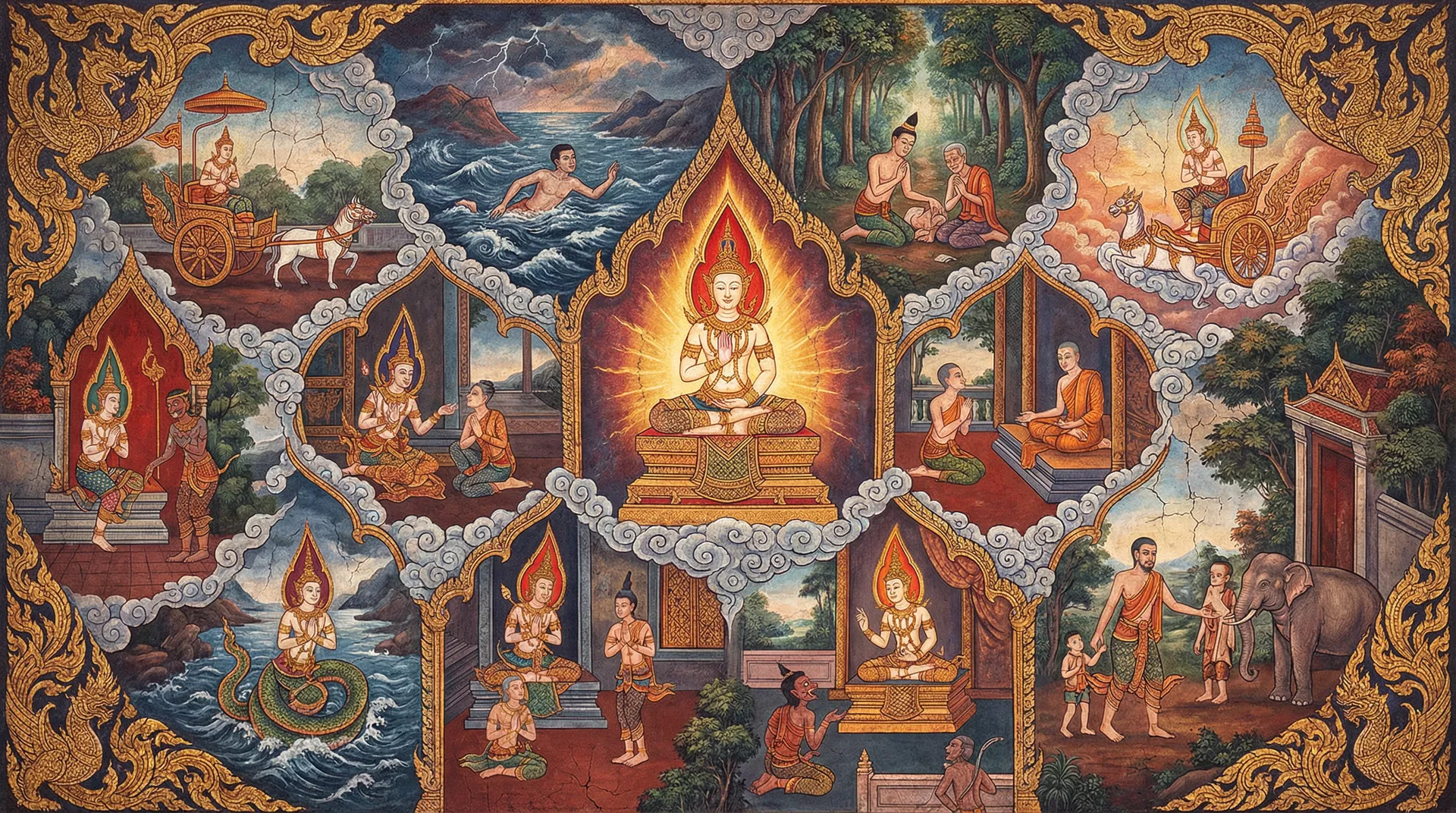
In the grand kingdom of Kosala, ruled a king named Pasenadi, a monarch known for his piety and his love for the Dharma. He was a man who genuinely sought to live a life of virtue, and his court was often graced by the presence of wise monks and learned scholars who guided him on the path of righteousness.
One day, King Pasenadi decided to hold a magnificent feast, an event meant to honor the Sangha and to share the fruits of his kingdom with those who dedicated their lives to spiritual practice. Invitations were sent to all the esteemed monks, promising an abundance of the finest food and the most comfortable accommodations.
Among those invited was a venerable monk, a man of profound wisdom and immense self-control. He was known for his ascetic lifestyle, his detachment from worldly comforts, and his unwavering devotion to the teachings. He accepted the king's invitation, not for the sake of luxury, but out of respect for the king's intentions.
On the day of the feast, the royal dining hall was adorned with flowers and banners, and tables were laden with a dazzling array of delicacies. The monks arrived, each receiving a warm welcome and a place of honor. The king himself served the monks, his heart filled with joy as he offered them the choicest dishes.
As the feast progressed, the king noticed that the venerable monk, though present, ate very little. He observed that the monk seemed to be partaking of a simple meal of rice gruel, prepared from the remnants of grains, which he had brought himself. The king, puzzled by this, approached the monk with great humility.
"Venerable sir," the king asked, "you are my honored guest, and this feast has been prepared with the utmost care. Yet, I see you eating only your own simple gruel. Is there something lacking in our offerings? Have I failed in my duty as a host?"
The monk, with a gentle smile, replied, "Your Majesty, your hospitality is boundless, and your offerings are indeed magnificent. However, my practice requires me to abstain from rich foods and to consume only what is essential for sustaining life. This simple gruel is all that my discipline requires."
The king, deeply impressed by the monk's austerity and self-discipline, felt a surge of respect. He understood that true contentment was not found in abundance, but in moderation and self-control. He saw that while he, a king, ruled over vast riches, this humble monk possessed a wealth far greater – the wealth of inner peace and freedom from desire.
The king then asked, "Venerable sir, if you were offered the finest delicacies, the most exquisite dishes, would you still choose this simple gruel?"
The monk responded, "Your Majesty, the purpose of food is to nourish the body, not to gratify the senses. If these rich foods were to disturb my peace of mind or hinder my spiritual progress, I would certainly choose this simple gruel. True nourishment comes from a content mind, not from the richness of the meal."
King Pasenadi was profoundly moved by the monk's words. He realized that the monk's detachment from worldly pleasures was the source of his profound peace and wisdom. He understood that the monk's virtue was not dependent on external circumstances but stemmed from an inner conviction.
The king bowed deeply to the monk, expressing his gratitude for the lesson. He left the feast with a renewed understanding of the Dharma, realizing that true happiness lies in simplicity, self-control, and the cultivation of inner virtues, rather than in the accumulation of material possessions or the indulgence of desires. The monk's quiet example served as a powerful reminder of the path to spiritual liberation.
— In-Article Ad —
💡Moral of the Story
True contentment and spiritual progress are achieved through simplicity, self-control, and detachment from worldly desires, not through material wealth or indulgence.
Perfection: Renunciation (Nekkhamma) and Patience (Khanti)
— Ad Space (728x90) —
More Jataka Tales You May Enjoy
 456Ekādasanipāta
Mūkapacca Jātaka
Mūkapacca JātakaIn the heart of the ancient kingdom of Mithila, nestled amidst emerald forests and w...
💡 True strength lies not in loudness or aggression, but in patience, keen observation, and understanding. Silence can be a powerful tool for wisdom.
 150Ekanipāta
Mahapada Jataka
Mahapada JatakaIn the ancient and prosperous city of Varanasi, there reigned a king named Bodhisatta...
💡 The greatest gift a ruler can give to their people is the teaching of righteousness and virtue (Dhamma), which leads to inner peace, wisdom, and lasting happiness.
88EkanipātaThe Great Dream Jataka
In ages past, when the Bodhisatta was cultivating his perfections, he was born as King Brahmattat, a...
💡 Blind suspicion and unfounded jealousy, fueled by deceit, can lead to great injustice. Truth and righteousness, patiently sought and revealed, are the only paths to healing and true reconciliation.
137EkanipātaMaha-Ummagga Jataka
The Great Wisdom of Prince VessantaraIn the ancient kingdom of Kalinga, famed for its glittering cit...
💡 The highest form of generosity is to give even that which is most precious, understanding that true happiness lies in selfless giving and compassion for all beings.
97EkanipātaThe Tale of the Ancient Swan
In the city of Savatthi, while the Buddha resided at the Jetavana Monastery, he recounted a past lif...
💡 True nobility resides in the heart and character, not in status or possessions. Forgiveness and inner peace are more valuable than any worldly gain.
4EkanipātaThe Tale of the Excellent Archer
The Tale of the Excellent Archer In the ancient kingdom of Mithila, a land blessed with fertile pla...
💡 Accusing others without reason and having impure intentions inevitably lead to one's own suffering. Forgiveness and genuinely good deeds are the path to peace and happiness.
— Multiplex Ad —