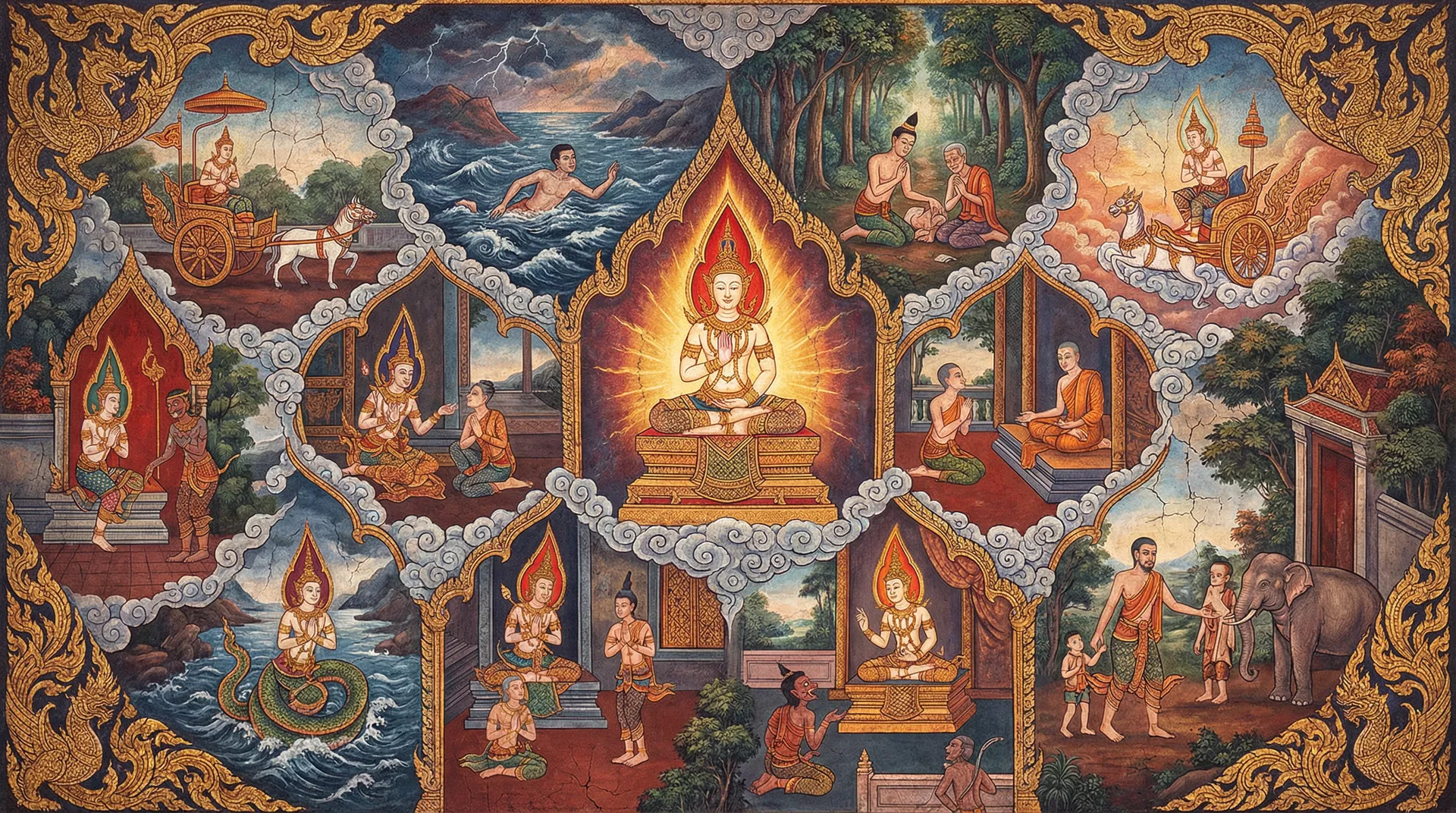
Kusa Jātaka
The King Who Found True Love
In the opulent city of Bhaddanagarā, ruled a king named Kusa. He was a man of great power and influence, yet his heart was heavy with a sorrow he could not quite articulate. He had a queen, Sudhammā, renowned for her beauty and grace, but their union, though blessed by the kingdom, lacked the warmth of true connection. Kusa often found himself drawn to the tales of ancient heroes and their epic quests, perhaps seeking a reflection of something missing in his own life.
One day, a mysterious omen appeared in the sky – a constellation that signaled a profound change. Driven by an inexplicable urge, King Kusa decided to undertake a perilous journey, leaving his kingdom under the care of his trusted ministers. His destination was unknown, his purpose unclear, but he felt compelled to seek something more, something real.
His travels took him to a distant land, where he encountered a maiden named Pabhavati. She was not of royal blood, nor was she adorned with jewels, but there was a radiant purity about her, a simplicity that captivated Kusa's heart. They met by chance, near a tranquil stream, and in her gentle eyes, Kusa saw a reflection of his own yearning for genuine affection. He fell deeply in love with her, a love unlike anything he had ever known.
He confessed his feelings, and Pabhavati, sensing the sincerity in his words, reciprocated his affection. They spent their days exploring the serene landscapes, their conversations flowing like the nearby stream, filled with understanding and mutual respect. Kusa, for the first time, felt a sense of true belonging, a peace that his royal life had never afforded him.
However, the duties of his kingdom weighed upon him. He could not abandon his people. Reluctantly, he revealed his identity to Pabhavati, explaining his royal obligations. Pabhavati, though saddened by the prospect of separation, understood. She agreed to wait for him, their hearts intertwined despite the distance.
Kusa returned to Bhaddanagarā, but his heart remained in the distant land with Pabhavati. His queen, Sudhammā, noticed his melancholy and grew suspicious. She learned of his clandestine love affair and, consumed by jealousy, devised a cruel plan. She sent emissaries to Pabhavati, carrying a false message that Kusa had abandoned her and urging her to return to Bhaddanagarā under false pretenses.
Pabhavati, heartbroken and deceived, believed the message. She traveled back to Bhaddanagarā, only to be met with the cold indifference of Sudhammā. The queen, reveling in her deception, treated Pabhavati as a mere servant, stripping her of her dignity and hope.
Meanwhile, King Kusa, tormented by the separation, learned of Sudhammā's treachery. Enraged by her cruelty and realizing the depth of his queen's deceit, he confronted her. He saw the emptiness in Sudhammā's actions, a stark contrast to the pure love he shared with Pabhavati. He banished Sudhammā, her jealousy having cost her everything.
Kusa then sought out Pabhavati, finding her in a state of despair. He embraced her, his love unwavering, and declared her his true queen. Together, they returned to the palace, where Kusa ruled with Pabhavati by his side, their reign marked by justice, compassion, and a love that had weathered trials and emerged stronger. The kingdom rejoiced, for their king had found not only a queen but a soulmate, proving that true love, though tested, can indeed conquer all.
— In-Article Ad —
💡Moral of the Story
True love and genuine connection are more valuable than titles or possessions, and deception and jealousy ultimately lead to ruin.
Perfection: Love (Priya) and Patience (Khanti)
— Ad Space (728x90) —
More Jataka Tales You May Enjoy
 97Ekanipāta
The Tale of the Ancient Swan
In the city of Savatthi, while the Buddha resided at the Jetavana Monastery, he recounted a past lif...
💡 True nobility resides in the heart and character, not in status or possessions. Forgiveness and inner peace are more valuable than any worldly gain.
 442Dasakanipāta
Sutasoma Jataka
Sutasoma JatakaIn the bustling city of Benares, lived a king named Sutasoma, a ruler whose heart was...
💡 True victory is not achieved through violence, but through understanding, compassion, and the transformation of negativity.
36EkanipātaThe Tale of the Horse-Breeder
In a past aeon, in the flourishing city of Varanasi, the Bodhisatta was born as a young Brahmin, end...
💡 The highest form of virtue is selfless compassion, willing to sacrifice for the well-being of others.
77EkanipātaThe Tale of the Water-Pot Elephant
The Tale of the Water-Pot Elephant In the ancient city of Varanasi, nestled beside the sacred Gange...
💡 The ultimate offering is the selfless sacrifice of one's life for others, driven by genuine compassion, capable of bringing about complete restoration and healing.
6EkanipātaThe Compassionate Elephant
The Compassionate ElephantIn the heart of a vast, sun-drenched savanna, where acacia trees dotted th...
💡 True compassion demands the greatest sacrifice, and love can transform the world.
85EkanipātaVessantara Jātaka
Vessantara Jātaka In the magnificent kingdom of SiBī, ruled the noble King Sanjaya and his virtuous ...
💡 True generosity comes from the heart and requires immense courage and sacrifice. The practice of giving, even when it leads to personal suffering, leads to profound spiritual merit and liberation.
— Multiplex Ad —