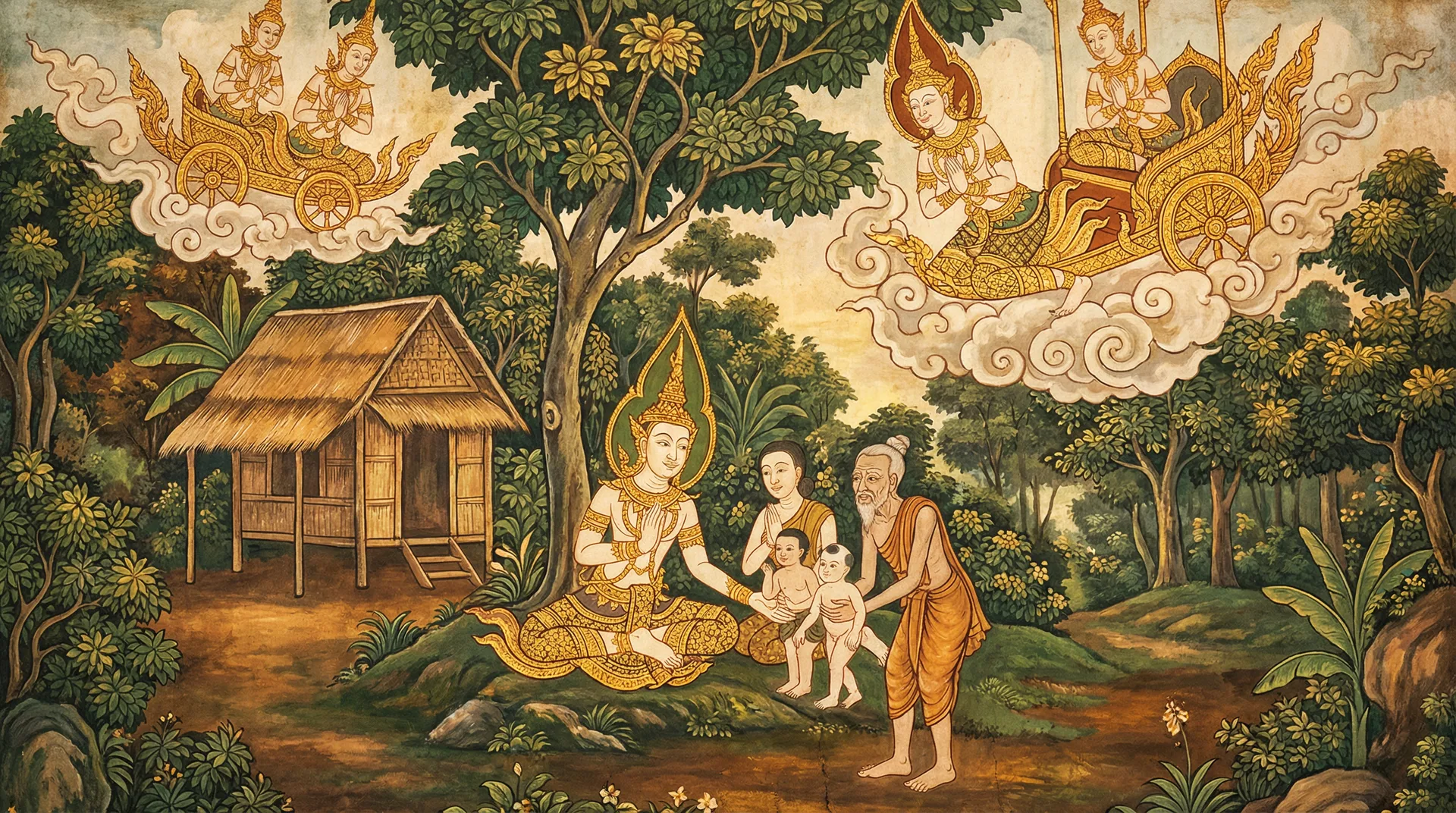
Kusa Jataka
The Tale of Prince Kusa and the Trials of Love
In the magnificent city of Indapatta, ruled King Okkaka, a monarch of great renown. He had a son, Prince Kusa, whose beauty and charm were legendary, but whose heart was often swayed by fleeting desires. The king, wishing to see his son wedded to a princess of equal repute, arranged a grand tournament. Many princesses attended, but it was Princess Pabhavati, the daughter of the King of Madra, whose radiant beauty captured Prince Kusa's heart instantly.
Their wedding was a spectacle of joy and celebration. Prince Kusa, however, was a fickle lover. Soon after their marriage, his attention was drawn to another princess, the lovely Princess Ratnamala, daughter of the King of Savatthi. He began spending more time with her, neglecting his wife, Pabhavati, who was deeply devoted to him.
Princess Pabhavati, heartbroken by her husband's neglect, confided in her father. The King of Madra, a man of wisdom and foresight, understood the capricious nature of youth. He decided to teach his son-in-law a lesson.
He sent a message to King Okkaka, stating that a fierce demon had captured Princess Pabhavati and demanded a ransom of seven hundred thousand gold coins. King Okkaka, distressed but resolute, gathered the ransom. However, he suspected foul play and sent his trusted minister to investigate.
Meanwhile, the King of Madra instructed his daughter to disguise herself as an old, wrinkled woman. He then brought her to Prince Kusa, introducing her as a servant. "This woman," he declared, "claims to have seen your wife, the demon's captive. She can guide you to the demon's lair, but she is a humble servant and requires a considerable sum for her services."
Prince Kusa, eager to rescue his wife, readily agreed. The disguised Pabhavati led him on a long and arduous journey, through dense forests and treacherous mountains. During their travels, Kusa, still infatuated with Ratnamala, would often speak of her, describing her beauty and grace. The disguised Pabhavati, though her heart ached, listened patiently, her own sorrow hidden beneath her wrinkled disguise.
One day, they reached a hidden cave. Pabhavati revealed her true identity to Kusa. "My lord," she said, her voice filled with a mixture of sorrow and love, "I am Pabhavati, your wife. I was not captured by a demon, but led here by my father to show you the consequences of your neglect and the depth of my devotion. You have been blinded by infatuation, neglecting the true love that awaits you."
Kusa was stunned. He saw before him the woman he had wronged, her beauty undimmed by the hardships of their journey, her love unwavering. He was filled with remorse and shame. He realized the shallowness of his infatuation with Ratnamala compared to the enduring love of Pabhavati.
He begged for her forgiveness. "Pabhavati," he pleaded, his voice choked with emotion, "I have been a fool. I have wronged you terribly. Please, forgive my ignorance and my foolishness. I vow to be a devoted husband, to cherish you above all else."
Pabhavati, her heart softened by his sincere remorse, forgave him. They returned to Indapatta, and from that day forward, Prince Kusa remained steadfastly devoted to his wife. He never again succumbed to infatuation, understanding that true love is built on loyalty, commitment, and the recognition of the true worth of one's beloved.
The King of Madra, upon hearing of his son-in-law's transformation, rejoiced. He saw that his plan had succeeded in bringing true understanding and lasting love to his daughter's life.
Prince Kusa, having learned a profound lesson about the nature of love and fidelity, ruled his kingdom with wisdom and devotion, always cherishing his wife, Princess Pabhavati, as the greatest treasure of his life.
— In-Article Ad —
💡Moral of the Story
True love is characterized by loyalty, commitment, and unwavering devotion. Infatuation is fleeting and can lead to great suffering, while true love endures through trials and tribulations.
Perfection: Patience (Khanti)
— Ad Space (728x90) —
More Jataka Tales You May Enjoy
 496Pakiṇṇakanipāta
Mūgapakkha Jātaka
Mūgapakkha JātakaIn the ancient kingdom of Mithila, nestled amidst lush green hills and crystal-clea...
💡 True wisdom and effective communication can manifest in ways beyond spoken words, such as through actions, illustrations, and deep understanding.
 10Ekanipāta
The Bodhisatta as a Tortoise
The Bodhisatta as a TortoiseIn the tranquil embrace of a sacred forest, where ancient trees formed a...
💡 The ultimate act of compassion, even at the cost of one's own life, can bring forth miraculous salvation.
136EkanipātaPanchavudha Jataka
The Tale of the Five WeaponsIn the ancient city of Varanasi, nestled beside the sacred Ganges River,...
💡 True fulfillment and invincibility are not found in external possessions or power, but in the cultivation of inner virtues like truth, compassion, generosity, patience, and wisdom.
 270Tikanipāta
Mulakamsa Jataka
Mulakamsa JatakaIn the thriving city of Varanasi, famed for its artisans and its bustling markets, r...
💡 True justice requires accountability for harm caused, even if disguised by clever arguments; wisdom lies in discerning intentions beyond mere words.
261TikanipātaNimi Jataka
Nimi JatakaIn the glorious city of Mithila, ruled the wise King Nimi. His reign was a beacon of righ...
💡 Even the most glorious heavenly realms are impermanent. True and lasting happiness is found in the liberation from suffering through the attainment of Nirvana, which requires inward cultivation of wisdom and detachment.
106EkanipātaBhaddasala Jataka
The Tale of the Wise Elephant and the Foolish King In the ancient kingdom of Mithila, ruled a king n...
💡 True wisdom often comes from unexpected sources. A leader's true strength is shown not in anger or pride, but in humility, compassion, and the willingness to serve their people.
— Multiplex Ad —