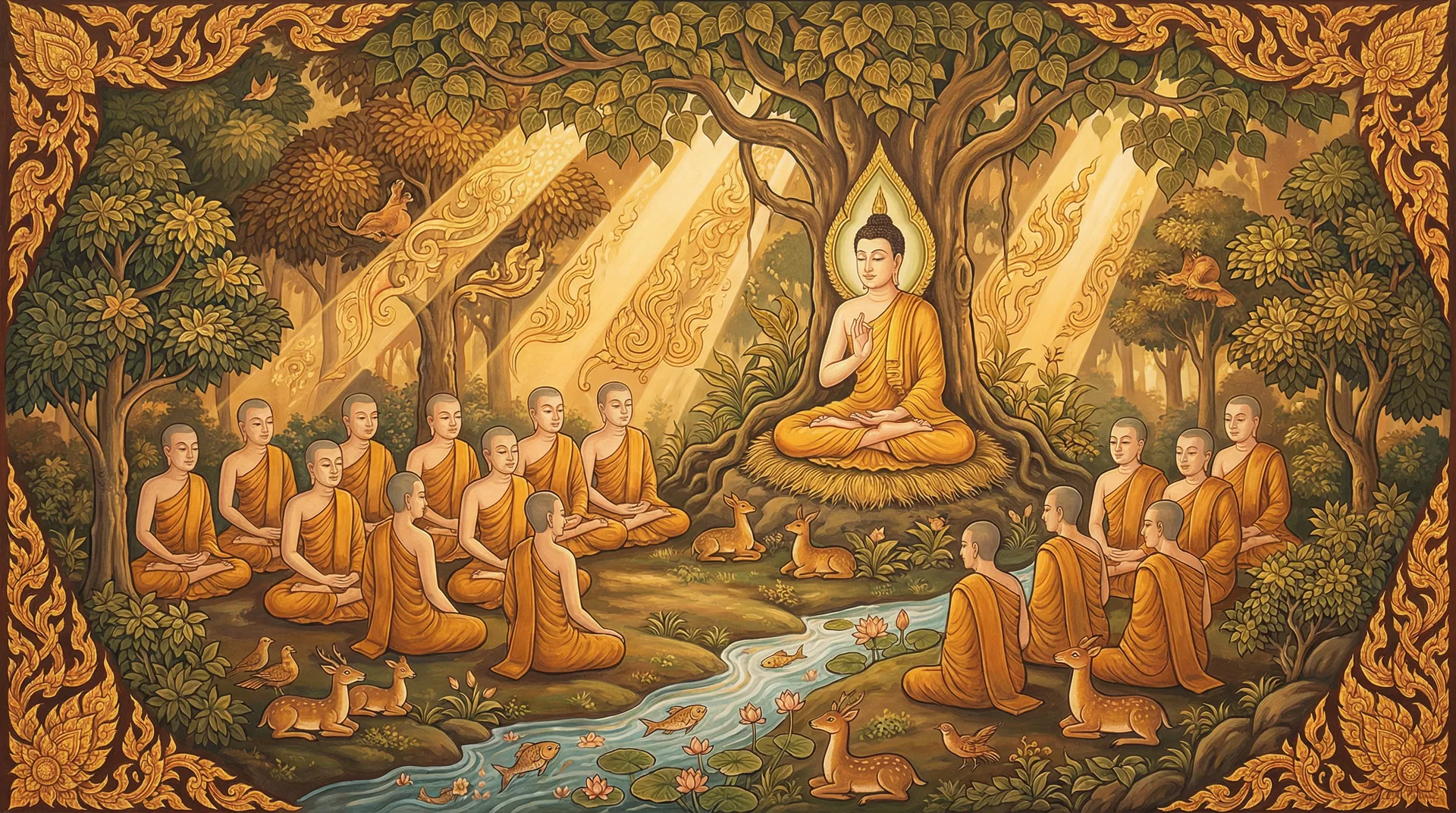
Sāriputtajātaka
The Tale of the Steadfast Scholar
In the bustling city of Varanasi, where merchants hawked their wares and scholars debated the intricacies of philosophy, lived a young man named Sāriputta. He was not born into wealth or nobility, but possessed a sharp intellect and an insatiable thirst for knowledge. His days were spent in the dusty halls of the city’s great library, poring over ancient texts and engaging in earnest discussions with learned men.
Sāriputta’s greatest ambition was to attain the highest form of wisdom, the kind that could illuminate the path for others. He dedicated himself to rigorous study, his mind a keen instrument honed by countless hours of learning. He mastered various disciplines, from the laws of grammar and logic to the profound truths of the spiritual world. Yet, despite his vast learning, he felt a persistent emptiness, a sense that true understanding eluded him.
One day, while studying a rare manuscript, he came across a passage that spoke of a legendary hermit, an ascetic named Jotipāla, who lived deep within the Himalayas. It was said that Jotipāla possessed wisdom so profound that it could unravel the deepest mysteries of existence. Inspired, Sāriputta resolved to seek out this hermit and learn from him directly.
The journey was arduous. Sāriputta traveled for months, crossing treacherous mountain passes and navigating dense forests. He faced hunger, thirst, and the biting cold, but his resolve never wavered. His mind, accustomed to intellectual challenges, was now tested by the physical endurance required for his quest. He often meditated on the teachings he had already acquired, using them as fuel for his spirit.
Finally, after many trials, he reached the remote hermitage where Jotipāla resided. The hermit was an old man, his face etched with the wisdom of years, his eyes radiating a serene light. He lived a life of extreme simplicity, subsisting on roots and fruits, his only companions the wind and the mountains.
Sāriputta humbly approached Jotipāla and bowed deeply. “Venerable sir,” he said, his voice filled with reverence, “I have traveled far to seek your guidance. I have studied many scriptures and engaged in countless debates, but I still feel a void in my understanding. I yearn for the true wisdom that you possess.”
Jotipāla looked at Sāriputta with a gentle gaze. “Young man,” he said, his voice like the soft murmur of a stream, “your eagerness is commendable. But wisdom is not a treasure to be found in dusty books or debated in crowded halls. It is a flame that is kindled within, through diligent practice and unwavering discipline.”
Sāriputta became Jotipāla’s disciple. His training was unlike anything he had experienced before. It involved not just intellectual pursuit, but a profound transformation of his entire being. He learned to meditate for hours on end, observing the subtle workings of his own mind. He practiced mindfulness in every action, from gathering firewood to preparing his simple meals. He learned to control his desires, to detach himself from worldly comforts, and to cultivate compassion for all living beings.
The initial days were a struggle. Sāriputta’s mind, accustomed to rapid intellectualization, found the slow, deliberate pace of meditative practice challenging. He often felt frustrated, his ego resisting the surrender of intellectual pride. He would recall his past debates, his quick wit, and his extensive knowledge, and feel a pang of longing for his former life. But each time doubt crept in, he would remember Jotipāla’s words and his own earnest desire for true wisdom.
One particularly difficult evening, Sāriputta sat by the dying embers of a fire, feeling utterly dejected. He had spent the day struggling to quiet his restless mind, and he felt no closer to enlightenment than when he had started. He considered abandoning his quest and returning to the city, where he was respected and admired for his intellect.
Just then, Jotipāla approached him. He sat down beside Sāriputta and, without a word, began to carefully tend the dying embers, coaxing them back to life with gentle puffs of air. He did this with such focused attention and quiet grace that Sāriputta watched, mesmerized. When the embers finally glowed brightly again, Jotipāla looked at Sāriputta.
“You see, young Sāriputta,” the hermit said softly, “even in the smallest of tasks, there is a lesson. Just as these embers needed patient tending to rekindle their flame, so too does wisdom within the mind. It requires consistent effort, unwavering patience, and a deep understanding of the process. Intellectual knowledge is but a map; true wisdom is the journey itself, experienced with every step.”
This simple act, and Jotipāla’s gentle explanation, had a profound impact on Sāriputta. He understood that his impatience, his reliance on intellectual prowess, was hindering his progress. He began to approach his practice with renewed dedication, embracing the stillness and the quiet work of transforming his mind. He learned to find joy in the process, to be present in each moment, and to accept the challenges as part of his growth.
Over the years, Sāriputta’s mind became calm and clear. He attained a profound understanding of the nature of reality, not through abstract reasoning, but through direct experience. He saw the interconnectedness of all things and the impermanence of all phenomena. His wisdom was no longer confined to his intellect; it permeated his entire being, radiating outward in his actions and his interactions.
When Jotipāla eventually passed away, Sāriputta remained at the hermitage, continuing his practice and living a life of profound wisdom and compassion. He became a beacon of light for those who sought genuine understanding, guiding them not with complex doctrines, but with the simple, powerful example of his own transformed life. He had learned that true scholarship was not merely about accumulating knowledge, but about cultivating wisdom through steadfast effort and unwavering inner discipline.
— In-Article Ad —
💡Moral of the Story
True wisdom is not merely intellectual knowledge but a profound inner transformation achieved through diligent practice, patience, and steadfast discipline. The journey of self-discovery is as important as the destination.
Perfection: Effort and Wisdom
— Ad Space (728x90) —
More Jataka Tales You May Enjoy
 273Tikanipāta
Assaka Jataka
Assaka JatakaIn the heart of a vast and ancient kingdom, there once lived a king named Assaka. King ...
💡 True leadership is not determined by birthright or status, but by demonstrated character, inner strength, humility, and a commitment to serving others.
 16Ekanipāta
The Monkey King's Courage
The Monkey King's CourageIn the heart of a verdant jungle, teeming with life and vibrant with the ch...
💡 True courage lies in facing fear and acting for the protection of others, regardless of the odds.
11EkanipātaThe Dutiful Son
The Dutiful SonIn a small, humble village nestled at the foot of rolling hills, lived a young man na...
💡 Filial piety, determination, and a pure heart can overcome formidable obstacles and bring about miraculous healing.
 514Vīsatinipāta
Nimi Jataka
The King Who Dreamt of HeavenIn the prosperous kingdom of Mithila, there reigned a virtuous and just...
💡 Virtuous actions, unwavering generosity, and a life dedicated to righteousness pave the path to heavenly realms and lasting peace. Aspirations for higher existence should be pursued through diligent merit-making.
5EkanipātaThe Monkey King's Sacrifice
The Monkey King's SacrificeIn the dense, emerald heart of the Vindhya Mountains, where ancient trees...
💡 True leadership is defined by selfless sacrifice for the well-being of others.
15EkanipātaThe Bodhisatta as a Scholar
The Bodhisatta as a ScholarIn the hallowed halls of an ancient monastery, nestled amidst serene, rol...
💡 True wisdom is demonstrated through the compassionate application of knowledge for the well-being of others.
— Multiplex Ad —