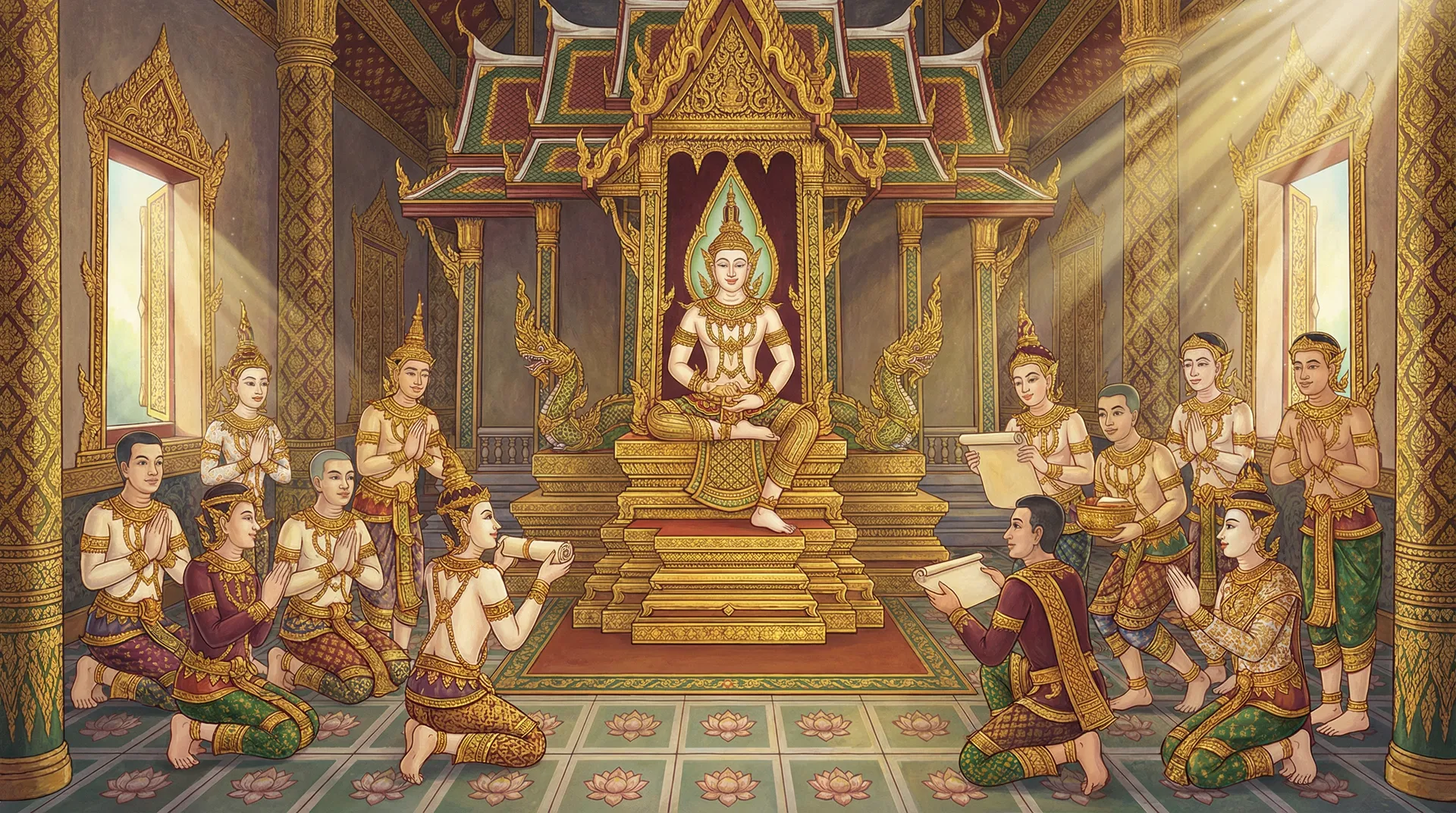
Mahāsuvanna Jataka
The Golden Swan's Flight
In the ancient city of Mithila, nestled beside a shimmering lake, lived a king renowned for his piety and his love for his people. He was a just ruler, but his heart longed for a treasure that gold and jewels could not buy – the gift of true wisdom that would guide him in his rule and bring lasting prosperity to his kingdom.
One day, while strolling by the lake, the king heard a melodious voice singing from the heavens. He looked up and saw a magnificent swan, its feathers shimmering with a golden hue, its song filling the air with an enchanting melody. The swan, as it flew closer, spoke to the king in a voice that was both gentle and profound. "O King," it sang, "I am Mahāsuvanna, a swan of immense wisdom, and I have heard the yearning in your heart. I come to offer you my guidance, but only if you can promise to uphold the five precepts with unwavering devotion."
The king, awestruck by the sight of the golden swan and the wisdom in its words, readily agreed. He pledged to live by the principles of non-killing, non-stealing, non-sexual misconduct, non-lying, and abstaining from intoxicants. Mahāsuvanna, pleased with the king's sincerity, descended to the royal palace and became his trusted advisor.
Mahāsuvanna's wisdom was indeed extraordinary. He advised the king on matters of state, helping him to govern with fairness and compassion. He taught the king how to cultivate virtues, how to understand the interconnectedness of all beings, and how to make decisions that would benefit not only his own people but all living creatures. The king, guided by Mahāsuvanna, transformed his kingdom into a land of peace, prosperity, and harmony. The people flourished, their hearts filled with gratitude for their wise king and his golden advisor.
However, the fame of the golden swan spread far and wide, reaching the ears of a greedy and power-hungry king in a neighboring land. This king, whose heart was as dark as his ambition was bright, coveted the secret of Mahāsuvanna's wisdom. He believed that if he could capture the golden swan, he could unlock its secrets and gain unparalleled power.
He gathered his formidable army and marched towards Mithila, his eyes fixed on the golden prize. The king of Mithila, though a man of peace, was not unprepared. He had learned much from Mahāsuvanna about strategy and defense. He rallied his troops, not with anger or aggression, but with a calm resolve, trusting in the wisdom he had gained.
As the invading army approached, Mahāsuvanna, the golden swan, spoke to the king. "Your Majesty," he said, his voice calm and steady, "fear not. The strength of a kingdom lies not in its armies, but in the righteousness of its ruler and the well-being of its people. Let us meet the invaders not with swords, but with truth and compassion."
The king, guided by Mahāsuvanna's counsel, went forth to meet the invading king, not with armor, but with a simple robe and a peaceful demeanor. He stood before the enemy king and began to speak, his voice resonating with the wisdom of Mahāsuvanna. He spoke of the futility of war, the suffering it caused, and the true meaning of prosperity, which lay in peace and harmony.
The invading king, accustomed to violence and coercion, was taken aback by the king's gentle yet powerful words. He saw the unwavering conviction in the king's eyes and the serene confidence that radiated from him. He also saw, soaring gracefully above the king, the magnificent golden swan, its presence a silent testament to the king's righteousness.
As the king continued to speak, the invading king's resolve began to crumble. He saw the folly of his ambition, the emptiness of conquest. He realized that true power came not from subjugation, but from wisdom and virtue. He lowered his sword, his heart filled with a newfound respect for the king of Mithila and his golden advisor.
The invading king, humbled and enlightened, apologized for his aggression and retreated with his army. He had come seeking a treasure of power, but he left with a far greater treasure – the seed of wisdom planted in his own heart. The king of Mithila, with Mahāsuvanna's continued guidance, ruled his kingdom with even greater wisdom and compassion, ensuring that peace and prosperity flourished for generations to come. The golden swan, its mission fulfilled, eventually returned to its celestial abode, leaving behind a legacy of enlightenment and the enduring power of truth.
— In-Article Ad —
💡Moral of the Story
True power and prosperity are not achieved through aggression or conquest, but through wisdom, righteousness, and compassion. Upholding ethical principles is the foundation of a just and harmonious society.
Perfection: Wisdom (Paññā) and Generosity (Dāna)
— Ad Space (728x90) —
More Jataka Tales You May Enjoy
 4Ekanipāta
The Tale of the Excellent Archer
The Tale of the Excellent Archer In the ancient kingdom of Mithila, a land blessed with fertile pla...
💡 Accusing others without reason and having impure intentions inevitably lead to one's own suffering. Forgiveness and genuinely good deeds are the path to peace and happiness.
 226Dukanipāta
Mūga-pakkhajātaka
The Tale of the Mute Bird In the ancient city of Mithila, nestled amidst lush greenery and shimmerin...
💡 Past actions and their consequences can be overcome through genuine compassion, empathy, and a transformed heart. Understanding and alleviating the suffering of others can lead to the resolution of past karmic debts.
73EkanipātaThe Tale of the Elephant Prince
In a time long past, when the Bodhisatta was yet to attain full Buddhahood and was circulating throu...
💡 True loyalty and devotion can overcome deception and protect the innocent.
96EkanipātaThe Great Pangalika Jataka
In the ancient city of Savatthi, during the time of the Buddha, the Teacher, in his boundless compas...
💡 True courage is not the absence of fear, but the determination to act despite it, especially when it means helping others.
 251Tikanipāta
Nandiya-Jātaka
Nandiya-JātakaIn the heart of a lush forest, where ancient trees whispered secrets to the wind and s...
💡 True fulfillment and lasting happiness are found not in worldly possessions or power, but in detachment, simplicity, and the pursuit of spiritual enlightenment. The greatest leadership is often demonstrated through selfless sacrifice and the courage to follow one's highest calling.
81EkanipātaMāhāsukha Jātaka
Māhāsukha Jātaka Long ago, in the bustling city of Mithila, lived a king named Brahmadatta. He was a...
💡 True happiness is found not in external possessions or status, but in inner peace, detachment, and boundless compassion.
— Multiplex Ad —