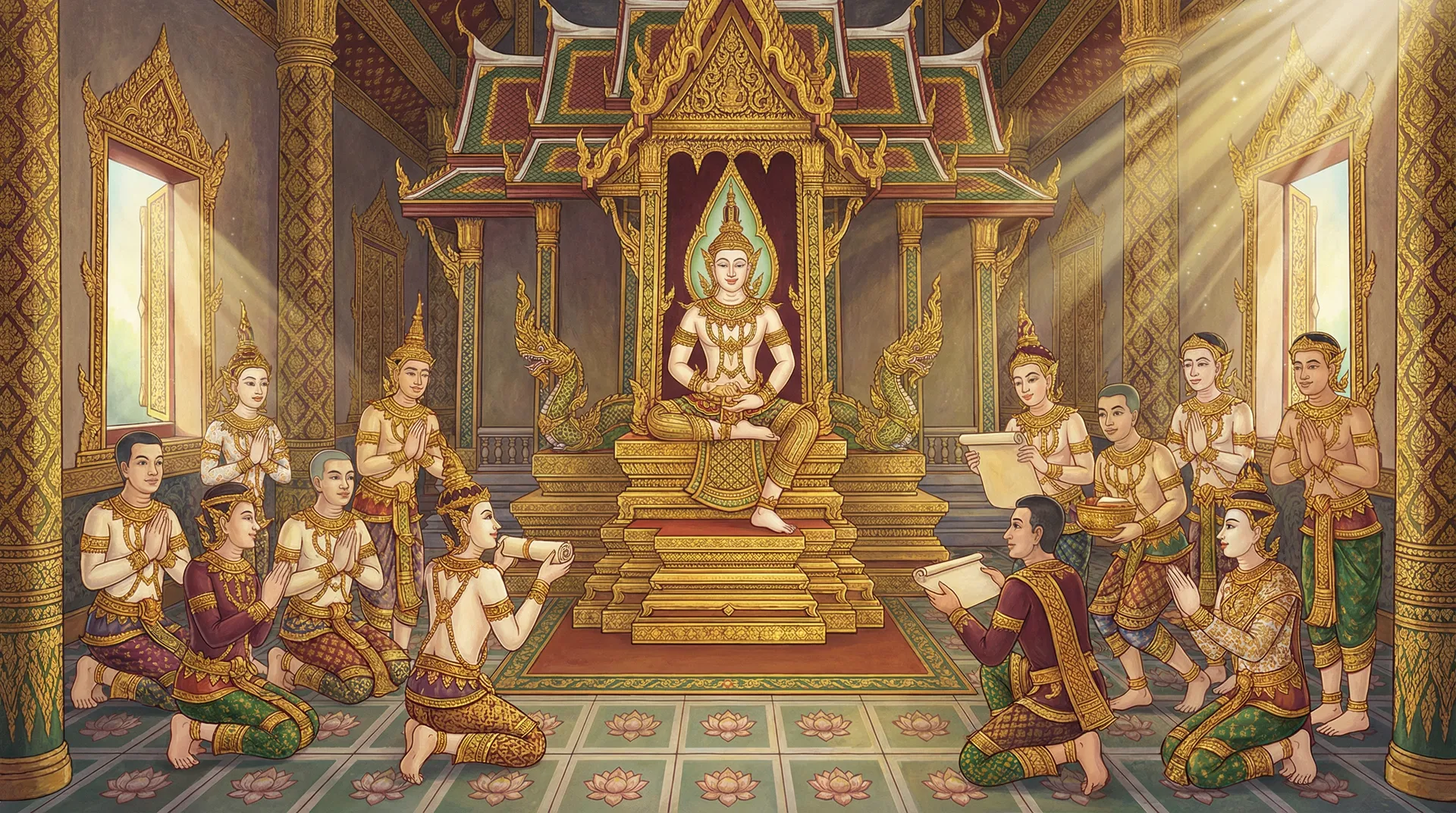
Kakkara Jataka
The Bodhisattva's Humble Service
In a time long past, in a kingdom blessed with fertile lands and a gentle populace, the Bodhisattva chose to be born as a humble potter. He was named Kakkara, and from his childhood, he exhibited an extraordinary spirit of contentment and selfless service. While other children played with toys, Kakkara found joy in shaping clay, not for personal gain, but for the benefit of others.
His village was small, and its inhabitants were simple folk who relied on their own hands for sustenance. Kakkara, with his skillful hands and compassionate heart, became an indispensable part of their lives. He crafted sturdy pots for storing grain, elegant vases for flowers, and practical vessels for daily use. But his generosity extended far beyond his craft. If a villager's roof was leaking, Kakkara would offer his help in repairing it. If a neighbor fell ill, he would bring them nourishing food and sit by their bedside, offering comfort and solace.
His fame, however, was not confined to his village. Tales of his kindness and his exceptional pottery reached the ears of the King. The King, who was known for his just rule but also for his occasional impatience with those who seemed less driven by ambition, summoned Kakkara to the royal palace.
The King, seated on his opulent throne, looked down at the simple potter, who stood before him with humility and grace. "Kakkara," the King declared, his voice resonating with authority, "your skill in pottery is unparalleled. I wish to commission you to create a magnificent set of ceremonial vessels for a grand festival. These vessels must be of the finest make, adorned with intricate designs, and imbued with an aura of royalty. If you succeed, you will be richly rewarded with gold and jewels. But know this, if you fail, you will face my displeasure."
The courtiers around the King murmured their agreement, eager to witness the potter's struggle and perhaps his downfall. They were accustomed to ambition and the pursuit of reward. Kakkara, however, felt no fear. He bowed respectfully and accepted the King's command.
He returned to his humble workshop, not with thoughts of gold and jewels, but with a deep sense of responsibility. He knew that the King desired grandeur, but Kakkara's true artistry lay in his ability to imbue every piece he created with purpose and sincerity. He began by carefully selecting the finest clay, kneading it with dedication, and shaping it with utmost care. He did not rush. He let the clay speak to him, guiding his hands.
As he worked, he thought of the King's desire for magnificence. He understood that true magnificence was not merely in outward adornment but in inner substance. He decided to create vessels that, while beautiful, would also be imbued with the spirit of service that guided his own life.
He sculpted a series of large, sturdy pots, perfect for storing the kingdom's grain, ensuring abundance for all. He crafted elegant bowls that, though intended for the festival, were also perfectly suited for sharing food among the people. He made pitchers that could carry cool, refreshing water to those who toiled in the fields. Each vessel was a masterpiece, not just of form, but of function and compassionate intention.
When the day of the festival arrived, the King eagerly awaited the presentation of the ceremonial vessels. Kakkara, with his usual humility, brought forth his creations. The courtiers gasped. The vessels were indeed beautiful, with a subtle, natural elegance. But they lacked the ostentatious gold and jewels they had expected. They were not dripping with excessive ornamentation.
The King's face fell. He had expected a display of wealth and power, reflected in the vessels. He looked at Kakkara, disappointment etched on his face. "Kakkara," he said, his voice heavy, "where is the grandeur? Where are the jewels? These are simple pots and bowls."
Kakkara, with a gentle smile, gestured to the vessels. "Your Majesty," he replied calmly, "these vessels are indeed for the festival. But they are also for the people. The large pots will ensure that no one in your kingdom goes hungry. The bowls are for sharing abundance, and the pitchers will carry life-giving water. True grandeur, I believe, lies not in the fleeting sparkle of jewels, but in the enduring well-being and contentment of your people. These vessels are crafted with that intention."
The King, taken aback by Kakkara's earnest words, looked closely at the vessels again. He saw the strength, the practicality, and the underlying spirit of service. He realized that Kakkara had understood his command in a far deeper way than anyone else. He had created not just ceremonial objects, but symbols of a just and caring kingdom.
Overwhelmed by Kakkara's wisdom and humility, the King declared, "Kakkara, you have shown me true wealth. Your service is more valuable than any gold. You have not only created beautiful vessels but have also created a legacy of compassion." The King, deeply humbled, abandoned his initial desire for ostentation and embraced Kakkara's vision, ensuring that the festival truly celebrated the well-being of his people.
Kakkara returned to his village, not with riches, but with the profound satisfaction of having served with integrity and wisdom, proving that humble service, guided by compassion, is the greatest art of all.
— In-Article Ad —
💡Moral of the Story
True value and grandeur lie not in outward displays of wealth and ornamentation, but in selfless service, practicality, and the well-being of others. Integrity and compassion are the highest forms of artistry.
Perfection: Generosity (Dana)
— Ad Space (728x90) —
More Jataka Tales You May Enjoy
 70Ekanipāta
The Kurunga Jataka
In ages past, when the Bodhisatta was fulfilling his perfections, he was reborn as a magnificent whi...
💡 Discernment and critical thinking are essential to avoid deception. True security lies in unity, good conduct, and self-reliance, not in superstitions or false promises.
3EkanipātaThe Bodhisattva and the Golden Deer
The Bodhisattva and the Golden Deer In the ancient kingdom of Mithila, nestled amidst emerald fores...
💡 Selfishness and the failure to help others lead to suffering. When we help others, we receive good in return.
10EkanipātaThe Bodhisatta as a Tortoise
The Bodhisatta as a TortoiseIn the tranquil embrace of a sacred forest, where ancient trees formed a...
💡 The ultimate act of compassion, even at the cost of one's own life, can bring forth miraculous salvation.
16EkanipātaThe Monkey King's Courage
The Monkey King's CourageIn the heart of a verdant jungle, teeming with life and vibrant with the ch...
💡 True courage lies in facing fear and acting for the protection of others, regardless of the odds.
8EkanipātaThe Wise King of Birds
The Wise King of BirdsPerched atop the highest peak of the Himalayas, where the air was thin and cry...
💡 True wisdom lies in selfless compassion, and the greatest sacrifices bring about miraculous salvation.
27EkanipātaThe Bodhisatta as a Deer King
The Bodhisatta as a Deer KingIn the heart of a verdant forest, where ancient trees stood sentinel an...
💡 True courage and leadership are demonstrated through selfless sacrifice for the well-being of others.
— Multiplex Ad —