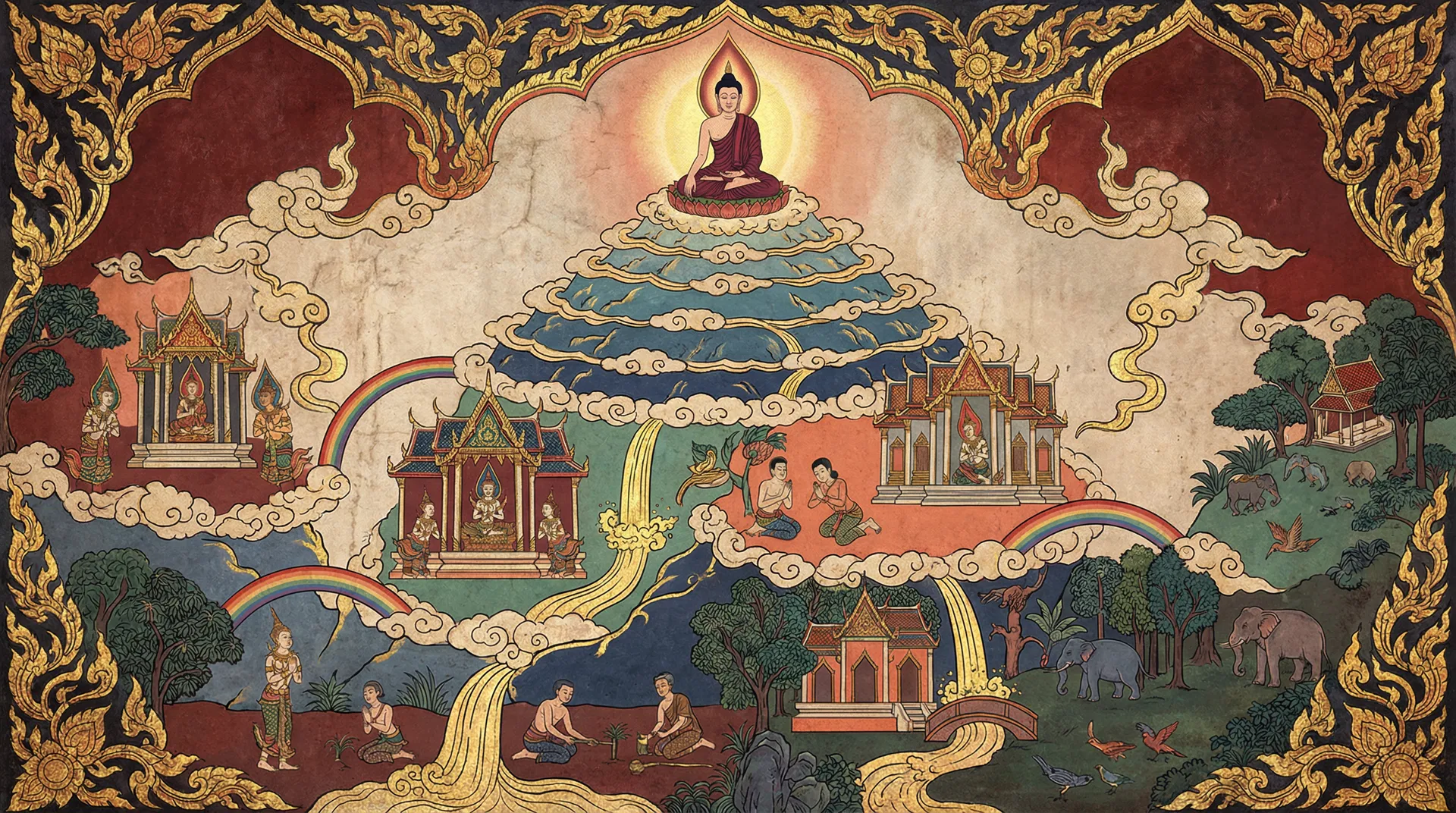
Mūgapakkha Jātaka
Mūgapakkha Jātaka
In the ancient kingdom of Mithila, nestled amidst lush green hills and crystal-clear rivers, lived a king named Sattigumbha. He was a just and benevolent ruler, known for his wisdom and compassion. However, despite his many virtues, a deep sadness often shadowed his heart. This sadness stemmed from the fact that he had no heir, no prince to inherit his throne and continue his legacy of righteousness.
One day, while the king was meditating in his serene garden, a celestial being, a deva from the Tāvatiṃsa heaven, appeared before him. The deva, understanding the king's sorrow, offered him a boon. 'Your Majesty,' the deva's voice resonated like the gentle chime of bells, 'you have lived a life of merit. I can grant you a son, a prince who will bring great joy and prosperity to your kingdom.'
The king, overwhelmed with gratitude, accepted the offer. He prayed for a son who would be not only strong and wise but also possess an unwavering moral compass. Soon after, the queen conceived, and her pregnancy was marked by an unusual serenity and peace that pervaded the entire palace. The kingdom rejoiced, anticipating the arrival of their future prince.
When the prince was born, he was named Mūgapakkha, meaning 'one who is silent' or 'one who has a mute mouth.' This name was not a reflection of his inability to speak, but rather a prophecy. From the moment he was born, Mūgapakkha remained utterly silent. He would not cry, he would not babble, he would not utter a single sound. The royal physicians were baffled, and the king and queen, though initially worried, grew to accept their son's unique nature. They loved him dearly, recognizing his keen intelligence and his observant eyes, which seemed to absorb everything around him.
As Mūgapakkha grew, his silence became a source of wonder and speculation. Some whispered that he was under a curse, others that he was a divine being in disguise. But Mūgapakkha himself seemed content in his silent world. He would spend hours observing the workings of the kingdom, watching the courtiers, the soldiers, the merchants, and the common folk. His mind was sharp, and he grasped complex matters with an ease that belied his silence.
The king, recognizing his son's intelligence, ensured he received the best education. Mūgapakkha learned various arts and sciences, mastered military strategy, and studied the laws and customs of the land. He absorbed knowledge like a sponge, his silent contemplation fueling his understanding.
One day, a neighboring kingdom, ruled by a tyrannical and ambitious king, threatened Mithila with war. The king of Mithila, though valiant, was growing old and frail. He summoned his ministers and generals to discuss the impending conflict. The council chamber was filled with anxiety and fear. The ministers debated various strategies, but no clear path to victory emerged.
Prince Mūgapakkha, now a young man, sat quietly in the corner, observing the proceedings. Though he had never spoken a word in public, his presence was always felt. The king, desperate for a solution, looked towards his son. 'Mūgapakkha,' he said, his voice heavy with worry, 'what is your counsel? Even a silent observer might have wisdom to share.'
To everyone's astonishment, Mūgapakkha stood up. He walked to a large scroll that depicted the terrain between the two kingdoms. With a piece of charcoal, he began to draw. He sketched out a series of strategic maneuvers, pointing out hidden paths, advantageous positions, and potential ambush points. His drawings were so clear and detailed that they instantly conveyed his strategic genius. He showed how to outflank the enemy, how to use the natural landscape to their advantage, and how to strike at the enemy's weakest points.
The ministers and generals were stunned. They had never imagined such brilliance could be expressed without words. The king, tears welling up in his eyes, embraced his son. 'My son,' he exclaimed, 'you have saved our kingdom! Your wisdom is profound, and your strategy is flawless.'
Following Mūgapakkha's silent counsel, the army of Mithila marched forth. The battle was fierce, but thanks to the prince's ingenious plan, they achieved a resounding victory. The enemy king, humbled and defeated, sued for peace.
Mithila was safe, and the kingdom hailed Prince Mūgapakkha as their savior. The king, filled with pride and joy, declared that his son's silence was not a weakness but a profound strength. He realized that true wisdom often lies not in the loudness of words, but in the depth of understanding and the clarity of action.
From that day on, Prince Mūgapakkha became a respected leader. He continued to rule alongside his father, offering his wise counsel through his actions and his insightful drawings. He proved that communication transcends mere speech, and that silence, when filled with wisdom, can be the most powerful form of expression. He eventually ascended the throne, ruling Mithila with the same quiet strength and profound insight that had marked his life, bringing peace and prosperity to his people for many years to come.
— In-Article Ad —
💡Moral of the Story
True wisdom and effective communication can manifest in ways beyond spoken words, such as through actions, illustrations, and deep understanding.
Perfection: Wisdom (Paññā)
— Ad Space (728x90) —
More Jataka Tales You May Enjoy
 218Dukanipāta
Masa Jataka
Masa JatakaIn a serene monastery nestled amidst rolling hills, lived a devout monk named Bodhisattva...
💡 Attachment to desires and possessions leads to suffering. True contentment comes from inner peace and detachment, not from external things.
 85Ekanipāta
Vessantara Jātaka
Vessantara Jātaka In the magnificent kingdom of SiBī, ruled the noble King Sanjaya and his virtuous ...
💡 True generosity comes from the heart and requires immense courage and sacrifice. The practice of giving, even when it leads to personal suffering, leads to profound spiritual merit and liberation.
 423Aṭṭhakanipāta
Daddabha Jātaka
Daddabha JātakaIn the verdant kingdom of Mithila, ruled a king named Brahmadatta, a monarch renowned...
💡 Mastery over one's emotions, particularly anger, is a sign of true strength and wisdom. By cultivating patience and mindfulness, one can transform destructive impulses into constructive actions.
53EkanipātaThe Bodhisatta as the Clever Swan
The Bodhisatta as the Clever SwanOn the shores of a crystal-clear lake, where the water mirrored the...
💡 Intelligence and foresight are more powerful than brute force, and can protect the innocent without resorting to violence.
145EkanipātaMahosadha Jataka
The Tale of Mahosadha, the Wisest of All In the ancient city of Mithila, under the reign of King Ved...
💡 Profound wisdom, applied with compassion and foresight, can bring peace, prosperity, and justice to a kingdom and its people.
176DukanipātaMahāsuka Jātaka
Mahāsuka JātakaIn the ancient city of Mithila, nestled amidst lush gardens and bustling marketplaces...
💡 True happiness is not found in external possessions or fleeting pleasures, but in the cultivation of inner peace, wisdom, and virtue. The greatest treasure is the joy of a contented mind, free from the bondage of insatiable desires.
— Multiplex Ad —