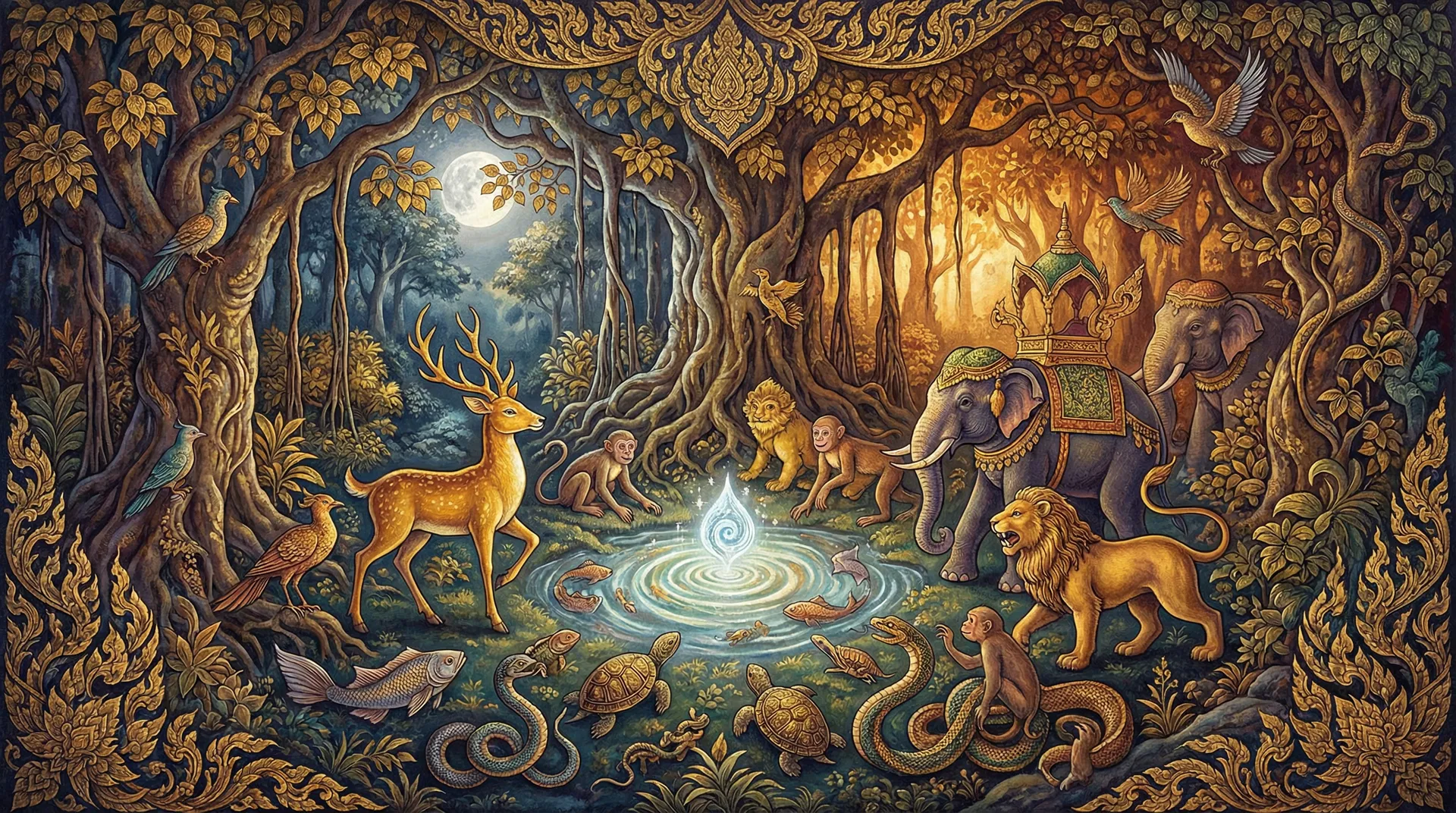
Saddanta Jātaka
The Tale of the Noble Elephant
In the vast and ancient forest of Himavanta, where colossal trees reached towards the heavens and hidden clearings teemed with life, there roamed a magnificent elephant named Saddanta. He was no ordinary creature; he was a Bodhisatta, a being destined for enlightenment, possessing a purity of heart and a strength of character that set him apart. His tusks, long and gleaming like polished ivory, were said to be made of pure gold, and his strength was legendary, yet he used his immense power only for the protection of the forest creatures.
Saddanta lived a life of tranquil contemplation and selfless service. He guided lost animals, protected weaker creatures from predators, and ensured the harmony of the forest ecosystem. His presence was a blessing to all who dwelled there. The other animals revered him, seeking his wisdom and his gentle guidance.
However, as is often the case, even the most virtuous beings can attract the envy and greed of others. In the royal city of Indapatta, the king, a man consumed by worldly desires, heard tales of the miraculous golden tusks of the Bodhisatta elephant. Obsessed with possessing such a rare treasure, he sent his hunters into the Himavanta forest, hoping to capture Saddanta and bring him back to his court.
The hunters, driven by the king's insatiable desire, ventured deep into the forest. Guided by their scouts, they eventually found Saddanta bathing in a serene lake, his golden tusks shimmering in the sunlight. They laid a trap, a cunning snare designed to capture the mighty elephant. As Saddanta stepped into the trap, it sprang shut, ensnaring his mighty leg.
The elephant, though powerful, was caught. He could have easily thrashed and broken free, perhaps even injuring the hunters in his struggle. But the Bodhisatta, even in his distress, acted with compassion and wisdom. He knew that violence would only perpetuate suffering.
As the hunters approached, their faces filled with a mixture of awe and malice, Saddanta spoke, his voice deep and resonant, carrying the weight of his eons of wisdom. “Why do you seek to capture me? My tusks are a burden, not a treasure. They have brought me only suffering and the greed of men.”
The hunters, startled by the talking elephant, were momentarily silenced. They explained the king's decree and the promise of immense reward. Saddanta, seeing their determination, sighed. “If you must have my tusks,” he said, his voice laced with sorrow, “then take them. But know that they are not mere ivory. They are imbued with the purity of my life’s practice. I will give them willingly, but I ask for one boon.”
The hunters, eager to fulfill their mission, readily agreed. “What is your boon, noble elephant?” they asked.
“My boon is this,” Saddanta declared, “that you take my tusks, and present them to the king, but tell him that these tusks were given freely by a compassionate being who wished him well. Let him understand the suffering that greed brings, and may he find true happiness not in possessions, but in righteousness.”
With heavy hearts, yet driven by their orders, the hunters proceeded to sever the golden tusks. As they did so, a dark cloud suddenly covered the sun, and a chilling wind swept through the forest. The moment the tusks were detached, Saddanta, the noble elephant, gave up his life, his body collapsing to the ground. His pure spirit ascended to the heavens, leaving behind a profound silence.
The hunters, carrying the heavy golden tusks, returned to King Indapatta. They presented the tusks and recounted Saddanta’s dying words, emphasizing the elephant’s compassion and his plea for the king to abandon greed. The king, upon hearing the story and seeing the magnificent tusks, was struck by a deep remorse. The weight of Saddanta’s sacrifice, the purity of his dying wish, and the sheer magnitude of his suffering caused by the king’s greed, finally broke through the king’s hardened heart.
The king realized the futility of his endless pursuit of wealth and power. He understood that true happiness and fulfillment lay not in possessing material things, but in living a life of virtue, compassion, and selfless service. He renounced his greedy ways, dedicated himself to righteous rule, and became known as a just and benevolent king, forever remembering the noble elephant of Himavanta and the profound lesson his sacrifice had taught him.
— In-Article Ad —
💡Moral of the Story
Greed leads to suffering for all involved. True happiness and fulfillment are found not in the accumulation of possessions, but in practicing compassion, generosity, and righteousness.
Perfection: Generosity (Dāna Paramī)
— Ad Space (728x90) —
More Jataka Tales You May Enjoy
 249Dukanipāta
Sarabhanga Jataka
Sarabhanga JatakaIn the ancient land of Gandhara, amidst rolling hills and fertile valleys, lived a ...
💡 True strength lies not in external power or worldly achievements, but in the unwavering discipline and mastery of one's own mind.
 404Sattakanipāta
Sama Jataka
Sama JatakaIn the tranquil foothills of the Himalayas, where the air was crisp and the scent of pine...
💡 Filial piety (devotion to parents) and a life lived with unwavering virtue and sincerity possess immense power, capable of overcoming even the gravest of misfortunes.
233DukanipātaPhra Ong Khon Duang Chan (The Bodhisatta as a Celestial Being Who Manifested as a Moonbeam)
Phra Ong Khon Duang Chan (The Bodhisatta as a Celestial Being Who Manifested as a Moonbeam) High abo...
💡 Compassion, even in its most subtle forms, has the power to bring forth life and renewal, transforming despair into hope and offering solace to those in need.
171DukanipātaMahīsosaka Jātaka
Mahīsosaka JātakaIn the ancient kingdom of Mithila, nestled amongst rolling hills and verdant forest...
💡 True loyalty and affection cannot be bought or coerced. The worth of a creature, or a person, is not determined by external forces but by their inner spirit and their bonds with those who truly care for them.
 144Ekanipāta
Maca Hamsa Jataka
The Tale of the Golden Swan King In the realm of the Himalayas, amidst snow-capped peaks and crystal...
💡 True wealth lies in inner virtue, wisdom, and compassion, not in material possessions which are transient.
242DukanipātaKusa Jataka
Kusa JatakaIn the ancient kingdom of Mithila, nestled amidst verdant plains and whispering bamboo fo...
💡 True nobility lies not in birthright, but in character, resilience, and unwavering integrity, especially when faced with betrayal and hardship.
— Multiplex Ad —