
Sīlabuya Jātaka
The Tale of the Virtuous Prince
In the land of Dhāranī lived a king renowned for his righteousness and wisdom. He had a son, Prince Sīlabuya, whose name meant 'foundation of virtue'. From his youth, the prince displayed an extraordinary commitment to the Five Precepts – abstaining from killing, stealing, sexual misconduct, false speech, and intoxicants. His every action was guided by a profound sense of morality and compassion. He was a beacon of integrity in a world often swayed by desires and deceit.
As Prince Sīlabuya grew older, his father, the king, recognized the immense potential of his son to rule justly. He began to entrust him with more responsibilities, preparing him for the day he would ascend the throne. The prince discharged his duties with utmost diligence, always prioritizing the well-being of his subjects and upholding the principles of dharma.
However, not all hearts in the kingdom were as pure as the prince's. A group of envious courtiers, resentful of the prince's rising influence and incorruptible nature, plotted against him. They whispered rumors, spread falsehoods, and tried to manipulate situations to tarnish his reputation. Their ultimate goal was to seize power for themselves, believing the prince's strict adherence to virtue made him unfit to rule a kingdom.
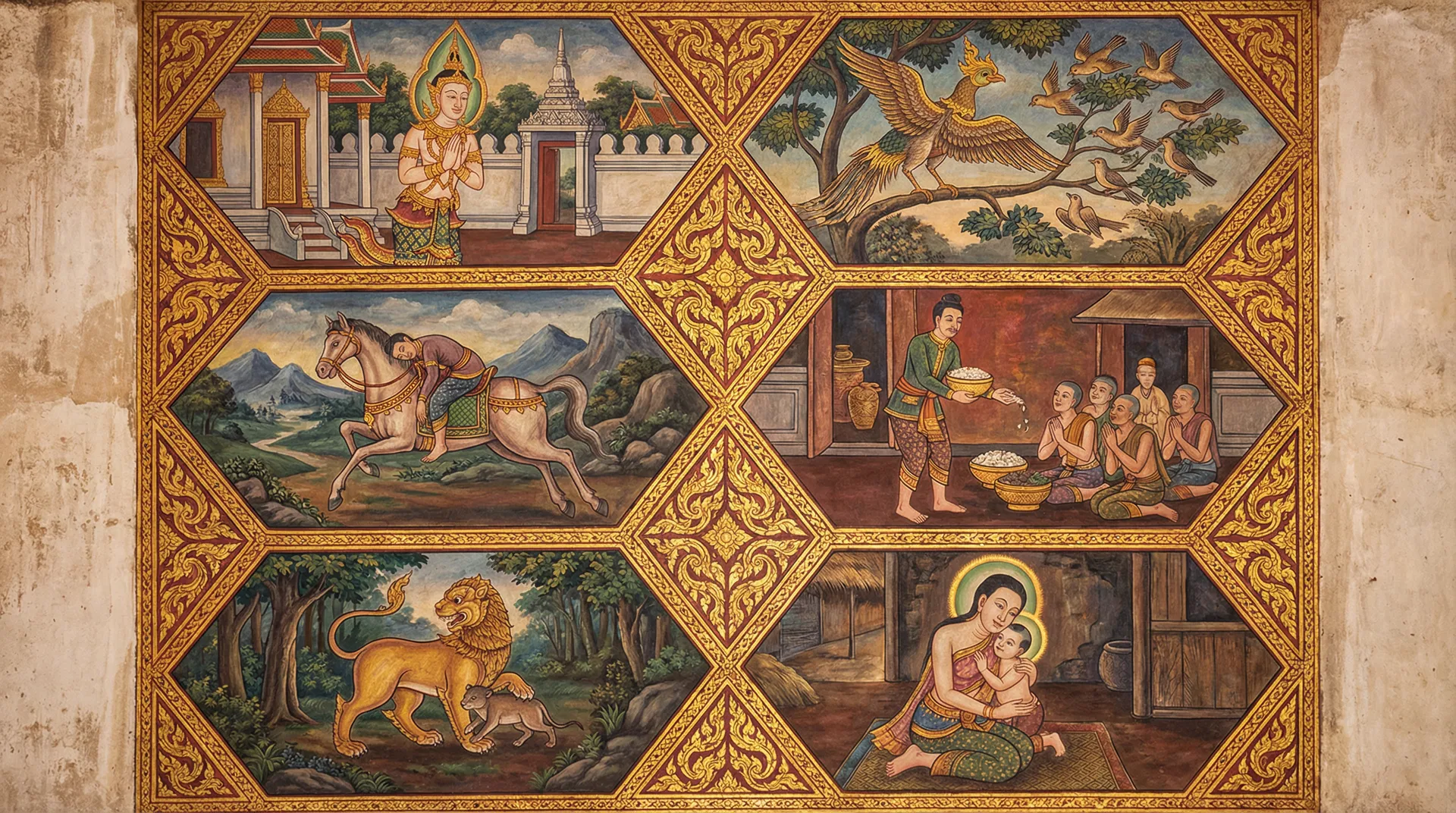
One day, the conspirators devised a particularly wicked scheme. They knew the prince's compassion extended even to the humblest creatures. They captured a rare and beautiful bird, known for its melodious song, and secretly placed it in the prince's private chambers. Then, they went to the king, their faces a mask of feigned concern.
“Your Majesty,” one of them began, his voice dripping with false sorrow, “we have a grave matter to report. We fear for the safety of the kingdom. This morning, we discovered a rare and sacred bird, a symbol of divine favor, trapped within Prince Sīlabuya’s chambers. It appears the prince, in his ignorance, has endangered its life.”
The king, though trusting his son, was disturbed by the accusation. He summoned Prince Sīlabuya, his brow furrowed with concern. “My son,” he said, “is this true? Have you harmed this sacred creature?”
Prince Sīlabuya, though aware of the prince's love for animals, had to consider the implications. He knew that the bird was a symbol of good fortune, and its accidental harm could be seen as a bad omen. He looked at his father with clear, honest eyes.
“Father,” he replied calmly, “I have always strived to uphold the virtue of harmlessness. I would never intentionally bring suffering to any living being. I did not trap the bird, but I acknowledge that it was found in my care. If my unintentional association with its distress causes you concern, then I offer this as atonement.”
With unwavering resolve, Prince Sīlabuya then performed a profound act of generosity and selflessness. He declared that he would relinquish his claim to the throne. He stated, “If my presence here, even through accidental circumstances, brings unease or is perceived as a cause of harm, then I shall step aside. Let the kingdom be ruled by one who brings no such shadow, and let this sacred bird be freed to spread its blessings elsewhere.”
The king was astonished by his son’s noble sacrifice. The courtiers, who expected the prince to deny the charges or make excuses, were taken aback by his humility and willingness to give up everything for the sake of peace and the perception of virtue. The king, seeing the prince’s true character – his unwavering adherence to his principles even when faced with false accusations – realized the depth of his son’s virtue.
The king declared, “This is not a sign of guilt, but a testament to the extraordinary virtue of my son! His willingness to sacrifice his birthright, his very life’s ambition, to uphold the principle of harmlessness is the highest form of righteousness. Such a man is not unfit to rule; he is the only one truly fit!”
The king publicly exposed the treachery of the envious courtiers, who were banished from the kingdom. Prince Sīlabuya, his virtue proven beyond doubt, was celebrated even more. He eventually ascended the throne and ruled Dhāranī with the same unwavering commitment to virtue, compassion, and justice that had defined his life. His reign was marked by peace, prosperity, and a profound respect for all living beings, solidifying his legacy as the 'foundation of virtue'.
— In-Article Ad —
💡Moral of the Story
True virtue is demonstrated not by denying wrongdoing, but by a selfless commitment to principles, even when faced with false accusations. Integrity and compassion are the hallmarks of a just ruler.
Perfection: Vigilance (Ārakkha Paramī)
— Ad Space (728x90) —
More Jataka Tales You May Enjoy
 28Ekanipāta
The Bodhisatta as a King of Bears
The Bodhisatta as a King of BearsIn the vast, snow-laden wilderness of the far north, where towering...
💡 Wise leadership, determination, and inspiring trust can guide a community through perilous challenges to safety.
 388Chakkanipāta
Samkicca Jataka
Samkicca JatakaIn the vibrant city of Savatthi, a place alive with the chatter of merchants and the ...
💡 Honesty and integrity are the most valuable treasures. Even when faced with deception and adversity, speaking the truth and maintaining one's principles will ultimately lead to vindication.
132EkanipātaKuddala Jataka
The Tale of the Weaver's Son Long ago, in the bustling city of Savatthi, renowned for its vibrant ma...
💡 A truly prosperous kingdom is one where the well-being of its poorest citizens is a priority, and where systematic compassion is integrated into governance.
 208Dukanipāta
Masa Jataka
Masa Jataka In the bustling city of Mithila, where artisans toiled and merchants traded, lived a dev...
💡 True wisdom lies not in outward displays of power or prestige, but in the internal cultivation of reverence, respect, and integrity for all beings and all things, no matter how small or seemingly insignificant.
36EkanipātaThe Tale of the Horse-Breeder
In a past aeon, in the flourishing city of Varanasi, the Bodhisatta was born as a young Brahmin, end...
💡 The highest form of virtue is selfless compassion, willing to sacrifice for the well-being of others.
69EkanipātaThe Golden Swan Jataka
In a verdant forest, cradled by majestic mountains, resided a multitude of birds. The morning air wa...
💡 True peace and contentment are found not in external achievements or possessions, but in the mastery of one's own mind, through detachment, mindfulness, and self-awareness.
— Multiplex Ad —