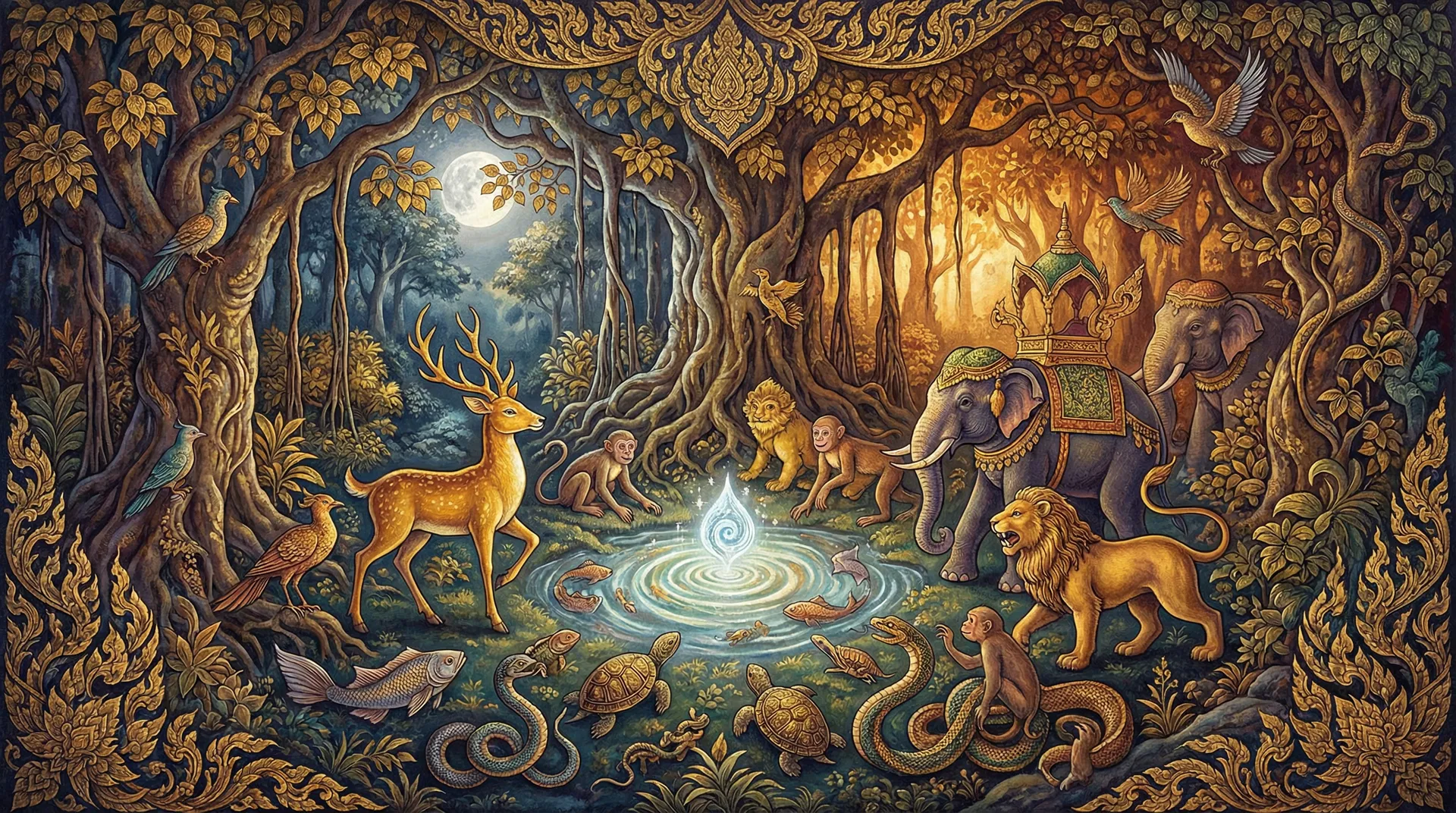
Mahosadha Jataka
Mahosadha Jataka
In the prosperous kingdom of Mithila, under the wise and just rule of King Vedeha, there lived a Bodhisattva named Mahosadha. In this lifetime, Mahosadha was born as a young Brahmin boy, gifted with an intellect so sharp and a wisdom so profound that he was destined to become the king's chief advisor. Even as a child, his uncanny ability to solve complex problems and his deep understanding of human nature set him apart.
The kingdom of Mithila was a beacon of prosperity, but it was often threatened by the ambitious neighboring kingdom of Kasi, ruled by the cunning King Culani Brahmadatta. King Culani, envious of Mithila's wealth and influence, constantly sought ways to undermine King Vedeha. He employed spies, spread rumors, and concocted elaborate schemes, but each time, Mahosadha's extraordinary intelligence thwarted his plans.
One of King Culani's most devious plots involved a challenge to King Vedeha's wisdom. He sent a message to Mithila, claiming that he possessed a magical chariot that could fly. He challenged King Vedeha to produce a chariot of equal or greater power, or face the humiliation of admitting defeat. This was a trick, as King Culani had no such chariot; he simply wanted to force King Vedeha into an impossible task.
King Vedeha, though wise, was perplexed by this challenge. He consulted his ministers, but none could devise a solution. In their despair, they turned to the young Mahosadha. Mahosadha, with a calm smile, listened to the king's predicament. He understood that the challenge was not about actual flying chariots, but about outsmarting the opponent.
Mahosadha instructed the king to have a magnificent chariot built, but with a special modification. He ordered that the wheels of the chariot be made incredibly large and heavy, and that the chariot itself be constructed with the finest materials, appearing grand and impressive. He then instructed the king to send a message back to King Culani, stating that the chariot was indeed ready, but it required a special wind to make it fly, a wind that would only blow when King Culani's own magical chariot was brought forth.
King Culani, expecting a direct confrontation with a flying chariot, was caught completely off guard. He had no flying chariot, and he realized that his trick had been exposed by Mahosadha's superior intellect. He was forced to admit defeat, much to the relief and admiration of King Vedeha and the people of Mithila.
Another time, King Culani attempted to sow discord within Mithila by sending messengers with identical gifts to all the noblemen. The gifts were small, inexpensive wooden boxes, each containing a single pea. The intention was to insult the noblemen and create resentment towards King Vedeha, who would be blamed for such stinginess. However, Mahosadha, anticipating this move, had already instructed the noblemen on how to respond.
When the gifts were distributed, Mahosadha advised the noblemen to accept the boxes with gratitude and then, in private, to plant the pea. He told them that the King, in his infinite wisdom, was providing them with the seeds of future prosperity. When the pea grew into a plant, and eventually a tree bearing many peas, the noblemen were able to present King Vedeha with a bountiful harvest, much to the consternation of King Culani, who saw his scheme backfire spectacularly.
Mahosadha's wisdom extended beyond outsmarting his enemies. He was a proponent of justice, compassion, and fair governance. He established systems of irrigation, promoted agriculture, and ensured that the laws were applied justly to all, regardless of their social standing. He resolved disputes with fairness, mediated conflicts with wisdom, and always prioritized the well-being of the people.
His keen intellect was not limited to grand strategies; he applied it to everyday matters as well. He could discern truth from falsehood, identify hidden motives, and offer solutions to seemingly insurmountable problems. He taught the people of Mithila the importance of critical thinking, the value of truthfulness, and the power of a well-reasoned mind.
The reign of King Vedeha, guided by Mahosadha's brilliance, became a golden age of peace, prosperity, and justice. The kingdom flourished, and its people lived in contentment, secure in the knowledge that their king, supported by his unparalleled advisor, was a protector of their welfare. Mahosadha's life was a testament to the profound impact that wisdom, when combined with compassion and a commitment to truth, can have on the destiny of a kingdom and the lives of its people.
Wisdom, when combined with compassion and a commitment to truth, is the greatest asset of any leader and the foundation of a prosperous society.
— In-Article Ad —
💡Moral of the Story
Profound wisdom, combined with compassion and strategic thinking, can overcome any challenge and lead to justice and prosperity.
Perfection: Wisdom (Panna Paramita)
— Ad Space (728x90) —
More Jataka Tales You May Enjoy
 187Dukanipāta
Kakoli Jataka
The Tale of the Talking BirdIn the vibrant land of Kashi, there once stood a magnificent monastery, ...
💡 Envy can lead to great wickedness, but true virtue, resilience, and wisdom will ultimately overcome betrayal.
 389Chakkanipāta
Mahasutasoma Jataka
Mahasutasoma JatakaIn a distant land, where ancient trees touched the heavens and rivers flowed like...
💡 True power lies in wisdom, compassion, and self-control, not in force or selfish indulgence. Understanding the nature of suffering and craving is the path to liberation.
 507Pakiṇṇakanipāta
Kusa Jataka
The Prince Who Endured Hardship for LoveLong ago, in the opulent kingdom of Kosala, lived a prince n...
💡 True love endures all trials and tribulations. Compassion and understanding are paramount in overcoming conflict and bitterness.
 296Tikanipāta
Kacchapa Jataka
The Kacchapa Jataka: The Steadfast Tortoise In the ancient land of Mithila, ruled by a wise and just...
💡 True strength lies not in avoiding hardship, but in enduring it with steadfastness, patience, and unwavering hope. Compassion and perseverance can inspire even the most pragmatic to choose a more humane path.
293TikanipātaMacchusaṇḍa Jātaka
The Tale of the Fish Who Saved a CityIn the ancient city of Kosala, nestled beside the vast and shim...
💡 Respect for nature and its creatures is paramount. True prosperity comes from living in harmony with the environment, not from exploiting it. Sincerity and humility can move even the most powerful forces.
 366Pañcakanipāta
KUKKURA JATAKA
KUKKURA JATAKALong ago, in a kingdom nestled beside a sparkling river, there lived a king renowned f...
💡 True loyalty is an intrinsic quality, not merely a result of training. It stems from love, trust, and a genuine bond, and can manifest in unexpected ways, even leading to acts of selflessness.
— Multiplex Ad —