Bhuridatta Jataka
Bhuridatta Jataka
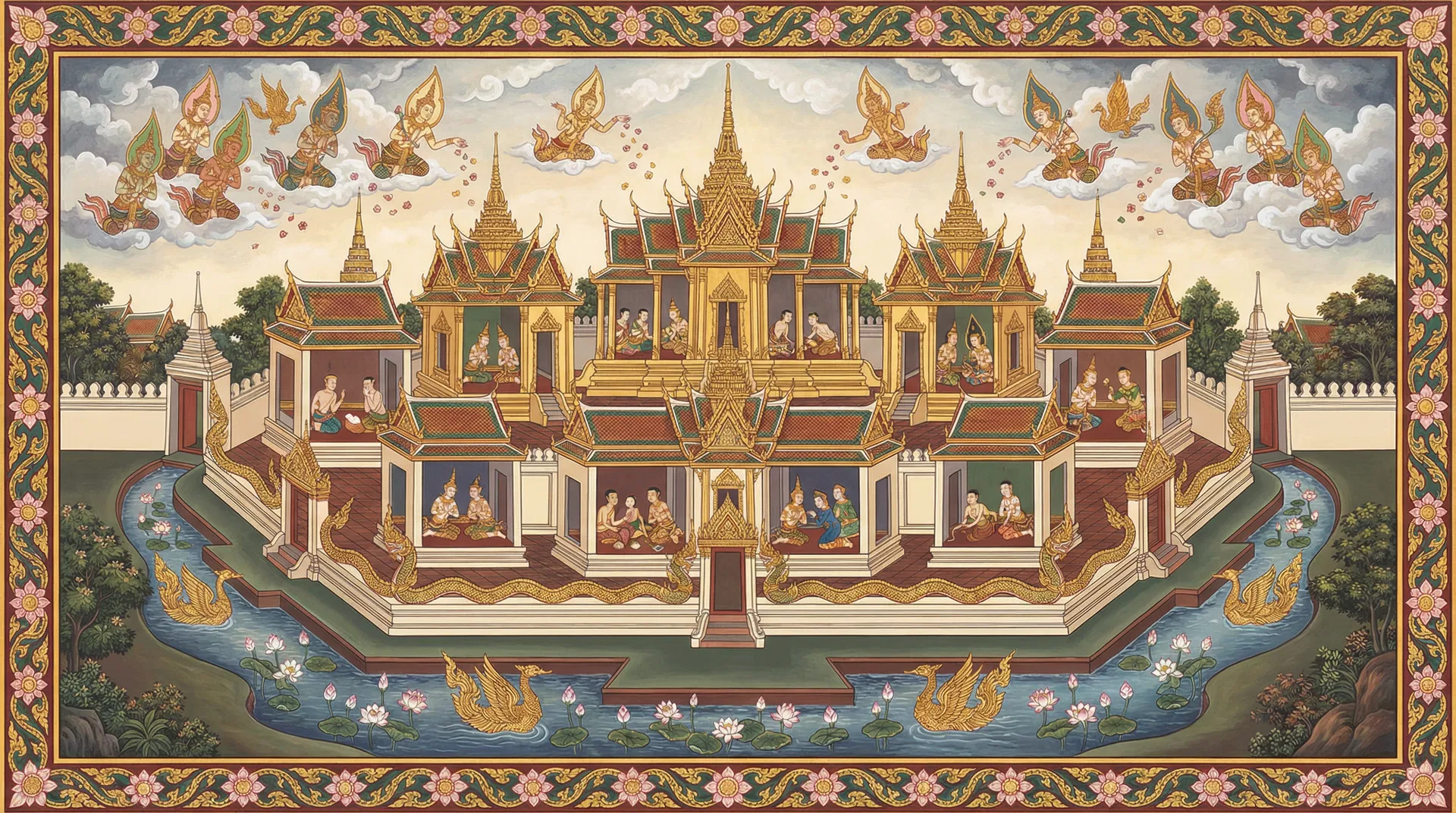
In the verdant land of Kampila, where the river was a silver ribbon winding through emerald fields, lived a wise and compassionate Bodhisattva in the form of a serpent king named Bhuridatta. He dwelled in a magnificent underground palace, adorned with phosphorescent gems and guarded by legions of his kind, but despite his regal status and the loyalty of his subjects, Bhuridatta’s heart was filled with a quiet melancholy. He yearned for a life free from the cycle of suffering, a life dedicated to the highest spiritual pursuits.
Bhuridatta possessed a unique ability – he could manifest in human form, a handsome prince, and he often used this power to observe the human world, to learn from its inhabitants, and to practice his virtues. One day, while in his human guise, he encountered a group of ascetics, men who had renounced the world in search of enlightenment. He was deeply impressed by their discipline and their detachment, and he learned much from their teachings, particularly about the importance of non-violence and the cultivation of compassion.
However, the world of sentient beings is fraught with peril, and the path of virtue is often tested. A cruel and greedy snake-charmer, known for his ruthlessness and his insatiable desire for wealth, heard tales of the extraordinary serpent king, Bhuridatta. Driven by avarice, the snake-charmer devised a wicked plan. He knew that rare and powerful serpents were highly prized, and he believed that capturing Bhuridatta would bring him immense riches and fame.
Using a combination of cunning traps, potent herbs that weakened even the mightiest creatures, and a relentless pursuit, the snake-charmer eventually managed to capture Bhuridatta. The Bodhisattva, despite his immense power, allowed himself to be captured, seeing it as an opportunity to further cultivate his virtues of patience and forbearance. He was bound with ropes, his magnificent scales dulled by dust and despair, and paraded through villages and towns as a spectacle.
The snake-charmer treated Bhuridatta with utter brutality, forcing him to perform tricks for jeering crowds, beating him when he refused, and displaying him in a cage for all to see. The humiliation and suffering were immense, yet Bhuridatta remained steadfast in his resolve. He did not retaliate, nor did he harbor any ill will towards his tormentor. Instead, he used the experience to deepen his understanding of suffering and to strengthen his resolve to help all beings escape its clutches.
During his captivity, Bhuridatta’s fellow serpents, filled with rage and sorrow at the abduction of their king, plotted revenge. They sent emissaries to the snake-charmer, threatening him with fiery retribution if he did not release their king immediately. However, Bhuridatta, even in his suffering, intervened. He sent a message to his people, urging them to refrain from violence. He explained that his capture was a consequence of his past karma and that any act of vengeance would only create more suffering and perpetuate the cycle of retribution.
He implored his people to practice compassion and understanding, even towards their enemies. He reminded them that true strength lay not in brute force, but in the power of non-violence and forgiveness. His words had a profound effect on his subjects, who, though initially enraged, eventually understood their king’s wisdom and chose to follow his path of peace.
The snake-charmer, witnessing the unwavering patience and the profound wisdom of Bhuridatta, began to feel a pang of conscience. He saw that the serpent king, despite his torment, radiated a sense of calm and nobility that defied his cruel treatment. He realized that this was no ordinary creature, but a being of extraordinary spiritual depth. The constant exposure to Bhuridatta’s virtue began to wear down the snake-charmer’s hardened heart.
One fateful day, as the snake-charmer was preparing to exhibit Bhuridatta at a grand festival, the Bodhisattva, drawing upon his immense spiritual power and his unwavering compassion, spoke to the snake-charmer. He did not accuse or condemn, but explained the nature of karma and the suffering that his cruel actions were causing not only to Bhuridatta but also to himself. He spoke of the interconnectedness of all beings and the boundless merit that could be gained by practicing kindness and compassion.
His words, delivered with such gentleness and profound understanding, struck the snake-charmer like a bolt of lightning. For the first time, he truly saw the suffering he had inflicted and the emptiness of his pursuit of wealth. Overwhelmed with remorse, the snake-charmer fell at Bhuridatta's feet, begging for forgiveness. He released Bhuridatta from his bonds and vowed to abandon his cruel profession, dedicating the rest of his life to acts of kindness and service.
Bhuridatta, true to his compassionate nature, readily forgave the snake-charmer. He understood that the man, too, was a victim of his own ignorance and greed. The Bodhisattva returned to his kingdom, his heart filled with a renewed sense of purpose. He continued to rule his subterranean realm with wisdom and kindness, always remembering the lessons learned during his ordeal. His story became a powerful testament to the transformative power of patience, compassion, and the unwavering adherence to virtue, even in the face of extreme adversity.
The path of virtue is often tested, but true strength lies not in brute force, but in the power of non-violence and forgiveness. Even in suffering, one can find an opportunity to cultivate patience and compassion.
— In-Article Ad —
💡Moral of the Story
Patience, compassion, and forgiveness can overcome even the greatest cruelty and transform the hearts of adversaries.
Perfection: Patience (Khanti Paramita)
— Ad Space (728x90) —
More Jataka Tales You May Enjoy
 527Mahānipāta
Mahā-susukajātaka
The Tale of the Contented Monkey In a lush, verdant forest teeming with life, where ancient trees sc...
💡 True happiness and contentment are found not in the abundance of external possessions, but in appreciating what one already has and choosing to find joy in the present moment.
 137Ekanipāta
Maha-Ummagga Jataka
The Great Wisdom of Prince VessantaraIn the ancient kingdom of Kalinga, famed for its glittering cit...
💡 The highest form of generosity is to give even that which is most precious, understanding that true happiness lies in selfless giving and compassion for all beings.
6EkanipātaThe Compassionate Elephant
The Compassionate ElephantIn the heart of a vast, sun-drenched savanna, where acacia trees dotted th...
💡 True compassion demands the greatest sacrifice, and love can transform the world.
86EkanipātaThe Great Vanga Jataka
Once upon a time, in the glorious city of Savatthi, while the Supreme Buddha resided at Jetavana Mon...
💡 True compassion lies in the willingness to sacrifice one's own well-being for the benefit of others, and such selfless acts can bring about miraculous positive change.
16EkanipātaThe Monkey King's Courage
The Monkey King's CourageIn the heart of a verdant jungle, teeming with life and vibrant with the ch...
💡 True courage lies in facing fear and acting for the protection of others, regardless of the odds.
131EkanipātaMugapakkha Jataka
The Tale of the Mute Prince In the ancient kingdom of Varanasi, nestled beside the sacred Ganges, li...
💡 True wisdom often lies not in speaking, but in knowing when and how to speak, especially when words are needed to uphold truth and compassion.
— Multiplex Ad —