Mugapakkha Jātaka
Mugapakkha Jātaka
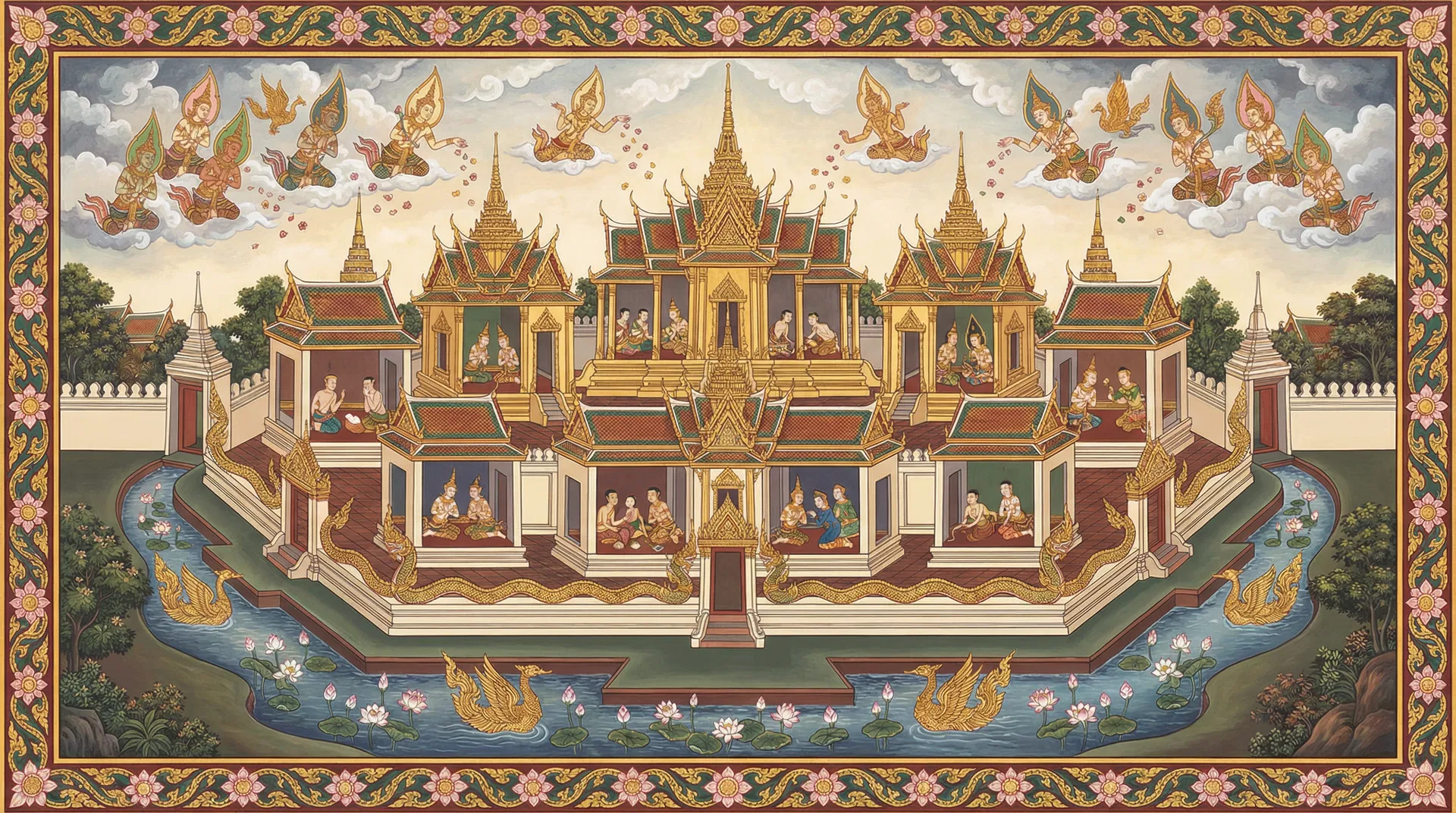
In the ancient land of Mithila, a realm renowned for its scholars and philosophers, there lived a prince named Mugapakkha. He was the son of King Suppāra, a just and benevolent ruler. From his youth, Prince Mugapakkha displayed an extraordinary intellect and a profound sense of duty. He was not only skilled in the arts of warfare and governance but also possessed a deep spiritual inclination, often seeking solace and wisdom in quiet contemplation.
However, a shadow loomed over the prince's destiny. In a past existence, he had been a foolish ascetic who, driven by pride and ignorance, had vowed to remain silent for twelve years, believing that silence alone would lead to enlightenment. During this vow, he had unintentionally caused harm to a wise sage, whose teachings he had disregarded due to his self-imposed muteness.
This past transgression manifested in Prince Mugapakkha's life as a peculiar affliction: he was born mute. Despite his intelligence and his ability to understand all languages, he could not utter a single word. His devoted parents, the King and Queen, were deeply saddened by their son's condition, yet they loved him dearly and ensured he received the best education and upbringing.
The prince, though unable to speak, communicated through his actions and his expressive eyes. He learned to read, write, and understand complex philosophies. He observed the world with keen insight, his mind a whirlwind of thoughts and observations that he longed to share.
One day, a powerful and ambitious neighboring king, King Viriya, sought to claim Mithila's throne. He sent an envoy to King Suppāra, demanding tribute and threatening war if his demands were not met. King Suppāra, a man of peace, was reluctant to engage in conflict but also unwilling to subjugate his kingdom.
The court was in turmoil. The King's advisors debated various strategies, but fear and uncertainty prevailed. Prince Mugapakkha, witnessing the distress of his father and the impending danger to his kingdom, felt a surge of determination. Though mute, he knew he had to act.
He approached his father and, with great solemnity, presented him with a written declaration. In it, he revealed his intention to face King Viriya in single combat to settle the dispute. He explained that while he could not speak, his courage and his commitment to his kingdom were unwavering. He believed that his willingness to defend Mithila, even in his silenced state, would prove his worthiness and deter the aggressor.
King Suppāra was hesitant. "My son," he said, his voice heavy with paternal concern, "this is a grave risk. You are my only heir. What if something were to happen to you?"
But Mugapakkha's resolve was firm. He conveyed through gestures and a stern look that this was the only path he could take to protect their people. He also conveyed that his silence was a karmic consequence, and facing this challenge was a way to confront and overcome that past mistake.
The challenge was sent to King Viriya. The ambitious king, intrigued by the prince's audacity and perhaps underestimating the mute prince, accepted. He believed it would be an easy victory and a swift path to conquering Mithila.
The day of the duel arrived. A vast crowd gathered to witness the spectacle. Prince Mugapakkha, clad in his royal armor, stood calmly in the arena. King Viriya, a towering figure of brute strength, sneered at his opponent.
As the combat began, King Viriya attacked with ferocity, expecting to overwhelm the silent prince. But Mugapakkha, despite his inability to speak threats or war cries, fought with the skill and precision of a seasoned warrior. His movements were fluid, his defense impeccable, and his strategy astute. He used his silence not as a weakness, but as a focus, channeling all his energy and concentration into the fight.
The battle raged on. The crowd, initially skeptical of the mute prince, was now captivated by his bravery and skill. They cheered him on, their hopes resting on their silent champion.
In a critical moment, King Viriya, overconfident and enraged by the prince's resilience, made a reckless move. Mugapakkha seized the opportunity. With a powerful thrust, he disarmed King Viriya, forcing him to concede defeat.
The victory was resounding. King Viriya, humbled and astonished, acknowledged the prince's courage and skill. He withdrew his demands, leaving Mithila in peace. The people of Mithila rejoiced, hailing their silent prince as their savior.
Prince Mugapakkha, though still unable to speak, had proven that true strength lies not in the ability to proclaim one's power, but in the courage of one's actions and the purity of one's heart. His silence, once perceived as a deficiency, had become a symbol of his inner strength and unwavering commitment. He continued to serve his kingdom with wisdom and dedication, his life a testament to the fact that even in the face of adversity and past karmic consequences, one can find liberation through courage, virtue, and selfless action.
— In-Article Ad —
💡Moral of the Story
True strength and leadership are demonstrated through courageous actions and unwavering commitment, not necessarily through eloquent speech. Overcoming personal limitations and past karmic consequences requires inner strength and resolute will.
Perfection: Virya Paramī (Perfection of Energy and Effort), Adhiṭṭhāna Paramī (Perfection of Determination)
— Ad Space (728x90) —
More Jataka Tales You May Enjoy
 436Navakanipāta
Mugapakkha Jataka
The Tale of the Mute PrinceIn the ancient city of Mithila, ruled a just and benevolent king named Vi...
💡 True strength and wisdom are not always expressed through words. Courage, intelligence, and unwavering resolve can speak volumes, even in silence. The ability to inspire and protect others transcends the need for a voice.
 141Ekanipāta
Mugapakkha Jataka
The Tale of the Mute Prince In the ancient kingdom of Mithila, ruled a just king named Dhanañjaya. H...
💡 True leadership is demonstrated through actions, courage, and compassion, not merely through eloquent speech.
 203Dukanipāta
Kacchapa Jataka
Kacchapa Jataka In the heart of a lush jungle, where ancient trees formed a canopy of emerald and th...
💡 Selfless compassion and sacrifice are the highest forms of generosity. True spiritual growth requires understanding the interconnectedness of all beings and practicing kindness.
161DukanipātaMugapakkha Jataka
The Tale of the Mute PrinceIn the ancient kingdom of Uttarapatha, nestled between towering, snow-cap...
💡 True wisdom and leadership are not defined by the ability to speak, but by the capacity to understand, to act with compassion, and to serve the needs of others. Sometimes, the greatest voices are found in the deepest silence.
133EkanipātaMakhadeva Jataka
The Tale of the Wise King and the Golden Goose In the ancient city of Mithila, ruled a benevolent ki...
💡 True wealth lies not in accumulating possessions, but in wisdom, contentment, and the understanding of impermanence. Greed destroys the source of sustained benefit.
65EkanipātaThe Great Monkey King
The Great Monkey King In a time long past, when the world was young and the forests teemed with lif...
💡 Upholding one's promise is of utmost importance. Breaking one's word inevitably leads to negative karma.
— Multiplex Ad —