Sasa Jātaka
Sasa Jātaka
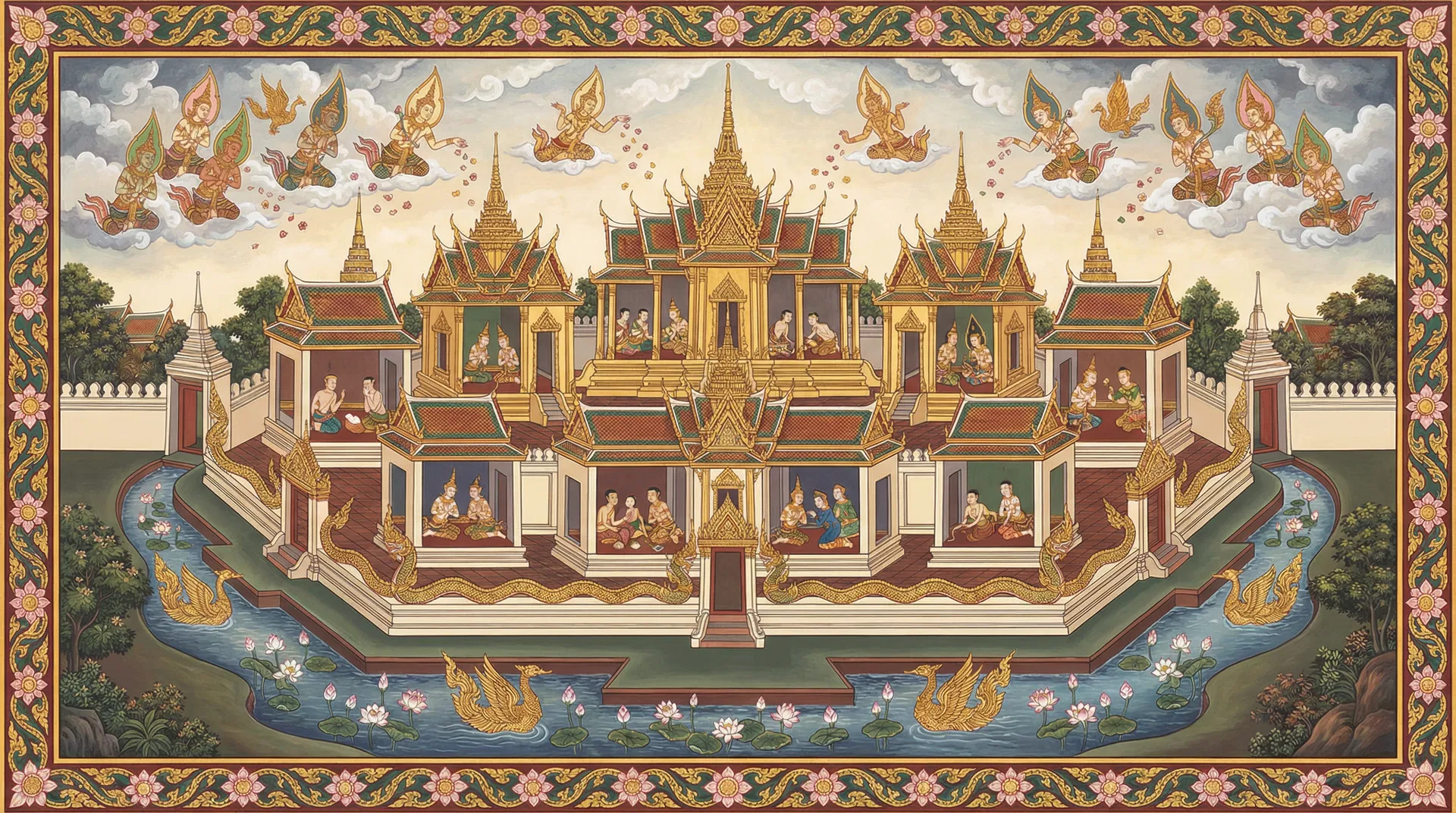
In a time long past, when the world was younger and the forests more ancient, there lived a wise and compassionate hare. This was no ordinary hare; it was the Bodhisatta, a being of immense virtue and purity, destined to guide others towards enlightenment.
The hare lived a simple life in a beautiful forest, surrounded by his animal companions: a jackal, a monkey, and an otter. They were a harmonious community, sharing the bounty of the forest and living in peace. The hare, with his gentle wisdom, often guided his friends, reminding them of the importance of virtue and kindness.
One day, the celestial king, Sakka, decided to test the beings of the earth. He descended from his heavenly abode, disguised as a poor Brahmin, and appeared before the animals as they were gathered in their usual meeting place.
"Alas, I am starving!" the Brahmin cried out, his voice weak and trembling. "I have traveled far and wide, and found no food. Is there anyone among you who can offer me sustenance?"
The monkey, eager to please, scurried up a tree and gathered a handful of ripe mangoes, offering them to the Brahmin. The otter, diving into the river, caught a fish and presented it to him. The jackal, though less resourceful, managed to find some leftover food from a previous meal and offered it to the hungry man.
The hare watched his friends, his heart filled with a desire to contribute. But he was a simple creature; he ate grass and herbs, and had nothing of value to offer. He felt a pang of sadness, wishing he could give something truly substantial.
As the Brahmin continued to lament his hunger, the hare's mind was filled with a profound realization. He remembered a teaching about the ultimate act of generosity: the offering of one's own life. He knew that his flesh, though small, could provide nourishment. He also knew that his life, as a Bodhisatta, was meant to serve as an example of ultimate selflessness.
"Brahmin," the hare said, his voice clear and steady, though his friends looked at him with concern. "I have nothing else to offer but my own body. If you wish, you may take my life and eat my flesh. It is the greatest gift I can give."
The monkey, otter, and jackal were horrified. "Brother Hare!" they cried. "Do not do this! Your life is precious! We cannot bear to see you harm yourself!"
But the hare was resolute. He gently hopped towards the Brahmin. "Please, build a fire," he instructed. "I will jump into it, and my flesh will be cooked for you."
The Brahmin, his disguise now seen through by the wise hare, revealed himself as Sakka, king of the gods. He was deeply moved by the hare's unwavering compassion and willingness to sacrifice his life for another. He knew that the hare was indeed the Bodhisatta.
Sakka then used his divine powers to scoop up the hare. He did not build a fire, nor did he harm the hare. Instead, he carefully placed the hare on the moon, where his image would be forever imprinted for all beings to see. This image, the hare in the moon, would serve as a perpetual reminder of the virtue of selfless giving.
"Little hare," Sakka said, his voice filled with admiration, "your act of supreme sacrifice will be remembered for all time. You have shown the world the true meaning of compassion and generosity. Your image shall adorn the moon, a beacon of hope and a testament to your boundless merit."
The hare, content and at peace, knew that his life had served its ultimate purpose. His friends, though saddened by his departure, were inspired by his noble act. From that day on, whenever beings looked up at the moon, they would see the image of the hare and be reminded of the profound lesson of selfless giving, a lesson that continues to resonate through the ages.
— In-Article Ad —
💡Moral of the Story
The highest form of generosity is the selfless offering of one's own life for the benefit of others. Such acts of supreme compassion leave an indelible mark on the world and inspire countless beings.
Perfection: Dana Paramī (Perfection of Generosity), Khanti Paramī (Perfection of Patience and Forbearance)
— Ad Space (728x90) —
More Jataka Tales You May Enjoy
 442Dasakanipāta
Sutasoma Jataka
Sutasoma JatakaIn the bustling city of Benares, lived a king named Sutasoma, a ruler whose heart was...
💡 True victory is not achieved through violence, but through understanding, compassion, and the transformation of negativity.
 47Ekanipāta
The Bodhisatta as the King of the Monkeys
The Bodhisatta as the King of the MonkeysIn a verdant forest so vast that its trees seemed to scrape...
💡 Wisdom, courage, and self-sacrifice are the most effective defenses against malice and greed.
 175Dukanipāta
Nimi Jātaka
Nimi JātakaIn the ancient and prosperous kingdom of Mithila, there reigned a virtuous king named Nim...
💡 Actions have consequences, both in this life and in the next. Virtuous deeds lead to happiness and celestial rewards, while unwholesome actions result in suffering. Living a life of righteousness is the path to true and lasting fulfillment.
40EkanipātaThe Parrot Jataka
In a time long past, when the Bodhisatta was reborn as a parrot, his plumage was the vibrant green o...
💡 Actions, driven by intention, have profound and lasting consequences, and a life of virtue leads to true happiness and liberation.
43EkanipātaThe Bodhisatta as the Clever Monkey
The Bodhisatta as the Clever MonkeyHigh in the canopy of a vast and ancient jungle, where sunlight s...
💡 Intelligence and unity are the most potent weapons against overwhelming adversity, and foresight can save lives.
50EkanipātaThe Bodhisatta as the King of the Sarabha
The Bodhisatta as the King of the SarabhaIn the wild and untamed Himalayas, where snow-capped peaks ...
💡 True courage lies in selfless sacrifice for the protection of others, demonstrating profound compassion.
— Multiplex Ad —