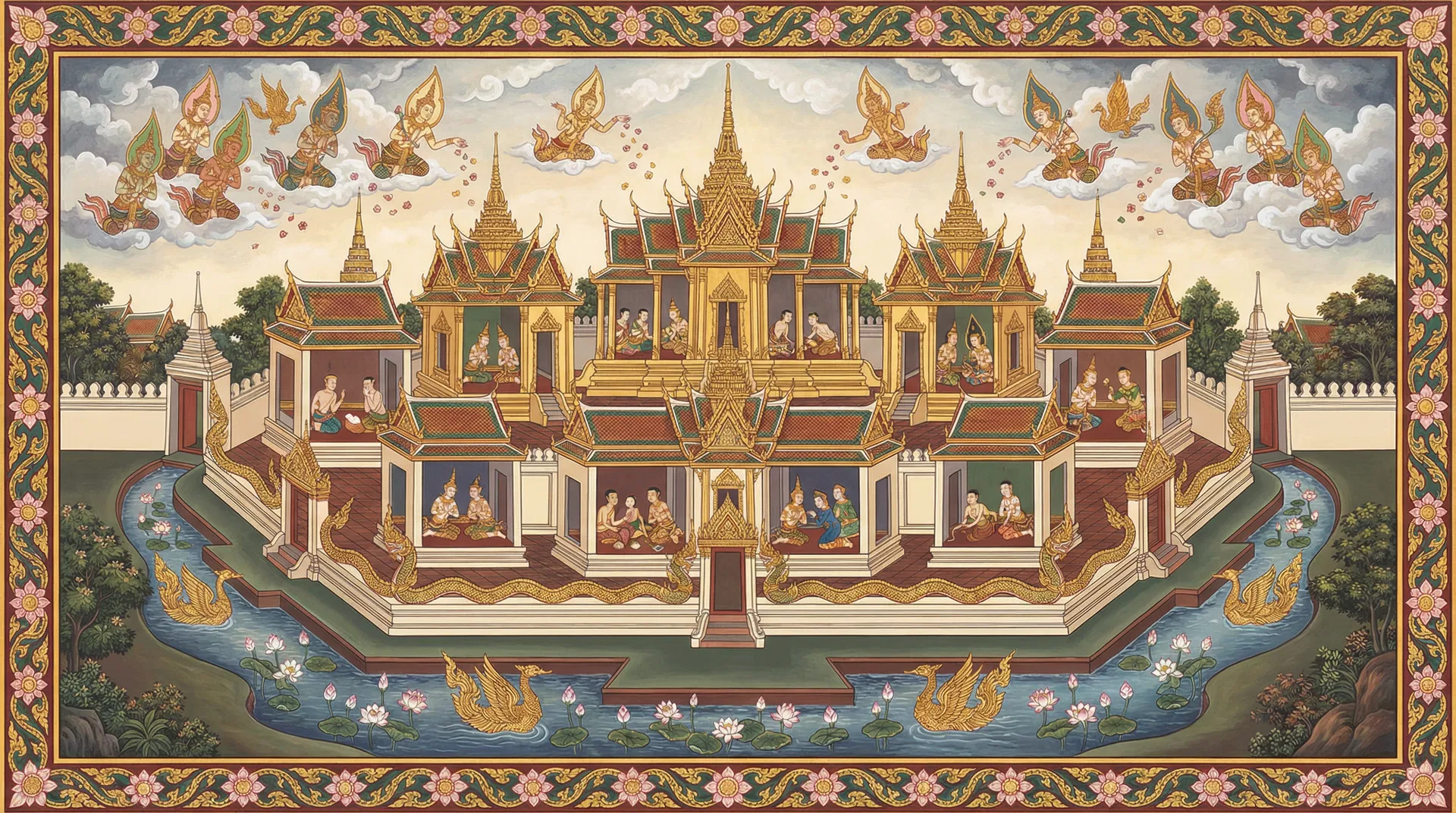
Mahāsutasoma Jātaka
Mahāsutasoma Jātaka
In the heart of a lush, verdant kingdom, nestled beside the roaring currents of a great river, lived a wise and compassionate king named Virūpākṣa. His reign was marked by justice and prosperity, and his people loved him dearly. Yet, the king harbored a profound sorrow: he had no heir to inherit his throne. He prayed and performed meritorious deeds, but his wish remained unfulfilled.
One day, a celestial being, witnessing the king’s earnest desire and virtuous nature, descended from the heavens. This being, an enlightened Bodhisatta in a past existence, took the form of a hermit with eyes like stars and a beard like flowing moonlight. He appeared before King Virūpākṣa as he meditated in his royal gardens.
"Your Majesty," the hermit’s voice resonated with ancient wisdom, "your devotion has not gone unnoticed. I have come to grant you a boon. You shall have a son, a prince destined for greatness, but know this: he will possess an insatiable hunger for flesh, a primal craving that must be satiated lest it consume him and bring ruin to your kingdom."
The king, overjoyed at the prospect of a son, despite the ominous warning, readily accepted. Soon after, Queen Sujātā gave birth to a prince of unparalleled beauty and strength, named Mahāsutasoma. As the prince grew, so did his peculiar hunger. It began subtly, with a fascination for the hunting grounds, and soon escalated to a disturbing obsession. He would spend his days tracking animals, his eyes gleaming with an unnatural intensity.
The king, heartbroken, tried to reason with his son. "My dear Mahāsutasoma," he would plead, "this hunger is unnatural. It pains me to see you consumed by such a primal urge. There must be another way."
But the prince, though not inherently cruel, found himself unable to resist the craving. It was a force within him, a shadow that whispered promises of satisfaction. He tried to control it, to channel it into harmless pursuits, but the hunger always returned, stronger than before.
One fateful evening, as the prince wandered through the forest, his hunger gnawing at him, he stumbled upon a magnificent white elephant, its tusks like polished ivory. The sight filled him with an overwhelming desire. He knew, with a certainty that chilled him to the bone, that the flesh of this noble creature would appease his craving. He pursued the elephant, his heart pounding, his senses heightened.
As he was about to strike, the elephant, with a mournful cry, transformed before his eyes into a divine being. It was the same celestial being who had granted the king his boon. "Prince Mahāsutasoma," the being spoke, his voice filled with sorrow, "do you not recognize me? You are driven by a hunger that is not your own. It is a consequence of a past action, a debt you must repay."
The celestial being then recounted a tale from a previous life. "In that life, you were a hunter, driven by greed and a callous disregard for life. You killed a great white elephant, not out of necessity, but for sport. Its flesh, though forbidden by its divine nature, you consumed with relish. This act has bound you to this insatiable hunger across lifetimes. The curse will only be lifted when you willingly offer your own flesh to satisfy the hunger of another, a selfless act of compassion that transcends your primal urge."
The prince was stunned. He saw the truth in the celestial being's words, the echo of his past actions resonating within him. He understood that his current suffering was a karmic consequence. He returned to the palace, the weight of this revelation heavy on his soul. He knew what he had to do.
The next day, Prince Mahāsutasoma approached his father. "Father," he said, his voice calm but firm, "I have discovered the source of my affliction. It is a karmic debt from a past life. The only way to break this cycle is to offer my own flesh to satisfy the hunger of another."
King Virūpākṣa was aghast. "My son, my only son! Never! I will not allow it!"
But Mahāsutasoma was resolute. He had spent the night in deep contemplation, his heart filled with a newfound resolve. He knew that true liberation lay not in succumbing to his hunger, but in transcending it through sacrifice.
He went to the royal kitchens, where the cooks were preparing the day's meal. He declared to them, "I offer my own flesh to be consumed by whoever has the greatest hunger and need."
The cooks, bewildered, initially refused. But the prince insisted, his determination unwavering. Finally, a ravenous demon, drawn by the scent of the prince’s selfless offer, appeared. The demon’s hunger was immense, a void that threatened to swallow everything.
The prince, without a moment's hesitation, offered himself. He instructed the cooks to prepare his flesh. As the demon began to feast, a miraculous transformation occurred. The prince’s flesh, as it was consumed, regenerated, leaving him unharmed. The demon, satiated and filled with gratitude, was freed from its own torment. The celestial being appeared once more, his countenance radiant. "Mahāsutasoma," he proclaimed, "you have conquered your primal hunger through boundless compassion and selfless sacrifice. You have demonstrated the highest form of generosity, the perfection of giving. Your suffering is ended, and your lineage is freed from this curse."
From that day forward, Prince Mahāsutasoma was free from his unnatural craving. He ruled his kingdom with wisdom, justice, and immense compassion, embodying the true spirit of a Bodhisatta. His reign brought peace and prosperity, and his story became a beacon of hope, teaching that true strength lies not in power, but in the willingness to give oneself for the well-being of others.
— In-Article Ad —
💡Moral of the Story
True liberation from suffering comes not from indulging desires, but from transcending them through selfless compassion and sacrifice. The consequences of past actions can be overcome by present acts of great merit.
Perfection: Dana Paramī (Perfection of Generosity)
— Ad Space (728x90) —
More Jataka Tales You May Enjoy
 320Catukkanipāta
Saddanta Jataka
Saddanta JatakaIn the magnificent Himalayan forests, where snow-capped peaks kissed the azure sky an...
💡 True virtue and compassion are unshakeable, even in the face of extreme suffering and betrayal. The pursuit of selfish desires through violent means leads only to further suffering and is ultimately futile.
 41Ekanipāta
The Tale of the Clever Crow
The Tale of the Clever Crow In the ancient city of Varanasi, nestled beside the sacred River Ganges...
💡 Disobedience to the teachings of experienced and benevolent individuals leads to suffering and destruction. Leaders must possess patience, sacrifice, and guide people towards the right path.
7EkanipātaThe Steadfast Deer
The Steadfast DeerIn the serene and emerald expanse of a sacred grove, where ancient banyan trees sp...
💡 Unwavering steadfastness and a pure heart can overcome the direst of circumstances.
3EkanipātaThe Bodhisattva and the Golden Deer
The Bodhisattva and the Golden Deer In the ancient kingdom of Mithila, nestled amidst emerald fores...
💡 Selfishness and the failure to help others lead to suffering. When we help others, we receive good in return.
 248Dukanipāta
Katthahari Jataka
Katthahari JatakaIn the bustling city of Savatthi, there lived a woodcutter named Katthahari. He was...
💡 Selfless compassion, even towards the smallest creatures and when faced with personal temptation, is a virtue that brings great rewards and blessings.
133EkanipātaMakhadeva Jataka
The Tale of the Wise King and the Golden Goose In the ancient city of Mithila, ruled a benevolent ki...
💡 True wealth lies not in accumulating possessions, but in wisdom, contentment, and the understanding of impermanence. Greed destroys the source of sustained benefit.
— Multiplex Ad —