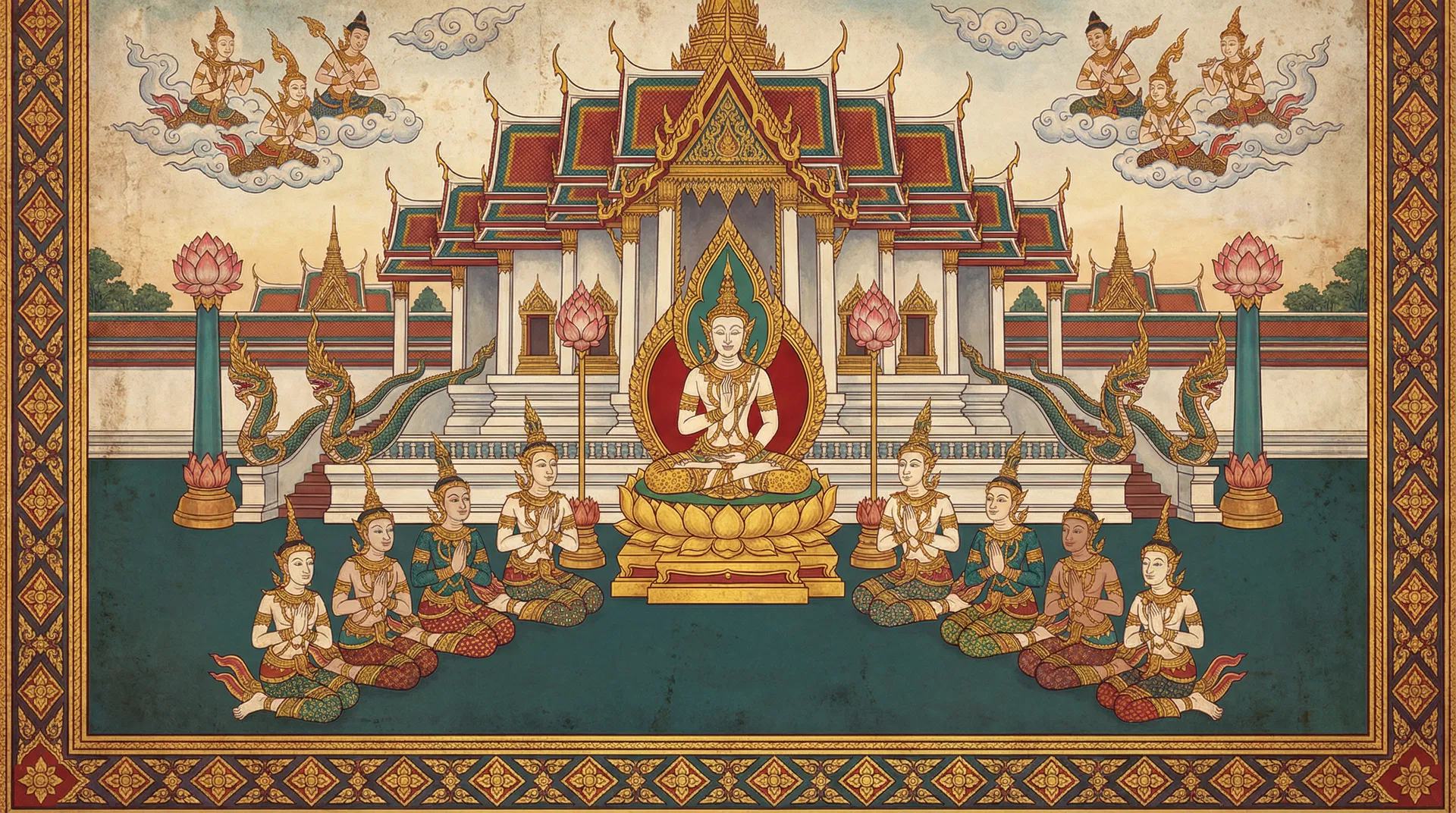
Kusa Jataka
The Prince Who Loved the Outcast
In the kingdom of Kampila, ruled a king named Danta, a man of great virtue and power. His queen, Kusavati, was as beautiful as she was wise. They were blessed with a son, Prince Kusa, and a daughter, Princess Pabhavati. Prince Kusa was renowned for his charm, his bravery, and his exceptionally kind heart. However, his heart was particularly drawn to those on the fringes of society, those often overlooked or shunned.
One day, while on a hunting expedition, Prince Kusa ventured deep into the forest. There, he encountered a young woman of extraordinary beauty and grace, gathering herbs. She was dressed in simple, coarse garments, and her demeanor suggested she belonged to a group often considered outcasts by the kingdom's strict social order. Yet, her eyes held a depth of wisdom and a quiet dignity that captivated the prince.
He dismounted from his horse and approached her. 'Greetings, maiden,' he said, his voice gentle. 'I am Kusa, son of King Danta. And you are?'
The young woman, startled but unafraid, replied with a serene smile, 'Your Highness, I am called Sundari. My people live apart, but we mean no harm and live by the ways of the forest.' Her voice was like the soft murmur of a stream, clear and melodic.
Prince Kusa found himself drawn to her not only by her beauty but by her intelligence and the purity of her spirit. They spoke for hours, of the forest, of the stars, of the nature of life, and of kindness. He learned that she possessed profound knowledge of medicinal herbs and a deep understanding of the natural world, skills often dismissed by the court.
Against the counsel of his advisors and the shock of the nobility, Prince Kusa declared his intention to marry Sundari. He saw no difference in her worth, only in her circumstances. He argued that true nobility lay in character, not in birthright. King Danta, though initially hesitant due to the social implications, was swayed by his son's unwavering conviction and the evident goodness of Sundari.
The marriage caused a stir in Kampila. Many whispered their disapproval, but Prince Kusa remained devoted to his wife. He shielded her from the scorn of some, and he shared with her the joys and responsibilities of royal life. Sundari, in turn, proved to be a wise and compassionate princess, her counsel often guiding Prince Kusa through difficult decisions. Her understanding of the common folk, born from her own upbringing, made her a beloved figure among the people, despite the initial prejudice.
However, their happiness was not to last unchallenged. Princess Pabhavati, Kusa's sister, was betrothed to the arrogant King Viradha of a neighboring kingdom. King Viradha, a man obsessed with lineage and status, heard tales of Prince Kusa's marriage to an 'outcast.' Enraged and humiliated that his future sister-in-law was married to someone he deemed unworthy, he broke off the engagement with Princess Pabhavati and sent a messenger to King Danta, demanding that Prince Kusa divorce Sundari or face war.
King Danta was placed in a terrible dilemma. He loved his son but feared the wrath of King Viradha. Prince Kusa, however, refused to yield. 'Father,' he declared, 'I will not abandon Sundari. My love for her is true, and my word is my bond. If King Viradha seeks war over this, then let it be so. But I will not compromise my principles or the happiness of my wife.'
Sundari, hearing of the threat, approached her husband with quiet resolve. 'My dearest Kusa,' she said, 'your love and acceptance have given me more than any royal title. If my presence brings conflict to your kingdom, then perhaps I should leave, for a time.'
But Prince Kusa embraced her. 'Never! You are my queen, and your place is by my side. We shall face this together. My love for you is stronger than any king's pride.'
The ensuing conflict was fierce. Prince Kusa, leading his army with Sundari often by his side, fighting with her knowledge of terrain and her courage, proved to be a formidable opponent. He fought not just for his kingdom, but for the principle that love and respect know no social boundaries. His people, inspired by his unwavering loyalty and Sundari's quiet strength, rallied behind him. They saw that true nobility was about inner worth, not outer status.
In the end, King Viradha, defeated and humbled, was forced to acknowledge the strength of Prince Kusa and the worth of Sundari. He was compelled to respect their union and, shamefaced, sought reconciliation. Princess Pabhavati was eventually remarried to a more suitable prince.
Prince Kusa and Sundari ruled with wisdom and compassion, their reign a testament to the fact that love, when true and steadfast, can overcome prejudice and societal barriers. Their story became a legend, reminding all that the heart's true nobility lies in its capacity for love and acceptance, regardless of birth or status.
— In-Article Ad —
💡Moral of the Story
True love and nobility of character transcend social status and prejudice. Acceptance, compassion, and unwavering loyalty are the foundations of a just and honorable union, capable of overcoming even the fiercest opposition.
Perfection: Love (Pema) / Good Conduct (Sila)
— Ad Space (728x90) —
More Jataka Tales You May Enjoy
 463Ekādasanipāta
Sasa Jātaka
Sasa JātakaIn a time long past, when the world was younger and the forests more ancient, there lived...
💡 The highest form of generosity is the selfless offering of one's own life for the benefit of others. Such acts of supreme compassion leave an indelible mark on the world and inspire countless beings.
 280Tikanipāta
Sattubhatta Jataka
The Tale of the Generous Merchant and the Ungrateful Friend In the bustling port city of Bharukaccha...
💡 Generosity is a noble virtue, but it must be balanced with wisdom and discernment. True friendship requires reciprocity and responsibility; enabling ungratefulness is ultimately harmful.
 177Dukanipāta
Kuṅku Jātaka
Kuṅku JātakaIn the verdant plains of Kosala, where emerald rice paddies stretched as far as the eye ...
💡 True strength and peace originate from within. External objects, however comforting, cannot replace inner resilience, wisdom, and the courage to face adversity with integrity. Letting go of attachments, even cherished ones, can be an act of liberation.
178DukanipātaMūgapakkha Jātaka
Mūgapakkha JātakaIn the bustling city of Varanasi, renowned for its vibrant arts and thriving commer...
💡 True wisdom is not always expressed through eloquent words. Deep observation, keen discernment, and insightful actions can reveal truths that speech may conceal. Silence can be a powerful medium for conveying profound understanding.
185DukanipātaKusa Jātaka
The Tale of the Excellent Kusa GrassIn the ancient kingdom of Kuru, on the banks of the sacred River...
💡 Acts of courage, compassion, and unwavering devotion, undertaken with pure intention, can overcome great obstacles and bring about renewal and hope, even in times of severe hardship.
206DukanipātaKosiya Jataka
Kosiya Jataka In the ancient city of Varanasi, nestled beside the sacred River Ganges, there lived a...
💡 True wealth is not measured by possessions, but by the generosity and compassion shown to others. The greatest joy comes from alleviating suffering and contributing to the well-being of the community.
— Multiplex Ad —